
April 20, 2026 · Permissionless Technologies
USDD vs UPD: Why Over-Collateralization Alone Is Not Enough
USDD has no freeze function and advertises 230%+ collateral. Yet it depegged in 2022, and TDR pulled $732M in Bitcoin backing without a vote. Here's why.
August 2024. Someone notices an on-chain movement. 12,000 Bitcoin, worth about $732 million, leaves the TRON DAO Reserve wallets backing USDD. No governance proposal. No token-holder vote. No prior announcement. Justin Sun confirms it afterwards with a tweet (DL News).
The math on the USDD transparency page still reads "over 230% collateralized." Technically true. The composition has shifted though. Where USDD used to be backed by a BTC plus TRX plus stablecoin basket, by late 2024 it's almost entirely TRX and USDT. The ratio looks the same. The risk profile is completely different (CCN).
Here's the part that matters for anyone reading the specs. USDD has no freeze function on its token contract. It's marketed as non-freezable, censorship-resistant, immune to issuer interference. All of that is true at the token level. And none of it prevented the 2022 depeg. None of it required community input on the $732M BTC withdrawal. None of it stops TRON DAO Reserve from reshaping collateral or monetary policy tomorrow.
This post walks through why over-collateralization plus a non-freezable token isn't the same thing as a decentralized stablecoin.
Key Takeaways
- USDD's token contract has no freeze function, no blacklist, and no admin override. TRON DAO markets it as a direct answer to USDT and USDC freezes (ChainBits).
- Despite advertised collateral ratios above 200%, USDD traded below peg in the $0.97-0.98 band for much of 2022-2023. Over-collateralization limited the drawdown but didn't enforce the peg (Gate Learn).
- In August 2024, TRON DAO Reserve withdrew 12,000 BTC (~$732M) from USDD reserves with no on-chain governance vote, shifting backing to predominantly TRX and USDT (DL News).
- USDD 2.0 launched in late 2024 / early 2025 with a Peg Stability Module and Smart Allocator yield engine. By April 2026, market cap is ~$1.54B and price trades near $1.00 (Bybit).
- Justin Sun settled his 2023 SEC fraud case in March 2026 via a $10M payment by a controlled affiliate. Personal charges were dismissed with no admission of wrongdoing (Reuters).
- UPD is a pre-audit, Sepolia-stage over-collateralized stablecoin with no freeze, no blacklist, and no reserve entity. Collateral is stETH held per-stabilizer in on-chain escrows, with no multi-sig that can rebalance billions unilaterally.
What's Actually in USDD's Token Contract?
USDD's marketing claim holds up at the code level. The token contract on TRON and its bridged deployments on Ethereum and BNB Chain don't include a blacklist(address) function, don't expose a freeze or destroyBlackFunds path, and don't carry a pausable modifier on transfers. The TRON DAO Reserve FAQ puts it plainly: USDD is "free from centralized intermediaries, so users do not have to worry about their assets being frozen with or without notice" (CryptoSlate).
That's a genuine differentiator against USDT and USDC. We've covered both. USDT's destroyBlackFunds call reduces balances to zero. USDC's blacklister role can freeze any address. USDD doesn't have those levers. If you hold USDD in your wallet, no single transaction from TRON DAO Reserve can wipe your balance.
So why did USDD still lose its peg? Why did a token that can't be frozen trade at 97 cents for 18 months? Because censorship resistance lives in one place, and economic control lives somewhere else entirely.
How Did USDD Still Depeg in 2022?
USDD launched in May 2022 with a familiar promise. Over-collateralized by 130% minimum, often 200%+ in practice, backed by a mix of BTC, TRX, USDT, and USDC. TRON DAO Reserve published the collateral breakdown. Contemporary snapshots showed 10,500 BTC, 240 million USDT, and 1.9 billion TRX backing roughly 667 million USDD. On paper, this was a Maker-style over-collateralized design with professional reserve management (TRON DAO blog).
Then the 2022 Alameda Research collapse hit. USDD traded below peg during the broader crypto selloff, settling into the $0.97-0.98 range. Some analyses reported it dipping lower during stress windows. And critically, USDD didn't snap back the way a properly anchored over-collateralized stablecoin should (TradingView).
Why not? Because over-collateralization only enforces the peg if there's a credible, frictionless redemption path at par. If you can swap $1 of USDD for $1 of collateral value on demand, the market arbitrages the discount away. If you can't, and instead have to hope TRON DAO Reserve defends the peg via discretionary TRX buybacks or collateral injections, you're not relying on over-collateralization. You're relying on TDR's willingness and capacity to intervene (The Standard).
The 2022 USDD design lacked a hard, protocol-enforced redemption guarantee at $1. TDR's TRX buybacks defended the peg when confidence held. When confidence wobbled, the token could and did trade persistently below par. A 200% collateral ratio doesn't help if nobody can reach the collateral at the stated rate.
This is the gap USDD 2.0 tries to close.
What Changed With USDD 2.0?
In late 2024 and early 2025, TRON rebranded the original design as "USDDOLD" and rolled out USDD 2.0. The architecture adds two pieces (Bitcoin.com News):
- A Peg Stability Module that mints and redeems USDD 1:1 against major stablecoins like USDT and USDC. This is the frictionless swap path that USDD 1.0 lacked. When USDD trades below $1, arbitrageurs redeem for USDT at par and capture the spread.
- A Smart Allocator that deploys reserve assets into conservative DeFi lending venues (Aave, Spark, JustLend) to generate sustainable yield. Users can convert USDD to sUSDD and capture a share of those yields (Venus community).
The results are visible in price data. As of April 18, 2026, USDD trades at approximately $1.00 on Bybit with a 24-hour range near $1.00 and a market cap of roughly $1.54 billion (Bybit). Circulating supply grew 56% between late November 2025 and early March 2026, from $452M to $728M, driven primarily by DeFi yield demand rather than centralized exchange inflows (MEXC).
So USDD 2.0 appears to have fixed the peg mechanics. Where does the risk go instead?
Where Did $732M in Bitcoin Collateral Go?
The risk concentration moved from "can't redeem at par" to "what's backing this redemption?" To understand the shift, trace the collateral.
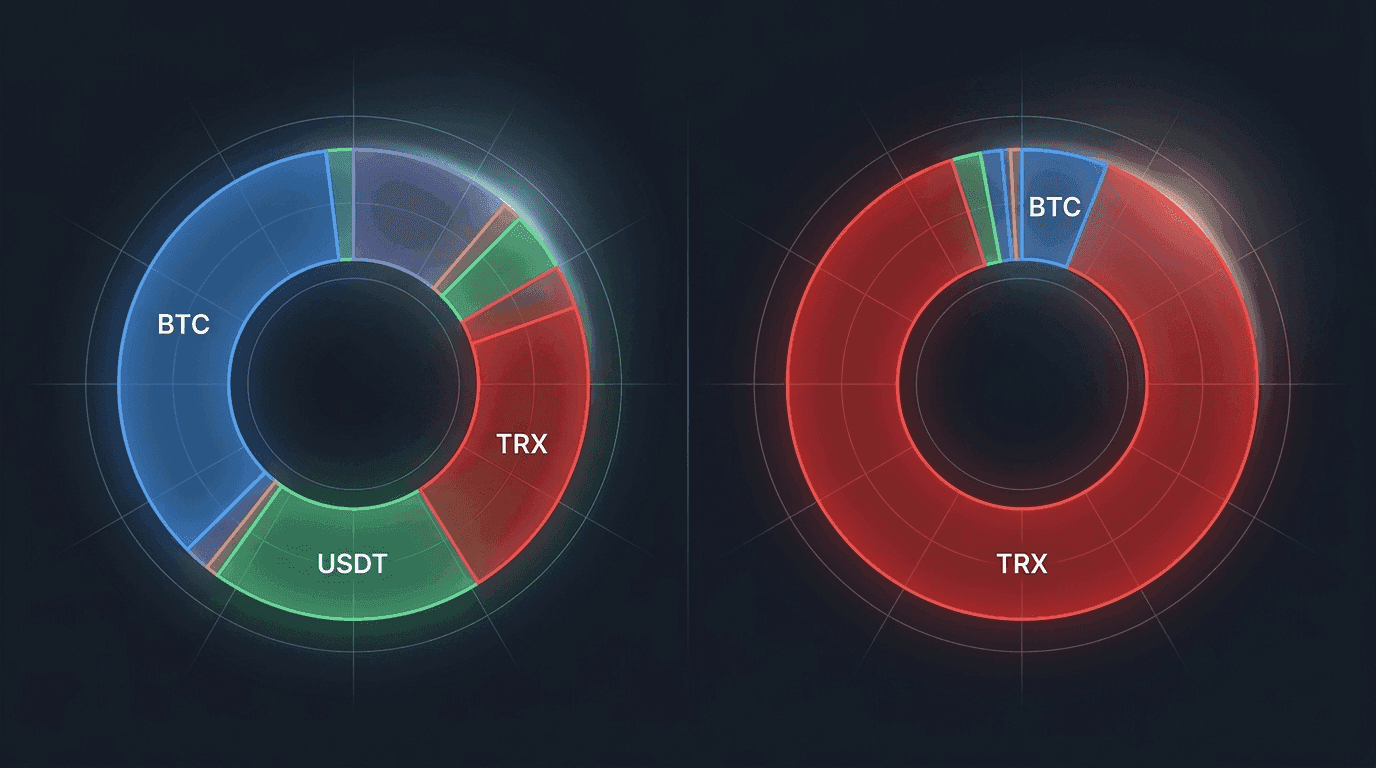
Early USDD reserves in 2022 were diversified. BTC plus TRX plus major stablecoins, with BTC making up a large portion of the backing's dollar value. By the end of 2024, the picture had changed substantially.
August 2024: TRON DAO Reserve transferred 4,000 BTC (about 42% of its BTC reserves at the time) from USDD-linked wallets to HTX. Justin Sun's explanation was that collateralization had "exceeded 300%" and excess reserves could be redeployed (TokenPost).
Weeks later: a second, much larger removal. Approximately 12,000 BTC worth $726-732M left USDD's collateral pool. The published transparency page after these moves showed ~230% collateralization, but composition had shifted to approximately 1.7 billion dollars of TRX and USDT backing 744-749 million USDD (DL News).
The ratio number stayed large. The asset quality changed. A collateral pool dominated by Bitcoin, USDT, and USDC has three effectively uncorrelated reserve assets. A pool dominated by TRX and USDT has one asset with its own issuer and one asset that is TRON's native token. When TRX moves, the collateral moves with it.
Here's the reflexive risk. If TRX drops 30%, USDD's collateralization ratio drops meaningfully, and simultaneously the market confidence in the peg degrades. Collateral quality and market confidence pull in the same direction. That's the opposite of what diversified collateral is supposed to do.
Could Maker-style governance have approved these BTC withdrawals? In theory, yes. But MakerDAO's governance involves public forum debate, on-chain MKR votes, multi-day timelocks, and published risk analysis. None of that happened for the USDD BTC withdrawals. They were announced after the fact, by tweet.
Who Actually Controls TRON DAO Reserve?

The official protocol whitepaper describes a 5-of-7 multi-signature arrangement for core contracts, including the issuance contract, TRX burn contract, and the safeVault used by the Peg Stability Module. Formal documentation frames TRON DAO Reserve as a decentralized autonomous organization conducting open-market operations and acting as lender of last resort for TRON stablecoins (USDD protocol 2.1 whitepaper).
In practice, the governance reality is thinner. A February 2025 investigation by Protos reported that the prior "governance portal" for USDD was shut down without community input. Protos characterized the structure this way: TRON DAO Reserve "has no DAO." The piece noted that only a single trivial governance vote had ever been held, authorizing the re-use of "burned" funds (Protos).
That characterization aligns with on-chain evidence. TDR can:
- Move billions of dollars in collateral between assets without a token-holder vote
- Launch a Peg Stability Module and Smart Allocator architecture under new branding
- Adjust yield parameters and subsidies at its discretion
- Decide what counts as "excess collateral" and redeploy it
The 5-of-7 multi-sig means any five designated signers can execute these actions. The composition of those signers isn't broadly governed by USDD holders or by a public token-weighted process. A Venus Protocol listing proposal in November 2025 noted that USDD "is expected to launch its governance in Q1 2026," implying that a more formal process hadn't yet arrived (Venus community). As of April 2026, public evidence of a broad, participatory on-chain governance system replacing the TDR-centric model remains limited.
So the pattern becomes clear. USDD's token contract is genuinely non-freezable. But above the token contract sits a reserve entity that can reshape backing, policy, and yield at will. That's not the same as decentralized stable money. It's a token-level protection with a policy-level single point of control.
And the person associated with that policy layer had his own legal complications to work through.
What About Justin Sun's SEC Case?
In March 2023, the U.S. Securities and Exchange Commission charged Justin Sun and three of his companies, Tron Foundation, BitTorrent Foundation, and Rainberry, with the unregistered offer and sale of TRX and BTT as securities and with fraudulently manipulating the secondary market through extensive wash trading. The complaint alleged Sun orchestrated hundreds of thousands of trades between accounts he controlled, generating about $31 million in illicit profits and paying multiple celebrities to tout TRX and BTT without disclosing compensation (SEC press release).
The charges didn't target USDD directly. They did cast a governance shadow over TRON's broader ecosystem, including USDD, for nearly three years.
In March 2026, the case settled. A Sun-controlled affiliate (Rainberry) agreed to pay a $10 million penalty. Sun himself, the Tron Foundation, and the BitTorrent Foundation saw charges dismissed with prejudice, with no admission of wrongdoing (Reuters). Coverage by the New York Times situated the settlement within a broader retrenchment of SEC crypto enforcement under the Trump administration and highlighted Sun's role as a major backer of World Liberty Financial, the Trump-linked crypto initiative (NYT).
For USDD holders, the legal overhang has been reduced but not removed. The alleged market manipulation was documented publicly. The resolution is "settled with no admission" rather than "exonerated." For risk managers evaluating a stablecoin whose reserve policy is effectively set by a small number of TDR-affiliated signers, the founder's documented history is a governance input, not just a historical footnote.
How Does UPD Handle This Differently?
UPD is an over-collateralized stablecoin currently in tech-preview on Sepolia and pre-audit. Like USDD, UPD has no freeze function, no blacklist, and no admin override at the token balance level. The code is public and short enough to reason about directly. Here's the full mint/burn surface of the UPD token:
// UPDToken.sol (Solidity 0.8.29)
bytes32 public constant CONTROLLER_ROLE = keccak256("CONTROLLER_ROLE");

function mint(address to, uint256 amount) external onlyRole(CONTROLLER_ROLE) {
    _mint(to, amount);
}

function burn(uint256 amount) external onlyRole(CONTROLLER_ROLE) {
    _burn(msg.sender, amount);
}
That's it. One role. Mint to an address. Burn from the caller's own balance. No freeze, no blacklist, no wipeFrozenAddress, no admin balance adjustment. The CONTROLLER_ROLE is granted to the StabilizerNFT contract, which orchestrates user self-minting against stETH collateral.
There's no reserve entity. There's no 5-of-7 multi-sig that can rebalance billions of dollars in backing. Collateral sits in per-stabilizer PositionEscrow contracts, deployed as BeaconProxies, one per stabilizer NFT. Each stabilizer owns their own allocated stETH. An OvercollateralizationReporter exposes a permissionless syncFromChain() function that anyone can call to verify the system-wide ratio against actual on-chain shares. The "transparency page" equivalent is the blockchain itself.
The contrast with the $732M BTC withdrawal case is structural, not stylistic. In the USDD model, a small signer set could execute a discretionary reserve policy change — moving billions across asset classes (BTC → TRX) without a vote.
UPD has no equivalent policy lever. Each Stabilizer rebalances their own position — they can free yield-accrued stETH above their minimum collateralization ratio, run their own off-chain hedge against the long-ETH exposure their position carries, even exit voluntarily by burning UPD. That kind of rebalancing happens all the time. What no role anywhere in the system can do is change the collateral asset (it's stETH, full stop), reach into another Stabilizer's position, or release collateral below the protocol's minimum ratio. Rebalancing exists; the centralized policy authority to weaponize it doesn't.
Does that make UPD "safer"? No. It changes the risk surface. stETH carries validator, slashing, and Lido-counterparty exposure that USDD's TRX-and-USDT basket doesn't. USDD has operated through multiple crypto cycles; UPD is currently in tech-preview on Sepolia, with the design drawing on lessons from an earlier beta we ran.
The regulatory position is similar to USDD's and DAI's. No issuer, no redemption window from a supervised entity, so UPD sits outside GENIUS and MiCA payment stablecoin frameworks. A business holding UPD would book it as a crypto asset on the balance sheet, the same category as DAI and USDD.
What about compliance? The compliance layer lives in a separate product. The Universal Private Pool (UPP) is a multi-ERC20 privacy pool that uses an ASP-based architecture to screen participants before they can enter. That compliance framework belongs to the pool, not to UPD. The stablecoin itself is permissionless, like ETH. ASP vs Proof of Innocence covers the privacy pool's compliance architecture in detail.
Head-to-Head Comparison
| Dimension | USDD | UPD |
|---|---|---|
| Market cap (Apr 2026) | ~$1.54B (Bybit) | Pre-launch (Sepolia) |
| Issuer / reserve entity | TRON DAO Reserve (5-of-7 multi-sig) | No reserve entity; users self-mint |
| Collateral model | Over-collateralized; TRX-heavy basket + PSM | Over-collateralized; stETH per-stabilizer |
| Collateral composition | Predominantly TRX + USDT after 2024 BTC removal | 100% stETH (non-freezable crypto) |
| Token-level freeze | None | None |
| Token-level wipe | None | None |
| Admin key on token | None on balances | None on balances; AccessControl for mint/burn only |
| Governance body | TRON DAO Reserve; minimal on-chain voting history | None; per-stabilizer ownership |
| Who can rebalance reserves? | TDR signers, without token-holder vote | No centralized reserve to rebalance |
| Peg mechanism | PSM (1:1 USDT/USDC swap) + Smart Allocator | Over-collateralization; user mint/burn against stETH |
| Yield wrapper | sUSDD (Smart Allocator, ~10-12%) | sUPD (delta-neutral, 8-10% target) |
| Depeg history | $0.97-0.98 (2022-2023, 18+ months below peg) | No mainnet history yet (design draws on lessons from a prior beta) |
| Founder legal overhang | SEC case 2023-2026, settled $10M (Reuters) | No founder; team-governed pre-audit |
| Reserve transparency | Published ratio; discretionary composition changes | Fully on-chain per-stabilizer; permissionless syncFromChain |
| Regulatory fit | Outside GENIUS/MiCA payment stablecoin perimeter | Outside issuer frameworks |
| Current maturity | Live since May 2022 | Pre-audit, Sepolia stage |
Which Risk Profile Fits Your Use Case?
Token Freedom vs Reserve Discretion
USDD and UPD both give you a token contract that nobody can freeze. For direct holding, transfers, and DeFi composability, the balance sheet is safe from blacklists at the token layer. If that's the entire threat you want to eliminate, both designs clear the bar.
The difference shows up above the token. USDD's backing sits under a discretionary reserve entity that has demonstrated willingness to change composition without community input. UPD's backing sits in per-Stabilizer escrows; each Stabilizer manages their own position and runs their own off-chain hedge, but no entity above the position can change the collateral asset, reach across positions, or release collateral below the minimum ratio. Same token-level censorship resistance. Different reserve-level control surface.
Concentration Risk
After the BTC withdrawals, USDD's backing is dominated by TRX and USDT. TRX is TRON's native token, correlated with TRON ecosystem health and TDR's own decisions. USDT comes with its own issuer freeze risk (covered in USDT vs UPD). That's two concentrated risk factors rather than a broad crypto collateral basket.
UPD is stETH-only, so the concentration is different in kind. Lido stETH carries validator risk, slashing risk, and withdrawal-queue mechanics during stress. It doesn't carry issuer freeze risk or TRON-ecosystem reflexivity.
Maturity vs Architecture
USDD has nearly four years of live operation, including a multi-quarter depeg episode it gradually recovered from. The 2025-2026 price stability under USDD 2.0 is observed data, not a model. That's meaningful.
UPD is in tech-preview on Sepolia, with the design drawing on lessons from an earlier beta we ran. The trade-off this section names is exactly that: USDD's four years of live operation versus UPD's narrower architectural separation at the reserve layer.
When to Use Each
When USDD Makes Sense
- TRON ecosystem participation where native venue liquidity matters more than reserve governance granularity.
- Short-duration DeFi positions where yield on sUSDD (JustLend, Venus, HTX Earn) is the primary use case.
- Contexts where a 4-year mainnet operational history, including a documented depeg and recovery, is preferred over a design that hasn't yet been mainnet-tested.
- Users comfortable with a reserve entity's discretionary policy as long as the token contract itself stays non-freezable.
When UPD's Risk Profile Fits
- Long-duration positions where reserve composition drift is an unacceptable risk.
- Use cases where the collateral itself must be non-freezable crypto with no issuer exposure above it.
- Protocol architectures where a small multi-sig rebalancing billions in collateral without a vote would be disqualifying.
- Operations in the two-tier stablecoin market that need a pure DeFi-tier asset with no reserve-entity discretion.
- Users who accept pre-audit and pre-mainnet status as a trade-off for architectural simplicity at the reserve layer.
Frequently Asked Questions
Can TRON DAO Reserve freeze USDD balances?
No, not at the token contract level. USDD has no blacklist, freeze, or balance-wiping function. TRON DAO Reserve cannot unilaterally reduce a specific wallet's USDD balance. What TDR can do is adjust reserves, pull PSM liquidity, change Smart Allocator parameters, and modify yields. Those actions affect the economic environment and peg dynamics without touching balances directly.
Why did USDD trade at $0.97 for 18 months if it was 200%+ collateralized?
Because over-collateralization only enforces the peg if there's a frictionless redemption path at par. USDD 1.0 relied on TRON DAO Reserve's discretionary TRX buybacks to defend the peg rather than a protocol-level 1:1 swap mechanism. When market confidence slipped during the 2022 Alameda-related selloff, the discount persisted. USDD 2.0 added a Peg Stability Module in late 2024 / early 2025 that addresses this mechanical gap (Bitcoin.com News).
What happened to USDD's Bitcoin collateral?
In August 2024, TRON DAO Reserve transferred 4,000 BTC out of USDD reserves. Shortly after, it removed a further 12,000 BTC worth approximately $732 million. Justin Sun explained the moves were justified because the collateralization ratio exceeded targets. The action happened without an on-chain governance vote, and observers including Protos and Bluechip publicly questioned USDD's decentralization claims as a result (DL News).
Is USDD 2.0 safer than USDD 1.0?
It trades closer to par, yes. The Peg Stability Module gives arbitrageurs a direct 1:1 redemption path against USDT and USDC, which is the mechanical improvement USDD 1.0 lacked. The reserve policy governance didn't change with the rebrand. TDR still controls composition, yield parameters, and open-market operations. Peg mechanics improved. Governance concentration did not.
How does UPD avoid the USDD-style collateral shift risk?
UPD has no centralized reserve to rebalance via policy. Collateral sits in per-Stabilizer PositionEscrow contracts, one per StabilizerNFT. Each Stabilizer can rebalance their own position — freeing yield that has accrued above the minimum collateralization ratio, hedging their long-ETH exposure off-chain, or exiting voluntarily by burning UPD against their position. What no role anywhere in UPD can do is change the collateral asset (it's stETH, full stop), reach into another Stabilizer's position, or release collateral below the protocol's minimum ratio. The kind of pool-level rebalancing authority TDR has over USDD's reserves doesn't exist in UPD's architecture.
Does UPD qualify as a regulated stablecoin under GENIUS or MiCA?
No. UPD has no issuer, no reserves held by a supervised financial institution, and no freeze mechanism. It doesn't meet the requirements for a "permitted payment stablecoin" under GENIUS or an EMT under MiCA. It would be treated as an unregulated crypto asset in both jurisdictions, the same balance-sheet category as USDD and DAI.
Is sUSDD comparable to sUPD?
Both are yield-bearing wrappers around their respective base tokens. sUSDD's yield comes from the Smart Allocator deploying reserves into DeFi lending protocols (Aave, Spark, JustLend), with APYs running 10-12% in late 2025 and 2026. sUPD targets 8-10% APY via delta-neutral hedging similar to Ethena's sUSDe. Different yield sources, similar wrapper patterns. sUPD's delta-neutral design also carries exchange and funding-rate risk that sUSDD's lending-based approach doesn't.
Conclusion
USDD does something real. At the token contract level, it's genuinely non-freezable. In a market where seven of the ten largest stablecoins can freeze your balance by admin decision, that counts. USDD 2.0's Peg Stability Module closes the mechanical gap that caused the 2022 depeg, and the token trades near par in April 2026.
The constraint is structural, not cosmetic. Above the token contract sits a reserve entity that can and has reshaped backing without a meaningful governance process. The BTC-to-TRX composition shift was executed by a small set of signers, not by a broad DAO vote. That's not what "decentralized stable money" promises.
Over-collateralization alone isn't enough. Non-freezability at the token layer isn't enough either. You also need the backing itself to be non-freezable, and you need a governance model where nobody can quietly reshape the collateral overnight. USDD delivers the first condition. It doesn't deliver the second or the third.
UPD's design is an attempt to hold all three: non-freezable token, non-freezable backing, and no centralized reserve discretion. It's currently in tech-preview on Sepolia, with the design drawing on lessons from an earlier beta we ran.
Read the specs. Read the reserve composition. Watch what the reserve entity does, not what the token contract says it can't do.
- USDT vs UPD: $4.2 Billion Frozen and Counting - blacklist plus burn at scale
- USDC vs UPD: One Man's Judgment Call - discretionary freeze governance
- PYUSD vs UPD: PayPal's Two-Transaction Wipe - freeze and wipe in two calls
- DAI vs UPD: When Decentralized Isn't Decentralized Enough - non-freezable token, freezable collateral
- USDe vs UPD: Delta-Hedged Yield or Pure On-Chain Collateral? - CEX-dependent yield vs on-chain design
- Can Stablecoins Be Frozen? A Solidity-Level Forensic Guide - contract-level mechanics across major stables
- What Is a Non-Freezable Stablecoin? - the foundational question
UPD is pre-audit and currently deployed on Sepolia. The comparison in this post is architectural and educational, not investment or legal advice.