
April 15, 2026 · Permissionless Technologies
USDT vs UPD: $4.2 Billion Frozen - and Counting
Tether's destroyBlackFunds function has wiped $4.2B from 4,163+ addresses. Here's how USDT freeze mechanics compare to an over-collateralized, no-admin-key alternative.
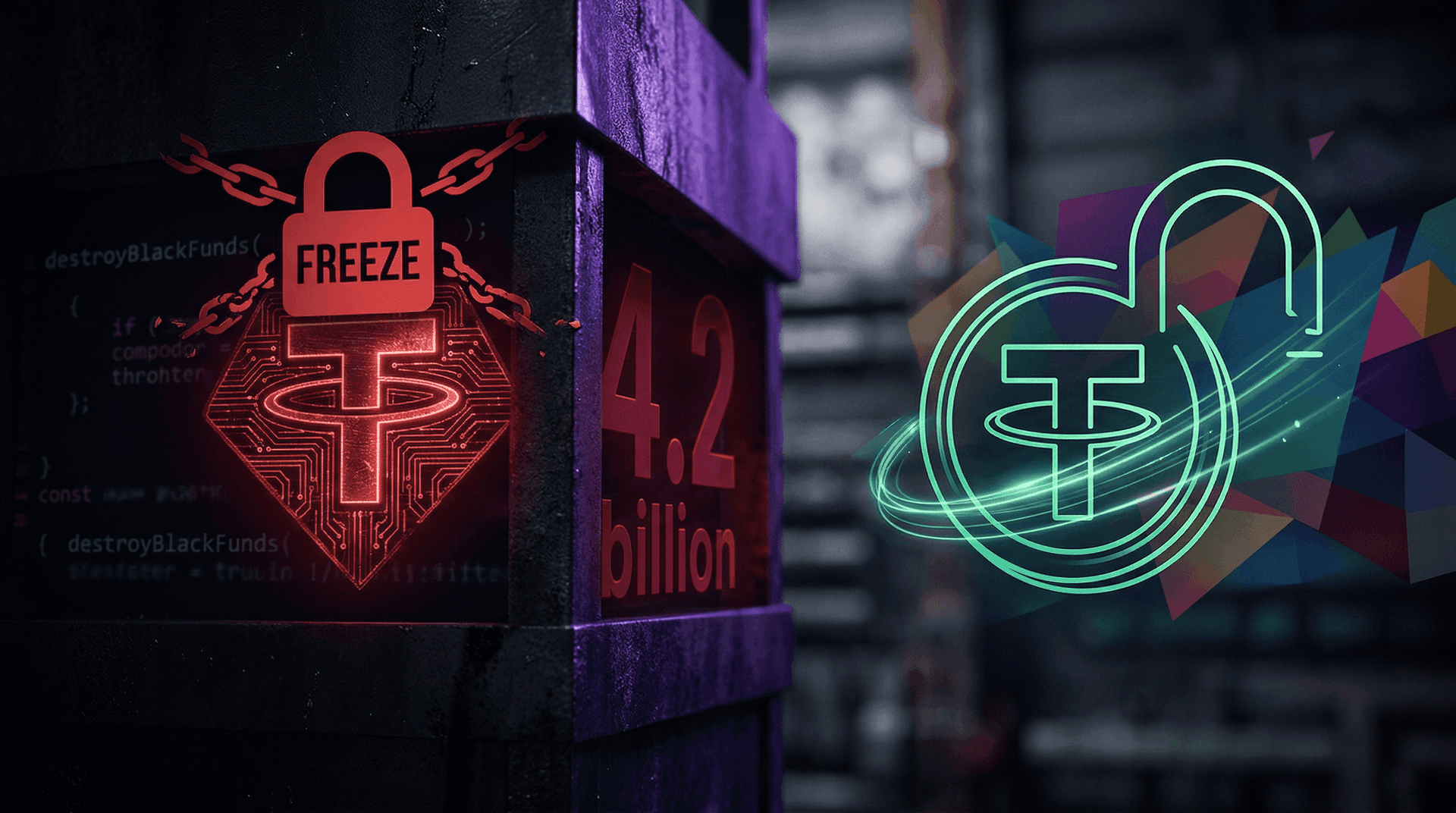
Tether's destroyBlackFunds function doesn't just freeze your tokens. It burns them. One admin call, and your balance is zero. No court order. No appeal process. The tokens don't move to another address - they cease to exist entirely, removed from total supply.
As of February 2026, Tether has used this authority to freeze $4.2 billion in USDT across thousands of addresses (Reuters, 2026). In 2025 alone, 4,163 addresses were blacklisted, locking $1.263 billion (BlockSec). That's not theoretical risk. That's a live, exercised power with a nine-figure weekly cadence.
This post compares USDT with UPD, an over-collateralized stablecoin with no admin key and no freeze function. They're genuinely different tools designed for different tiers of the stablecoin market. Understanding the architectural difference between them matters for anyone evaluating stablecoin exposure.
Key Takeaways
- USDT's
destroyBlackFundscan zero any balance with a single owner transaction - no multi-sig, no time-lock, no governance process. - $4.2 billion has been frozen by Tether as of early 2026, with activity accelerating year over year.
- USDT is the deepest stablecoin market by far - $184B market cap, essential for trading infrastructure. Its liquidity advantages are real.
- UPD is an over-collateralized design with no freeze function at the token layer, currently on Sepolia with mainnet launch approaching.
- USDT has an issuer that regulators can target. UPD has no issuer - users mint their own tokens, making it an accounting token rather than a payment token. Different balance sheet classification, same practical utility.
USDT: How It Works
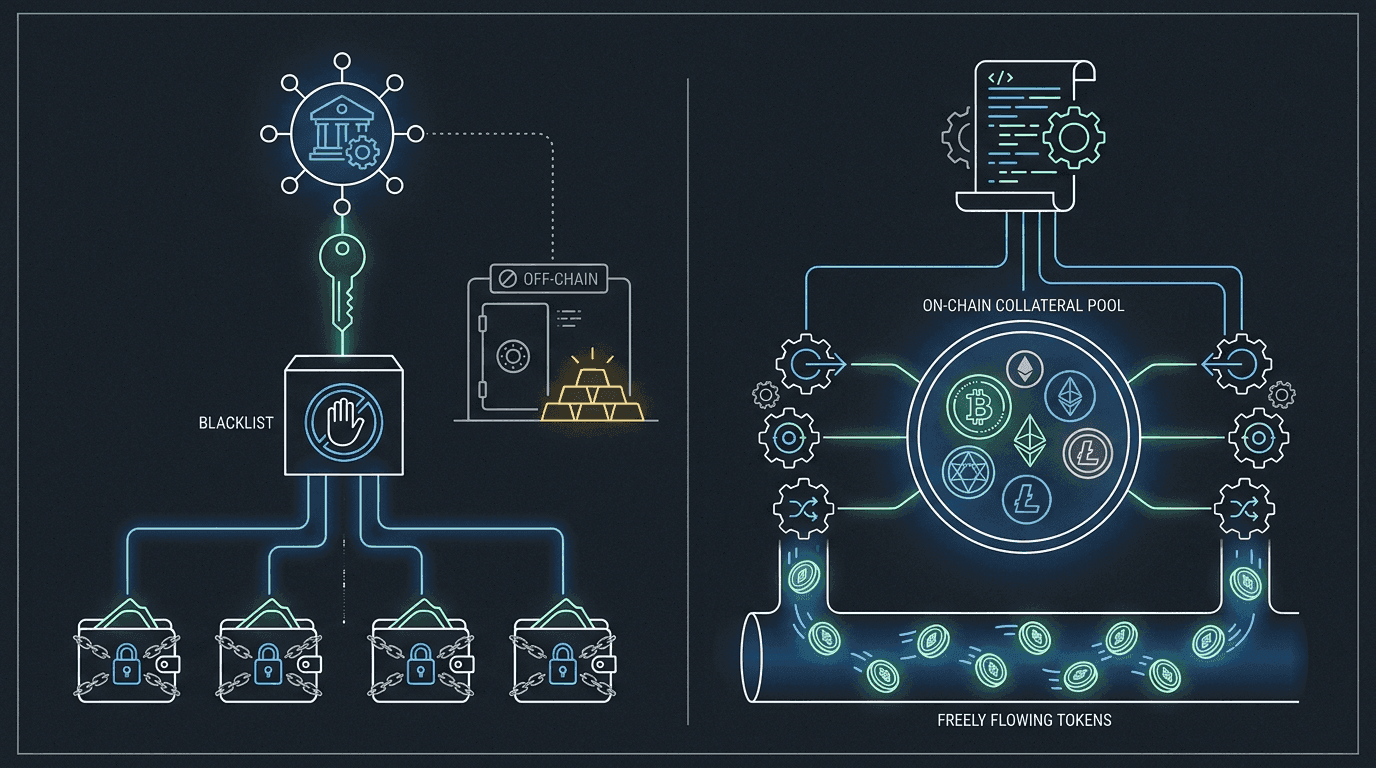
USDT is the world's largest stablecoin by market cap at approximately $184 billion (Bitrue, April 2026). It's issued by Tether Operations Limited, registered in El Salvador, and backed by reserves held off-chain - primarily cash, short-term US Treasury bills, and commercial paper (Statista). The peg holds because Tether promises 1:1 redemption at par, and the market has priced in that promise for over a decade.
The decentralization level is low by design. A single centralized issuer (MEXC) controls minting, redemption, and compliance enforcement. That centralization is what gives USDT its two defining properties: the deepest liquidity in crypto, and a freeze mechanism the issuer can trigger at any time.
The Freeze Mechanics
USDT's Ethereum contract (verified at 0xdAC17F...D831ec7) contains two critical functions (CoinGlass):
mapping (address => bool) public isBlackListed;

function addBlackList (address _evilUser) public onlyOwner {
    isBlackListed[_evilUser] = true;
}

function destroyBlackFunds (address _blackListedUser) public onlyOwner {
    require(isBlackListed[_blackListedUser]);
    uint dirtyFunds = balanceOf(_blackListedUser);
    balances[_blackListedUser] = 0;
    _totalSupply -= dirtyFunds;
}
Three things are worth noting about this code. First, addBlackList requires only onlyOwner - a single private key, with no multi-sig requirement, no time-lock delay, and no governance vote. Second, destroyBlackFunds doesn't transfer tokens to a holding address. It sets balances[_blackListedUser] = 0 and subtracts from _totalSupply. The tokens are gone. Third, transfer enforcement is handled separately:
require(!isBlackListed[msg.sender])This line in the transfer function blocks all sends from blacklisted addresses before destroyBlackFunds is even called.
The contract also includes a Pausable mechanism that can halt all USDT transfers globally - not just for a single address. That's a separate capability from the blacklist.
Why USDT Gets Used
It'd be misleading to describe USDT purely through its freeze mechanics. USDT dominates for reasons that matter to real participants.
USDT is the primary quote currency across most centralized exchanges. It's the dominant stablecoin on Tron, where transaction costs are measured in fractions of a cent. It has the deepest liquidity pools in DeFi by a significant margin. For a trading desk, an exchange, or a payment processor operating at scale, there is no practical substitute. The freeze risk is real, but so is the liquidity reality.
Unfreezing, for those who believe they've been wrongly blacklisted, requires full identity verification, proof of funds source, and complete transaction history. The process takes weeks to potentially two years. Recovery is not guaranteed.
UPD: How It Works

UPD is an over-collateralized stablecoin currently deployed on Sepolia, pre-audit, with mainnet launch planned. It represents a different architectural category from fiat-backed stablecoins.
With that established: here's what it is architecturally.
UPD mints tokens against on-chain crypto collateral at a ratio that ensures collateral value exceeds token supply. The protocol uses stETH as collateral because stETH is itself non-freezable by design, making it a natural fit for a non-freezable stablecoin. The liquid staking yield from stETH also flows through the system. There is no central issuer, no redemption desk, and no off-chain reserves. The peg is maintained by collateral ratios, automated liquidations, and oracle design, not by a company promising to redeem at par.
The token contract contains no blacklist function, no freeze function, no pause function, and no admin key with authority over balances. If you hold UPD, no single transaction can zero your balance. There is no owner key to call.
No Compliance at the Token Layer
UPD has no compliance mechanism attached to it at all. No freeze, no blacklist, no admin key, no restrictions on who can send or receive. It behaves like raw ETH - anyone can hold it, transfer it, or use it, and no single entity controls the flow.
On a public ledger, that's straightforward. You can follow the trail. Every transfer is visible, every address is traceable, and standard blockchain analytics tools work the same way they do for ETH or any other permissionless token.
The privacy pool is a separate system with its own compliance needs. When you move funds into a system that provides privacy guarantees, the on-chain trail becomes less obvious - you can't just follow the money. That's where the Association Set Provider (ASP) model comes in - covered in detail in ASP vs Proof of Innocence. The privacy pool requires participants to prove that their funds don't originate from illicit sources before entering. That compliance framework belongs to the pool, not to UPD itself. The token is permissionless. The pool has its own access rules.
The Regulatory Position
UPD doesn't just lack freeze capability. It lacks an issuer entirely. Users mint their own UPD by depositing collateral into the protocol's smart contracts. No company creates the tokens. No entity distributes them. The user is their own minter.
This has a direct consequence for frameworks like the GENIUS Act and MiCA. Both regulate "issuers" of stablecoins. GENIUS requires the issuer to freeze on demand. MiCA requires the issuer to be a licensed EU entity. If there is no issuer, there is no entity to regulate under either framework. UPD isn't a "permitted payment stablecoin" - it's an accounting token.
Does that make it less usable? No. A business holding UPD would classify it as a crypto asset on its balance sheet rather than a cash equivalent - a different line item, different impairment rules. But functionally, it works the same way: you can hold it, transfer it, settle with it, collateralize with it, and use it for any purpose you'd use a stablecoin for. The accounting category differs from USDT. The utility doesn't - and without the freeze risk, many businesses and individuals may find it more reliable, not less.
Head-to-Head Comparison
| Dimension | USDT | UPD |
|---|---|---|
| Market cap | $184B (Bitrue) | Pre-launch (Sepolia) |
| Collateral model | Fiat off-chain (T-bills, cash, commercial paper) | Crypto on-chain (stETH - non-freezable, liquid staking) |
| Freeze capability | Yes - blacklist + destroyBlackFunds | None |
| Admin key | Single onlyOwner key, no multi-sig | No admin key |
| Peg mechanism | Issuer redemption at par | Collateral ratios + liquidation |
| Liquidity | Deepest in crypto, essential for trading | Pre-launch, mainnet planned |
| Regulatory status | GENIUS Act-eligible (with issuer registration) | Accounting token - user self-mints, no issuer to regulate |
| Transparency | Quarterly attestations (off-chain reserves) | Fully on-chain, auditable in real time |
| Counterparty risk | Single offshore issuer | Smart contract risk, pre-audit |
| Audit status | Established, long operational history | Pre-audit, fully tested on Sepolia |
| DeFi composability | Good, with freeze risk for protocols | No freeze risk, pre-launch |
| Capital efficiency | 1:1 (fiat-backed) | Over-collateralized (capital inefficient) |
| Compliance model | Token-layer blacklist (issuer-controlled) | None at token layer - privacy pool has separate ASP compliance |
| Token wipe capability | Yes - destroyBlackFunds reduces total supply | No |
| Global pause | Yes - Pausable contract | No |
The Trade-Offs

Liquidity vs Censorship Resistance
This is the core tension, and it doesn't resolve cleanly in either direction.
USDT's $184 billion market cap and ubiquitous exchange support mean it's genuinely hard to operate at scale without it. For a hedge fund running arbitrage strategies, an exchange settling trades, or a market maker providing liquidity, USDT's depth is a structural requirement. Accepting freeze risk is, for many participants, an acceptable cost of that depth.
For a DeFi protocol holding treasury reserves, or a privacy-preserving application that needs a stablecoin with no token-layer admin control, the freeze risk is a design problem. If USDT collateral inside a lending protocol gets blacklisted mid-liquidation, the liquidation engine breaks. The protocol can't function correctly when its collateral ceases to exist mid-transaction. That's the kind of counterparty risk that lives in protocol design, not just individual portfolio decisions.
There's a broader point here too. Corporate digital asset treasury flows exceed $100 billion on-chain (Chainlink, 2025), and 43% of hedge funds plan DeFi integration (CryptoSlate). As institutional capital moves on-chain, the question of what happens when a regulator freezes a stablecoin inside a protocol stops being theoretical.
Regulatory Positioning
USDT and UPD sit in different regulatory categories, but the practical gap is narrower than it looks. USDT could become a "permitted payment stablecoin" if Tether registered with US regulators - the freeze capability is already there, and Tether is a clearly identifiable issuer. UPD has no issuer to register. Users mint their own tokens by depositing collateral. That makes it an accounting token rather than a payment token under GENIUS and MiCA.
For institutions that specifically require a "permitted payment stablecoin" for licensing purposes - a payment processor, a neobank, a custodian - USDT (with registration) fits that regulatory model and UPD doesn't. But for the broader category of businesses and individuals who simply need a reliable stablecoin they can hold, transfer, and settle with, UPD's accounting token status doesn't limit its utility. It shows up on a different balance sheet line item. It still works.
AML fines in 2024 totaled $3.2 billion (Consilient). For a compliance officer, a stablecoin that can be frozen on regulatory order is a feature, not a bug. The counter-argument - that the ability to freeze creates asymmetric risk between the issuer and the token holder - is real, but it's a separate concern from whether freeze capability is legally necessary for certain use cases.
Counterparty Risk: Different, Not Absent
What does counterparty risk actually mean for each stablecoin?
USDT's counterparty risk is concentrated in Tether Operations Limited. The company holds reserves off-chain, publishes quarterly attestations rather than real-time audits, and is registered in El Salvador rather than a major financial jurisdiction. A bank failure, a regulatory seizure of Tether's reserves, or an internal policy shift could all affect the peg. The token's freeze capability is also the issuer's compliance tool - and the issuer decides what triggers it.
UPD's counterparty risk is smart contract risk. The protocol is pre-audit, with the codebase fully tested on Sepolia. Bugs in the collateral manager, oracle manipulation, or a liquidation mechanism failure during a market crash could all cause peg instability or user losses. DAI, the closest comparable over-collateralized design, required emergency governance intervention during the March 2020 ETH crash. The risk profile is different from issuer risk, but it's not zero.
Which risk profile is preferable depends entirely on the context. Neither is obviously safer in absolute terms.
Transparency
On transparency, UPD has a structural advantage: collateral positions, minting ratios, and liquidation thresholds are all on-chain and auditable in real time by anyone. Tether publishes quarterly attestations - not audits - of its off-chain reserves. The distinction matters for institutions doing due diligence.
That said, UPD is pre-audit - the code hasn't yet been independently reviewed by a third-party security firm. On-chain visibility and a formal audit serve different purposes, and institutional due diligence typically requires both.
Use-Case Recommendations
When USDT Makes Sense
- Trading infrastructure. Any operation that requires tight spreads, deep order books, or multi-exchange settlement. There's no realistic alternative at USDT's liquidity depth.
- Tron-based payments. USDT on Tron has near-zero transaction costs and dominant merchant adoption in markets like Southeast Asia and Latin America. The liquidity network effects are durable.
- Regulated payment flows. Where regulatory clarity is a requirement - custodians, payment processors, licensed exchanges - a freezable stablecoin that can comply with legal orders is the appropriate instrument.
- Short-duration treasury positions. If you're holding stablecoins for days rather than months, the freeze risk is lower in probability terms, and USDT's liquidity makes entry and exit simple.
When a Non-Freezable Design (Like UPD) Makes Sense
- Businesses that want guaranteed access to their funds. Any company that doesn't want an offshore entity to be able to zero its operating capital with a single transaction. UPD is classified as a crypto asset on the balance sheet rather than a cash equivalent - a different accounting line item, but functionally just as usable for treasury, settlement, and day-to-day operations.
- Individuals who want certainty of access. If you hold UPD, no admin key, compliance heuristic, or multi-year review process can lock your balance. That's a property guarantee no issuer-controlled stablecoin can match.
- DeFi protocol collateral. Protocols that need a stablecoin that can't be frozen mid-liquidation have a structural reason to prefer designs without issuer-controlled blacklists. A liquidation engine that depends on non-freezable collateral is more predictable.
- Long-duration on-chain treasury positions. If a protocol or DAO holds stablecoin reserves for months or years, the probability of a freeze event (even as collateral in a protocol the holder doesn't control) compounds over time.
- Privacy-preserving infrastructure. Applications that need a stablecoin with no token-layer admin key - where a freeze could compromise the privacy architecture - need non-freezable designs. More on this in What Is a Non-Freezable Stablecoin?.
- Early integration and testing. If you're building DeFi infrastructure and want to integrate a non-freezable stablecoin ahead of mainnet launch, UPD is live on Sepolia for integration testing.
Where UPD Stands Today
UPD is fully tested on Sepolia, pre-audit, with mainnet launch planned. It doesn't have mainnet liquidity yet, which means it's not a drop-in replacement for USDT in any live treasury operation today. The architecture is proven on testnet, but institutional deployment requires a completed audit and mainnet launch.
The comparison in this post is architectural and forward-looking. The Two-Tier Stablecoin Market covers where each tier fits in a portfolio context.
Frequently Asked Questions
Can Tether freeze USDT without any external approval?
Yes. The addBlackList and destroyBlackFunds functions both use onlyOwner - a single private key with no multi-sig requirement, no time-lock delay, and no governance vote. Tether has confirmed it acts on requests from law enforcement and government agencies, but the technical authority requires only internal key control (CoinGlass).
Has Tether ever unfrozen funds?
Yes, in some cases. Unfreezing requires full identity verification, documentation of funds source, and complete transaction history. The process is handled case-by-case, typically takes weeks to potentially two years, and is not guaranteed. There is no published appeals process or SLA.
Is UPD actually non-freezable, or could an upgrade add a freeze function?
The current UPD token contract contains no blacklist, pause, or admin key. Whether a future upgrade could introduce one depends on the upgrade mechanism. If the contract is deployed as immutable bytecode with no proxy, it genuinely can't be changed. If it's behind an upgradeable proxy, the upgrader key matters. This is a relevant due-diligence question for any non-freezable stablecoin claim - including UPD. The answer requires reading the deployed contract, not just the documentation.
Does the privacy pool's ASP compliance model satisfy AML requirements?
UPD itself has no compliance model - it's permissionless like ETH. The compliance question applies to the privacy pool, which is a separate system. The ASP model provides cryptographic proof that a participant's funds don't originate from illicit sources before they can enter the pool. On a public ledger you can follow the money trail directly; the privacy pool needs ASP because it obscures that trail. Whether the ASP model satisfies AML obligations under a specific jurisdiction's law requires a legal opinion from qualified counsel. We're not making that claim.
What's the difference between USDT's reserve model and UPD's collateral model?
USDT reserves are held off-chain by Tether - in bank accounts, money-market funds, and T-bill positions. You're trusting that Tether actually holds what it says it holds, that the custodians are solvent, and that the reserves are accessible. Quarterly attestations, not real-time audits, provide assurance. UPD collateral is on-chain - smart contracts hold stETH, and the ratio is visible in real time to anyone. You're trusting the code and the oracle rather than the issuer. Both involve trust. The risk profiles are structurally different.
Conclusion
USDT and UPD are not competing for the same role. USDT is the dominant stablecoin in global crypto markets - deeply liquid, widely integrated, and designed for the regulatory tier that requires issuer control over token transfers. UPD is an over-collateralized design with no admin key - an accounting token rather than a payment token. It's classified differently on a balance sheet, but it's just as usable for businesses and individuals who want a stablecoin without the freeze risk that comes with issuer control.
The $4.2 billion frozen by Tether represents legitimate enforcement activity, mostly against wallets linked to sanctions violations, hacks, and fraud. It also represents a real and exercised power that sits entirely with one private entity. How much that matters depends on your position in the market: if you're a trading desk, probably not much. If you're a DeFi protocol with USDT exposure in a liquidation-critical path, it's a design question you need to answer before the edge case arrives.
The posts below cover the adjacent pieces of this comparison in more depth.
- What Is a Non-Freezable Stablecoin? - the full architecture breakdown
- Who Freezes Your Stablecoins? - the decision-making chain behind freeze events
- Can Stablecoins Be Frozen? - the Solidity mechanics across all major issuers
- Stablecoin Market Map 2026 - where USDT, UPD, and eight others sit architecturally
- Stablecoin Regulation 2026 - GENIUS Act and MiCA implications for each tier
- The Two-Tier Stablecoin Market - how regulated and non-freezable stablecoins coexist
- ASP vs Proof of Innocence - compliance without a freeze function, in detail
- Introducing UPD - UPD's full design and current status
UPD is pre-audit and currently deployed on Sepolia. The comparison in this post is architectural and educational, not investment or legal advice.