
April 14, 2026 · Permissionless Technologies
The Two-Tier Stablecoin Market: Regulated Cash vs DeFi Collateral
Regulation is splitting stablecoins into two categories. Tier 1 requires mandatory freeze hooks. Tier 2 has no issuer controls. Here's what that means for $287B in deployed capital.

Regulation is splitting stablecoins into two categories: payment instruments with mandatory freeze hooks, and DeFi collateral with no issuer controls. The GENIUS Act formalized this divide by requiring "seize, freeze, burn, or prevent transfer" capability as a core eligibility criterion for any permitted payment stablecoin. If your token can't be frozen on demand, it can't function as regulated digital cash under US federal law.
That's not a fringe interpretation buried in a footnote. It's the explicit statutory text. And MiCA, Singapore's MAS framework, Japan's Payment Services Act, and Hong Kong's FRS regime have all independently arrived at the same structural requirement. The convergence is now complete enough that the two-tier structure can be treated as settled regulatory architecture - not an emerging possibility.
For institutional treasurers, DeFi protocol designers, and risk managers, the question isn't whether this split is real. It's what the split means for capital allocation, collateral design, and balance sheet treatment going forward.
Key Takeaways
- The GENIUS Act explicitly mandates freeze capability for all "permitted payment stablecoins" - tokens without that function cannot qualify, regardless of their reserve quality (Latham & Watkins).
- Tether has frozen $4.2 billion in USDT to date (Reuters, 2026); Circle has blacklisted approximately $117 million in USDC across 600-plus wallets (AMLBot).
- Tier 2 tokens (DAI, USDe, USDD) fall outside the GENIUS and MiCA permitted issuer perimeters, which means no freeze mandate - but also no Group 1b Basel III capital treatment and potentially no "cash equivalent" status under IFRS (BIS).
- AML fines totaled $3.2 billion globally in 2024 (Consilient), creating asymmetric incentives for issuers: the cost of under-freezing can be existential, the cost of over-freezing is a complaint.
- 43% of hedge funds plan DeFi integration, meaning the stablecoin tier decision isn't abstract - it's a treasury and counterparty risk decision that needs to be made explicitly.
What the Split Looks Like
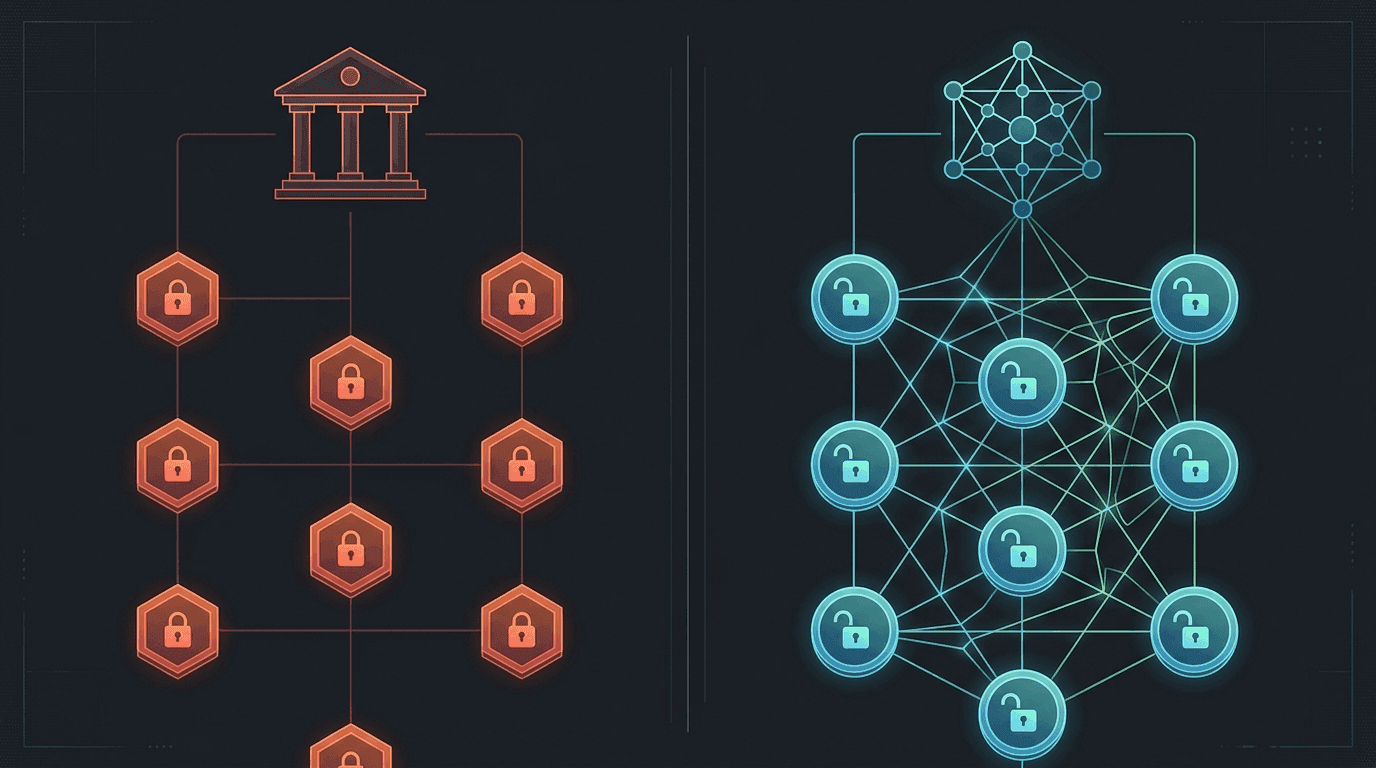
The two tiers are structurally distinct, not just different points on a spectrum.
Tier 1 - Regulated Payment Stablecoins are fiat-backed, issuer-controlled, and freeze-capable by design. They are: USDT ($184B), USDC ($78B), USD1 ($4.4B), PYUSD ($3.9B), USDG ($2.0B), RLUSD ($1.3B), and U ($1.0B) (Bitrue, April 2026). Each carries an admin key, an asset protection role, or a protocol-level clawback that lets a single entity stop your tokens from moving without your consent.
Tier 2 - DeFi Collateral Stablecoins are over-collateralized or synthetic, with no issuer-level freeze at the ERC-20 token layer. They are: DAI ($5.4B), USDD ($1.5B), and USDe ($5.8B base token). None of them qualifies as a "permitted payment stablecoin" under GENIUS or as an EMT under MiCA. None can be issued by a DAO or smart-contract-only protocol within those regulatory perimeters.
The separation matters because these tiers aren't interchangeable. Tier 1 tokens work for regulated payment infrastructure. Tier 2 tokens work for permissionless DeFi collateral. Using a Tier 1 token as core DeFi collateral introduces freeze risk into your liquidation engine. Using a Tier 2 token for regulated payment rails means you're operating outside the permitted perimeter.
What Freeze Capability Actually Means
It's worth being precise about what "freeze-capable" means across the Tier 1 tokens, because they're not all identical.
USDT's destroyBlackFunds() function zeroes a blacklisted address and reduces total supply. The tokens cease to exist. USDC's blacklist freezes transfers but leaves the balance in place - a different failure mode for a protocol holding it as collateral. Paxos's wipeFrozenAddress() on PYUSD and USDG zeroes the balance in two transactions: freeze first, wipe second. RLUSD uses XRPL's clawback amendment at the ledger level, retrieving tokens from a holder's wallet without their signature.
These distinctions matter at the protocol design layer. A blacklist-only freeze leaves stranded collateral. A destroy or wipe function removes collateral from existence. A clawback removes it from the counterparty's wallet directly. For a lending protocol holding any of these as collateral, these are meaningfully different failure modes mid-liquidation. Our Solidity-level analysis covers the exact contract mechanics.
Where Tier 2 Tokens Land
DAI is confirmed immutable by MakerDAO - no blacklist, no freeze, no admin key at the ERC-20 token layer. That's the strongest non-freeze guarantee of any top-10 stablecoin. The catch is in the collateral: roughly 72% of DAI's backing consists of centralized assets — USDC, other fiat-backed stablecoins, and RWAs (Bluechip). A coordinated freeze of that collateral could trigger undercollateralization - not by freezing DAI itself, but by hollowing out its backing.
USDD has no blacklist at the token layer, but its governance is effectively centralized around the TRON DAO Reserve. USDe base token has no blacklist for standard transfers, but sUSDe carries a FULL_RESTRICTED_STAKER_ROLE that can lock staking positions. What does that mean for holders of sUSDe? In practice, it's a freeze by another name.
None of the Tier 2 tokens can respond to a court order. None has a compliance team that can certify reserves. None can execute a GENIUS Act-mandated freeze. That's not a failing of lobbying or regulatory strategy - it's a structural consequence of their architecture.
Why the Split Is Happening Now
The split isn't new, but the regulatory scaffolding that enforces it is.
The GENIUS Act's Core Requirement
The GENIUS Act defines "permitted payment stablecoin issuers" and specifies exactly what they must be able to do. The language is direct: issuers must maintain the technical capability to "seize, freeze, burn, or prevent transfer" of tokens when legally required (Latham & Watkins). That capability is a condition of licensing, not an optional compliance feature.
The Act also bans interest payments on stablecoin balances (BobsGuide). The intent is to prevent payment stablecoins from competing with bank deposits for yield-seeking retail customers. The effect is a firm boundary around what regulated digital cash can look like as a product.
MiCA's Parallel Structure
MiCA came into force for stablecoins on 30 June 2024. It doesn't replicate GENIUS exactly - it creates two distinct issuer tracks: e-money tokens (EMTs) and asset-referenced tokens (ARTs). But the structural logic is the same. An EMT issuer must be a licensed credit institution or e-money institution in the EU. It must maintain full reserve backing, provide par-value redemption on demand, and keep reserves segregated (EBA).
Circle has EU authorisation. Tether hasn't sought it, leaving USDT as a "third-country crypto-asset" under MiCA. DAI, USDe, and USDD don't fit either the EMT or ART track cleanly - no licensed issuer, no approved white paper, no EBA oversight. EU-regulated firms can hold them but can't actively market them as payment instruments to retail clients.
Why Six Jurisdictions Landed in the Same Place
The Financial Stability Board's "same activity, same risk, same regulation" principle has been operationalized across GENIUS, MiCA, Singapore's MAS framework, Japan's Payment Services Act amendments, Hong Kong's FRS regime, and the UK's digital settlement asset framework. Each arrived independently at three identical requirements: licensed issuer, 1:1 reserves, and mandatory freeze or redemption capability.
Is that coincidence? No. The freeze requirement is the mechanism by which regulators and law enforcement can act on court orders, sanctions, and AML findings after the fact. Without it, a payment stablecoin is beyond the reach of legal process once tokens transfer. Every jurisdiction treats freeze capability as a baseline requirement for a money transmission licence. Applied to digital tokens, the same logic produces the same requirement.
For a deeper treatment of how these frameworks interact, our stablecoin regulation post covers the full jurisdictional picture.
The Consequences
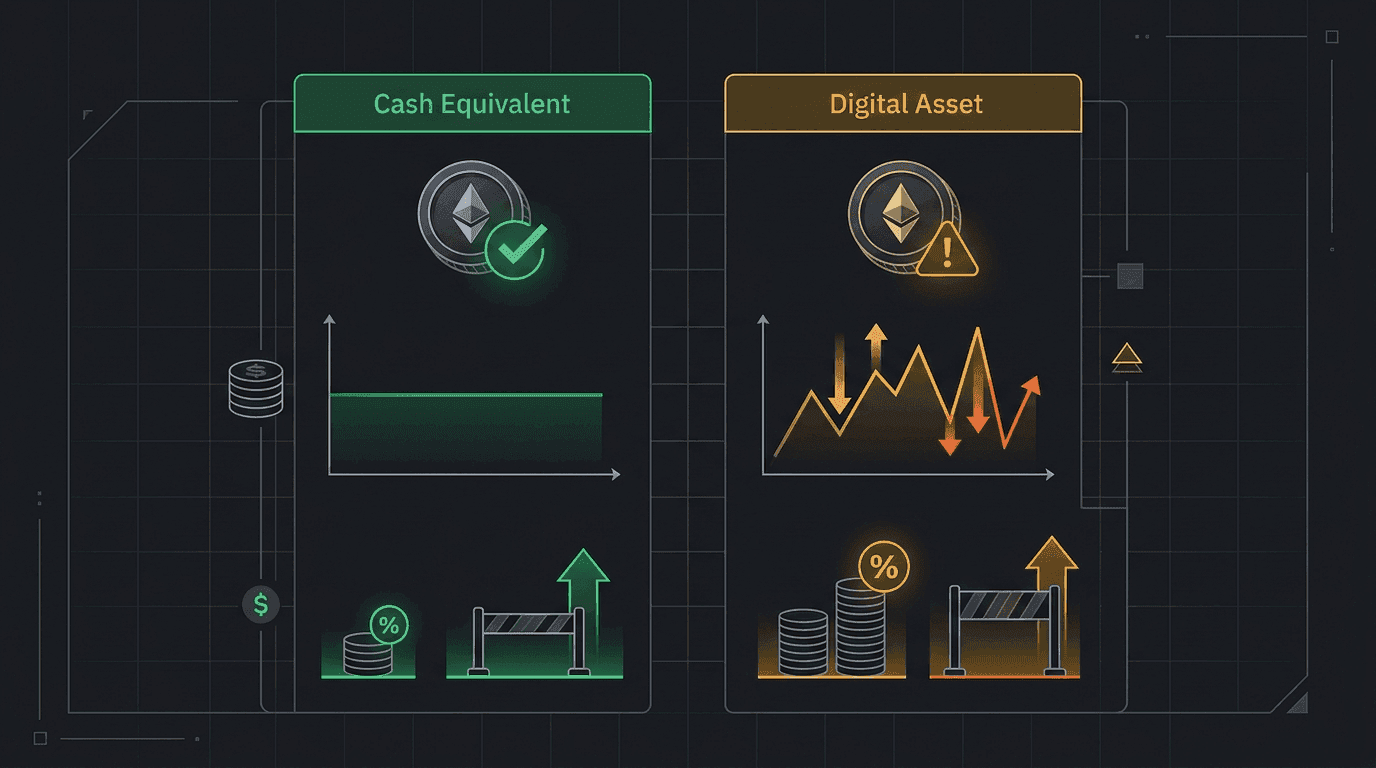
The regulatory split has concrete downstream effects on accounting, capital treatment, DeFi protocol design, and institutional treasury strategy. These aren't hypothetical.
Accounting Treatment Diverges by Tier
The accounting classification of a stablecoin depends on whether it carries a contractual redemption claim against a licensed issuer.
A Tier 1 stablecoin - fiat-backed, redeemable at par, issued by a licensed entity - can potentially qualify as a cash equivalent or financial instrument under IFRS 9 and IAS 7 (Plasma). That's the same treatment as a short-term Treasury bill. It affects how the position appears on the balance sheet, what impairment rules apply, and whether it counts toward liquidity ratios.
A Tier 2 stablecoin - over-collateralized, DAO-governed, no contractual claim on cash - is more likely classified as a cryptoasset or intangible. Not a cash equivalent. That means different impairment treatment, potentially mark-to-market volatility on the income statement, and more complex tax treatment when disposed.
For a corporate treasury with $100 billion on-chain (Chainlink), the accounting classification of the stablecoin it holds isn't a footnote. It's a material financial reporting difference.
Basel III Capital Treatment: The Tier Gap
Under Basel III, only supervised, regulated stablecoins qualify for Group 1b capital treatment - the preferred capital category for cryptoassets held by banks (BIS). Over-collateralized designs that fall outside the regulated perimeter attract punitive capital charges (Skadden). For a bank or insurance company holding DAI versus an equivalent USDC position, the regulatory capital cost can be materially higher.
That asymmetry shapes institutional behavior. Even if a portfolio manager prefers DAI's non-freeze properties, the capital cost of holding it versus USDC shifts the calculus. Regulatory treatment isn't just a compliance question - it's a return on capital question.
The Asymmetric Incentive to Over-Freeze
Why do Tier 1 issuers freeze so aggressively? The incentive structure is deeply asymmetric.
AML fines totaled $3.2 billion globally in 2024 (Consilient). TD Bank alone paid a $3 billion penalty (SanctionsScanner). The downside of missing a suspicious transaction - or being perceived as having missed one - can be existential for an issuer. The downside of freezing an innocent user? A complaint. Maybe a news cycle.
That asymmetry explains why Tether blacklisted 4,163 addresses in 2025 alone (BlockSec), locking up $1.26 billion in a single year. It explains why your money isn't really your money when it's held as a Tier 1 stablecoin. The issuer's compliance risk calculus doesn't include the cost to the person whose funds are frozen. That cost is fully externalized.
Could institutions tolerate a stablecoin that over-freezes? Up to a point. But protocol designers building liquidation engines, collateral managers sizing positions, and treasurers holding operational liquidity all need to price in the probability of a freeze event and its downstream consequences. The full governance analysis covers exactly who makes these decisions and what oversight exists.
Protocol Design Consequences
DeFi protocols that integrate Tier 1 stablecoins as collateral inherit freeze exposure in their liquidation logic. If a lending protocol holds a large USDC or USDT position and a freeze event hits mid-liquidation, the liquidation engine breaks. That's not theoretical. The DFINITY ckETH Minter case involved Circle freezing a wallet belonging to protocol infrastructure - downstream users of an unrelated protocol bore the cost.
GENIUS formalizes the expectation that payment stablecoins are freezable. Protocol designers should treat that as a guaranteed property of Tier 1 collateral, not an edge case. For protocols that need censorship resistance in their collateral, Tier 2 tokens are the only current option in the top 10 - with DAI carrying the strongest token-layer guarantee and its own collateral-composition caveats.
What architectural choices follow from this? Protocols integrating Tier 1 collateral need freeze-aware liquidation logic: detection, pausing, alternative collateral paths. Protocols preferring Tier 2 collateral need collateral-composition monitoring: tracking the upstream freeze exposure in DAI's USDC backing, for example. Neither is a simple "safe" choice. They're different risk profiles requiring different mitigations.
Who Wins in Each Tier
Neither tier is universally better. Each serves specific use cases well and others poorly.
Tier 1: Best in Class for Regulated Payment Rails
For regulated payment infrastructure, B2B settlement, and compliance-first institutional use cases, Tier 1 tokens are the practical answer. Within Tier 1, the relevant differentiators are: how aggressively does the issuer freeze, what's the documented process, and what's the regulatory footprint.
USDC is the strongest institutional choice within Tier 1. Circle is US-headquartered, has EU authorisation, and has built the most documented compliance infrastructure of any major issuer. Its blacklist-only mechanism (no destroy) also leaves open a recovery path that USDT's destroyBlackFunds() eliminates. The trade-off is lower market depth than USDT on some chains.
USDT wins on raw liquidity depth. Nothing else competes for large-block cross-exchange arbitrage or DEX depth on Ethereum and Tron. The freeze risk is real - $4.2 billion frozen to date - and the offshore issuer structure means the regulatory picture is less clean than USDC. For pure liquidity, it's the deepest pool. For compliance certainty, it carries more uncertainty.
PYUSD, USDG, RLUSD, and USD1 each serve specific distribution contexts - PayPal's consumer network, Paxos's institutional partners, Ripple's settlement network, WLFI's positioning - but none has the liquidity depth or regulatory clarity of USDC at scale.
Tier 2: Best in Class for Permissionless DeFi
For DeFi-native use cases where censorship resistance at the token layer matters, DAI remains the strongest option among the current top 10. The token is immutable, the ERC-20 contract has no admin key, and its composability across Ethereum DeFi is unmatched. Collateral-composition risk (the USDC backing) is the primary caveat - it's upstream, not direct, but it's real.
USDD has better token-layer freeze resistance than any Tier 1 token, but its peg stability history, opaque reserve governance, and TRON's validator centralization all make it a weaker choice than DAI for most DeFi applications. USDe works for yield-focused strategies when funding rates are positive, with the sUSDe staking restriction and CEX dependency factored in.
What does Tier 2 lack? Regulatory recognition, Group 1b capital treatment, clean IFRS accounting, and institutional acceptance in regulated contexts. That's a significant set of limitations for any institution operating under a compliance mandate.
For a complete breakdown of how each token fits each use case, the stablecoin market map covers the full architecture and collateral risk picture.
The Honest Trade-Off Statement
Choosing Tier 1 means accepting counterparty risk from an issuer with freeze capability, asymmetric incentives to over-freeze, and regulatory overhead that restricts product design. Choosing Tier 2 means accepting collateral-composition risk, regulatory exclusion from permitted payment rails, punitive capital treatment, and less favorable accounting classification.
There's no option that eliminates both. Any stablecoin that exists in 2026 is somewhere on this trade-off curve. The right choice depends on what you're optimizing for and what regulatory obligations you're operating under.
Is There a Third Path?
The Association Set Provider (ASP) model - drawn from research co-authored by Vitalik Buterin and described in our ASP vs. Proof of Innocence post - proposes separating compliance verification from token-layer control.
In the ASP model, users prove cryptographically that their address belongs to an association set with no known illicit history. The token has no freeze function. Compliance happens at the pool access layer, before a transaction enters the system - not after, via an issuer blacklist. UPD is one implementation of this approach: over-collateralized, no admin key, no freeze function, with ASP-layer compliance instead of token-level controls. It's pre-audit and testnet-only.
Whether ASP-layer compliance satisfies GENIUS Act requirements is an open legal question. Regulators have assumed "compliance-capable" and "freeze-capable" are the same thing because freeze-capable issuers were the only models on the table when these laws were drafted. That assumption is being tested. But it's not settled - and institutions shouldn't treat it as settled without formal regulatory guidance.
Frequently Asked Questions
Does the GENIUS Act ban Tier 2 stablecoins like DAI?
No. The GENIUS Act governs "permitted payment stablecoin issuers" - entities that want to issue regulated digital payment instruments in the US. DAI, USDD, and USDe don't qualify as permitted payment stablecoins, but they're not prohibited. The regulatory consequence is exclusion from regulated payment infrastructure, not prohibition from use or possession. A DeFi protocol holding DAI isn't violating GENIUS. A company trying to issue DAI as a US payment instrument would be (Latham & Watkins, 2025).
Can MiCA's ART category provide a path for DAI or similar protocols?
In theory, an asset-referenced token licence would let an entity issue a multi-asset-backed stablecoin under EU supervision. In practice, MiCA requires a legal entity, a Board of Directors, own funds, a MiCA-approved white paper, and EBA oversight for significant tokens (EBA). That's incompatible with MakerDAO's current governance structure. An ART-licensed entity might also need some wind-down or freeze capability to satisfy EBA requirements - which would fundamentally change the token's design. The ART path exists on paper but requires structural changes that would make the resulting token look very different from current DAI.
Why do institutions care about the accounting classification of stablecoins?
The classification affects how a position appears on the balance sheet, what impairment rules apply, and how disposals are taxed. A cash equivalent under IAS 7 is simple to hold and disclose. A cryptoasset or intangible under IFRS requires different impairment testing and may require mark-to-market treatment. For a corporate treasury or fund with significant stablecoin exposure, that's a material reporting difference - not an accounting technicality (Plasma).
What happens to a DeFi protocol's collateral book if a freeze hits mid-liquidation?
It depends on the freeze type. A blacklist-only freeze (USDC) leaves tokens stranded in a wallet - the protocol's position can't be moved, but the tokens still exist. A destroy-on-freeze mechanism (USDT's destroyBlackFunds()) or a wipe function (Paxos's wipeFrozenAddress()) removes the tokens entirely, reducing total supply and eliminating the collateral from existence. A liquidation engine that assumes collateral can always be transferred will break in either scenario, but the second scenario also eliminates the asset from the balance sheet. Protocol teams should build freeze-detection logic and fallback paths for both cases. The Solidity guide has the implementation details.
Is the two-tier structure permanent, or will regulations converge?
The current split reflects the state of law as written, not a permanent architectural truth. The FSB's peer review process (RegulationTomorrow) monitors implementation across jurisdictions and publishes pressure toward convergence. Future frameworks may accommodate ASP-based compliance, zero-knowledge proofs of regulatory compliance, or other approaches that separate censorship resistance from compliance verification. But those frameworks don't exist yet in binding regulatory form. For now, the two-tier structure is where institutions need to make decisions.
What This Means for Institutions Choosing Stablecoins
The two-tier split is no longer an industry debate. It's enacted law in the US, the EU, Singapore, Japan, Hong Kong, and the UK. Institutions making stablecoin decisions are choosing between two well-defined categories with different risk profiles, different regulatory treatment, and different use-case fits.
Three things follow directly from this analysis.
First, classify every stablecoin position you hold. Tier 1 or Tier 2 - the determination has accounting consequences under IFRS, capital consequences under Basel III, and compliance consequences under GENIUS and MiCA. Your risk committee should know which tier each position occupies and what regulatory treatment applies in each jurisdiction where your entity operates.
Second, model freeze risk as a first-order input for Tier 1 holdings. Tether has frozen $4.2 billion (Reuters). Circle has blacklisted $117 million (AMLBot). The asymmetric incentive structure means issuers will continue to freeze aggressively as AML enforcement intensifies. For DeFi protocols holding Tier 1 collateral, a freeze event during liquidation isn't a tail risk to be noted in documentation - it's a structural failure mode to be addressed in design.
Third, track collateral-composition risk for Tier 2 holdings. DAI's token-layer non-freezability doesn't extend to its collateral. Roughly 72% of its backing is centralized assets — USDC, other fiat-backed stablecoins, and RWAs (Bluechip). An institution holding DAI as a censorship-resistant asset should monitor that upstream exposure continuously, not treat DAI as fully immune to freeze dynamics.
The two-tier structure is the framework that $287 billion in stablecoin capital is now operating within. Forty-three percent of hedge funds planning DeFi integration (CryptoSlate) will make their stablecoin choices inside this framework - not in spite of it. The institutions that model the trade-offs explicitly will be better positioned than those that treat stablecoin risk as a single-dimension question of market cap and liquidity.
Related Reading
- What Is a Non-Freezable Stablecoin? - the architecture behind Tier 2 tokens and what non-freezable actually means
- Can Stablecoins Be Frozen? A Solidity Guide - the contract mechanics behind every freeze type in the top 10
- Who Freezes Your Stablecoins? - governance gaps and the oversight deficit in issuer freeze decisions
- Stablecoin Market Map 2026 - full architectural breakdown of the top 10 by freeze risk and DeFi fit
- Stablecoin Regulation 2026 - GENIUS Act, MiCA, and the six-jurisdiction convergence
- Your Money Is Not Your Money - why the freeze architecture exists and who bears its costs
- ASP vs Proof of Innocence - compliance without token-layer control