
April 13, 2026 · Permissionless Technologies
Stablecoin Regulation in 2026: GENIUS, MiCA, and the Global Freeze Mandate
The GENIUS Act requires issuers to freeze tokens on demand. MiCA restricts EU exchanges to licensed issuers. Six jurisdictions are converging on the same model. Here's the full map.
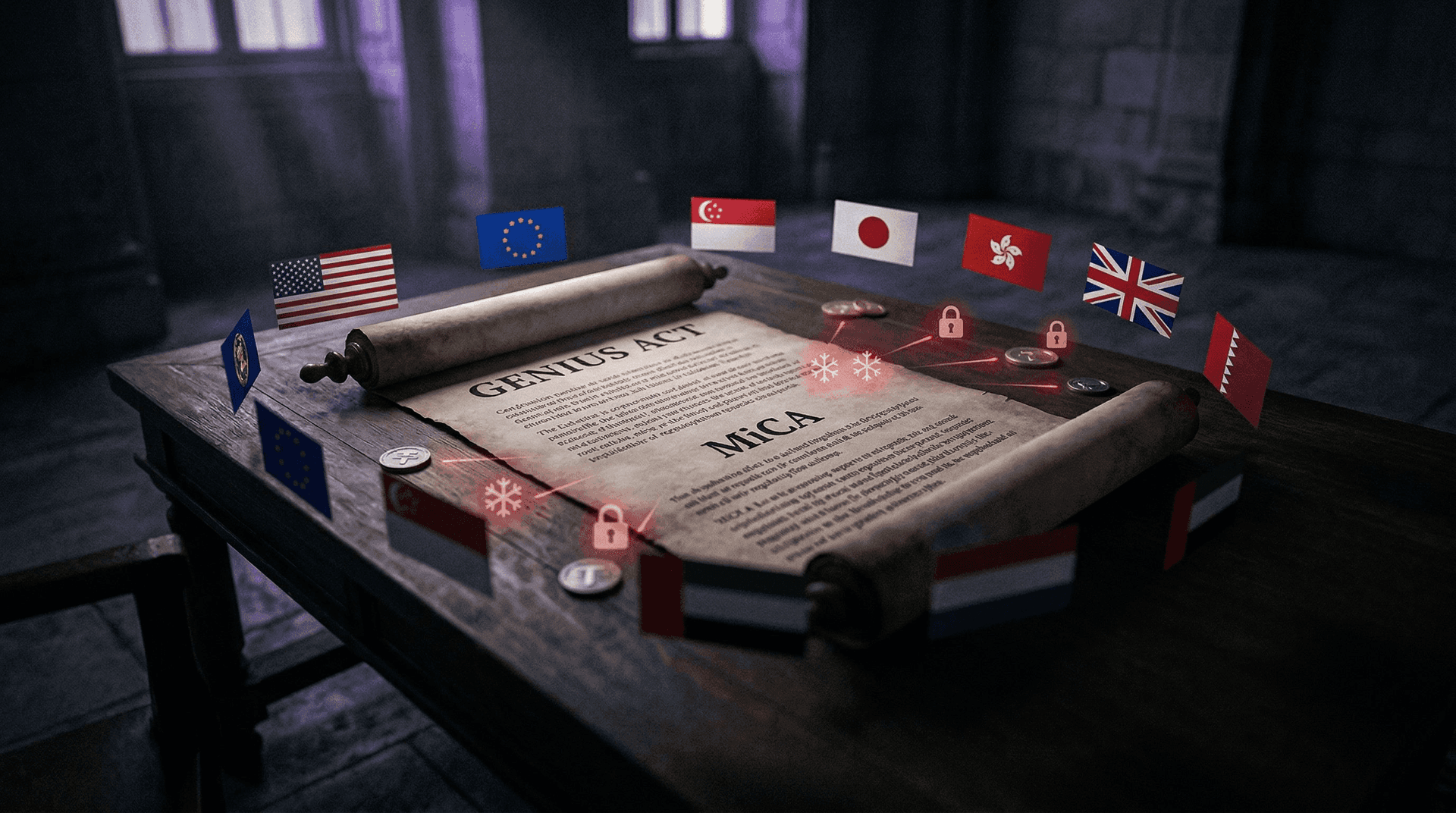
The GENIUS Act requires permitted stablecoin issuers to maintain the technical capability to "seize, freeze, burn, or prevent transfer" of tokens when legally required. That's not a side condition buried in the appendix. It's a core eligibility criterion. If your token can't be frozen, it can't be a permitted payment stablecoin under US federal law.
MiCA came into force for stablecoins on 30 June 2024. Singapore finalised its Single-Currency Stablecoin framework. Japan's Payment Services Act limits issuance to banks and licensed trust companies. Hong Kong's fiat-referenced stablecoin licensing regime took full effect in August 2025. Every major financial jurisdiction is moving in the same direction. The question for compliance officers, general counsel, and institutional treasurers isn't whether this is happening. It's what the split means for the capital they've deployed.
Key Takeaways
- The GENIUS Act explicitly mandates freeze capability for all "permitted payment stablecoins" - fiat-backed tokens without a freeze function cannot qualify (Latham & Watkins, 2025).
- Tether has frozen $4.2 billion in USDT to date (Reuters, 2026); Circle has blacklisted around $117 million in USDC (AMLBot, 2025).
- MiCA classifies stablecoins as either e-money tokens (EMTs) or asset-referenced tokens (ARTs), with distinct licencing paths and different degrees of EBA oversight (EBA).
- Over-collateralised designs like DAI fall outside both GENIUS and MiCA's issuer frameworks - not banned, but restricted from regulated payment chains and penalised under Basel III capital rules (BIS).
- Six major jurisdictions are converging on identical structural requirements: 1:1 reserves, licensed issuer, and mandatory freeze capability.
What the GENIUS Act Actually Requires
The GENIUS Act is the answer to ten years of congressional deadlock on digital-asset legislation. It passed in 2025, and its implementing regulations under the Clarity for Payment Stablecoins Act took effect in 2026, jointly creating a federal framework for "permitted payment stablecoins" in the United States (Wired).
The eligibility criteria are precise. To qualify as a permitted payment stablecoin, an issuer must be a bank or a specially authorised non-bank entity, subject to Federal Reserve or OCC supervision plus full BSA and AML obligations. Reserves must be maintained 1:1 in high-quality liquid assets: cash, central-bank balances, short-term Treasuries, or money-market funds held in segregated accounts with strict limits on rehypothecation. Monthly reserve attestations and annual audits are required. CEOs and CFOs must certify reserve accuracy, much like Sarbanes-Oxley sign-offs for public companies (Latham & Watkins).
One provision stands out for its operational implications: the Act explicitly bans permitted issuers from paying interest directly on stablecoin balances (BobsGuide). The intent is to prevent stablecoins from competing with bank deposits for yield-seeking retail customers, but the effect is a sharp limit on product design flexibility for anyone operating within the perimeter.
The Freeze Mandate in Plain Terms
The most consequential requirement for anyone designing or holding stablecoins is this: permitted issuers must maintain the technical ability to seize, freeze, burn, or prevent transfer of tokens when required by law (BeInCrypto, 2025). Ripple confirmed publicly that RLUSD can be frozen or clawed back using XRPL's clawback amendment. Circle's blacklist mechanism is already in production. Paxos documents its assetProtectionRole explicitly in its terms.
This isn't incidental. The freeze requirement is the mechanism by which regulators and law enforcement can recover illicitly obtained funds, enforce sanctions, and respond to court orders. From the regulator's perspective, a stablecoin without freeze capability is a stablecoin that's unenforceable - and therefore not a payment instrument they can permit.
Who Fits and Who Doesn't
The GENIUS framework cleanly separates the stablecoin market. USDC, PYUSD, USDG, and RLUSD are clearly in scope: fiat-backed, issuer-controlled, KYC-heavy, and architecturally freeze-capable (Yellow). USD1 and U are likely in scope too, pending issuer licensing details.
USDT is politically complex. It's fiat-backed, it already freezes billions, and it's the largest stablecoin by market cap. But Tether Limited is an offshore issuer. US persons can access USDT, but Tether itself isn't seeking a US licence, and its legal structure sits outside the GENIUS perimeter by design (Statista).
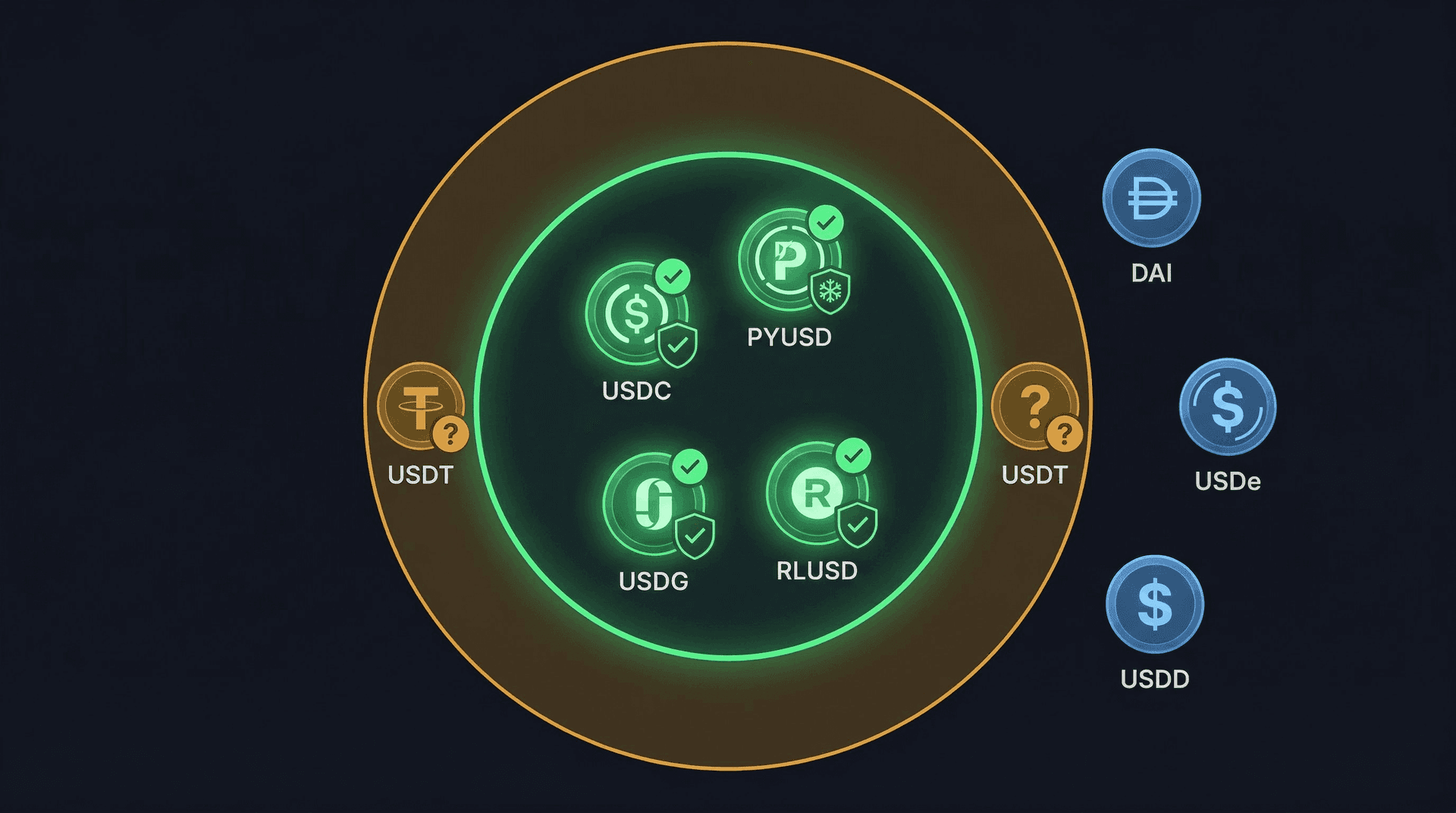
DAI, USDe, and USDD fall outside the perimeter by construction. The GENIUS Act explicitly disfavors DAO governance structures and foreign non-bank issuers for permitted status. No smart-contract-only issuer has a compliance team that can certify reserves. No immutable protocol can respond to a court order by executing a freeze. These tokens aren't banned. They're simply a different category of cryptoasset - and that distinction matters enormously for capital treatment and institutional deployment (LinkedIn).
What GENIUS Means for DeFi Protocols
DeFi protocols that integrate freezable stablecoins inherit freeze exposure. If a lending protocol holds a significant position in USDC or USDT as collateral, and a freeze event hits those tokens mid-liquidation, the liquidation engine breaks. That's not theoretical - the mechanics are documented in detail. GENIUS formalises the expectation that payment stablecoins are freezable. Protocol designers should price that into their collateral risk models.
MiCA: The EU's Two-Track System
The EU's Markets in Crypto-Assets Regulation is the most structurally detailed stablecoin framework in force globally. The stablecoin provisions in Titles III and IV became effective on 30 June 2024, more than six months before GENIUS passed (SwissBorg). MiCA doesn't replicate GENIUS - it creates a parallel structure with two distinct issuer tracks.
EMTs vs. ARTs: The Critical Distinction
E-money tokens (EMTs) reference a single official currency. The best-known example is a euro-pegged or dollar-pegged token. Issuers must be credit institutions or e-money institutions already authorised in the EU. They're required to maintain full backing with high-quality reserve assets, provide par-value redemption on demand, and keep reserves segregated from their own balance sheets (EBA).
Asset-referenced tokens (ARTs) reference multiple assets, non-fiat instruments, or algorithmic constructs. Issuers need a separate MiCA licence and a regulator-approved white paper (Cambridge). Tokens classified as "significant" by the European Banking Authority attract enhanced capital requirements, liquidity buffers, and direct EBA supervisory oversight.
The practical consequence: EU-authorised crypto-asset service providers can only market stablecoins that meet MiCA's EMT or ART requirements to retail clients. Tokens that don't qualify as either can still exist, but regulated EU firms can't actively promote them as payment instruments (TheBanks).
How MiCA Applies to the Top 10
USDC, USDT, PYUSD, USDG, RLUSD, USD1, and U qualify as EMTs once issued or authorised by an EU-licenced entity. Circle has EU authorisation in place. Tether's path is less clear - it's fiat-backed and already freeze-capable, but its offshore issuer structure creates licencing friction (LLPOLawFirm). Without MiCA authorisation, these tokens become "third-country crypto-assets" that EU-regulated exchanges can hold but can't actively market as EMTs.
DAI, USDe, and USDD land in a more complicated position. They're closer to ARTs under MiCA's taxonomy. That means they'd need a licensed issuer, an approved white paper, and reserve rules that a DAO or synthetic protocol simply doesn't have. MakerDAO isn't a licenced EU entity. Ethena doesn't have a MiCA-approved white paper. None of the three has EBA oversight as a significant token. EU-regulated firms will likely de-emphasise or de-list these for retail customers, even if they're not formally prohibited.
Is that a material problem for DAI's global utility? Not necessarily. But it does close off a large portion of regulated institutional distribution in the world's largest single market.
The Global Pattern: Six Jurisdictions, One Template

The GENIUS-MiCA split is not the whole picture. Six major jurisdictions have now implemented or finalised stablecoin frameworks, and the structural convergence is striking. Each one has independently arrived at the same three requirements: licensed issuer, 1:1 reserves, and mandatory freeze or redemption capability.
This isn't coincidence. The Financial Stability Board published high-level recommendations for global stablecoin arrangements in 2020, updated in 2023, grounding the framework in a core principle: same activity, same risk, same regulation (FSB). Its 2025 peer review found implementation remains fragmented in detail but convergent in direction (RegulationTomorrow). BIS and IOSCO have reinforced the theme: stablecoins that function as systemically important payment systems should be treated as such, regardless of the technology underneath (BIS).
Singapore
The Monetary Authority of Singapore finalised its Single-Currency Stablecoin framework for tokens pegged to the Singapore dollar or G10 currencies, issued in Singapore, with a circulation above SGD 5 million (Chambers). Requirements include 1:1 reserves in high-quality liquid assets, par-value redemption within five business days, and mandatory capital and governance standards (MSIGlobal). Only qualifying tokens can use the "MAS-regulated stablecoin" label (ReedSmith).
Japan
Japan's Payment Services Act amendments are arguably the strictest regime globally. Only banks, licensed money transfer agents, or trust companies can issue stablecoins. Backing must be 1:1 against deposits or government securities at all times (TransatlanticLaw). None of the top 10 stablecoins is currently Japan-licensed. They're accessible through regulated intermediaries, but none carries direct issuer authorisation (Coinbax).
Hong Kong
Hong Kong's Fiat-Referenced Stablecoin licensing regime ran a regulatory sandbox before full effect in August 2025 (CliffordChance). The HKMA's framework requires full reserve backing and redemption within one business day (FintechAndDigitalAssets). Issuers operating in HKD or HKD-pegged tokens need a licence before they can issue.
United Kingdom
The UK's Financial Services and Markets Act 2023 created a framework for "digital settlement assets" including fiat-backed stablecoins (Ashurst). Phase 1 covers fiat-backed tokens with FCA licensing and Bank of England oversight for systemically important sterling-backed systems (KPMG). Phase 2 may extend to algorithmic and crypto-backed designs. For now, the UK framework mirrors MiCA and GENIUS in its core structure.
UAE
Dubai's VARA classifies stablecoins as Fiat-Referenced Virtual Assets (FRVAs) or Asset-Referenced Virtual Assets (ARVAs) with distinct regulatory treatment (CharltonsQuantum). The Central Bank of the UAE oversees AED-pegged payment tokens exclusively (APE Law). Reserve requirements are 1:1, redemption must occur within one business day, and monthly disclosures plus independent audits are mandatory (OpenDue).
The Eligibility Matrix
Where does each major stablecoin stand across these frameworks? Based on issuer structure, reserve model, and public regulatory filings as of April 2026:
| Stablecoin | US (GENIUS) | EU (MiCA) | SG (MAS) | JP (PSA) | HK (FRS) | UK (DSA) | UAE (VARA) |
|---|---|---|---|---|---|---|---|
| USDC | Yes | Yes | Yes | ? | Yes/? | Yes | Yes |
| PYUSD | Yes | Yes/? | Yes/? | ? | Yes/? | Yes | Yes/? |
| USDG | Yes | Yes | Yes | ? | Yes/? | Yes | Yes |
| RLUSD | Yes | Yes/? | Yes/? | ? | Yes/? | Yes | Yes |
| USDT | ? | ? | ? | No | ? | ? | ? |
| USD1 | ? | ? | ? | No | ? | ? | ? |
| U | ? | ? | ? | No | ? | ? | ? |
| DAI | No/? | No/? (ART) | No | No | No | No | No |
| USDe | No | No | No | No | No | No | No |
| USDD | No | No | No | No | No | No | No |
"?" indicates regulatory eligibility depends on licensing steps that are in progress or unconfirmed as of the article date. "No" indicates structural incompatibility with the framework.
What does the pattern tell you? Every jurisdiction has independently concluded that a payment stablecoin needs an identifiable legal issuer who can respond to law enforcement. That's the thread connecting GENIUS, MiCA, the MAS framework, the PSA amendments, and the HKMA's FRS. No issuer, no eligibility. It's that simple.
What This Means for DeFi-Native Stablecoins
DAI, USDe, and USDD are not regulated payment stablecoins under any of these frameworks. That's not a failure of lobbying or an accident of timing. It's a structural consequence of their design. No identifiable legal issuer means no one to licence. No freeze function means the mandatory technical capability can't be demonstrated. No contractual redemption right means no par-value claim that a custodian can hold for you.
This doesn't make them illegal. None of the frameworks above bans their use or possession. What they do is restrict which regulated entities can hold, market, and integrate them into regulated payment infrastructure.
For DeFi protocols and professional investors operating outside tightly regulated payment rails, that's fine. DAI has run without a freeze function since 2017. USDe's delta-hedged synthetic model serves a clear use case in on-chain yield strategies. The question is whether they can play in the regulated institutional segment - and the answer from six major jurisdictions is: not as "permitted payment stablecoins."
The Accounting and Capital Sting
The regulatory exclusion has downstream consequences that show up on the balance sheet. Under IFRS and US GAAP, a fiat-backed stablecoin with a contractual redemption claim can potentially qualify as a cash equivalent or financial instrument under IFRS 9 and IAS 7 (Plasma). An over-collateralised or DAO-issued token with no contractual claim on cash is more likely treated as a cryptoasset or intangible, not a cash equivalent (LinkedIn/IFRS). That changes how the position appears on the balance sheet, how it's impaired, and what tax treatment applies.
Under Basel III, the capital treatment is even sharper. Only supervised, regulated stablecoins qualify for Group 1b treatment - the preferred capital category for cryptoassets (BIS). Over-collateralised designs fall into higher-risk categories with punitive capital charges (Skadden). For a bank or insurance company holding DAI, the capital cost can be materially higher than for an equivalent USDC position.
Institutions deploying $100 billion-plus on-chain (Chainlink) need to model this explicitly. Holding a non-freezable stablecoin isn't just a regulatory position. It's a capital efficiency decision.
The ASP Alternative
There's a third architecture that doesn't fit neatly into either bucket, and it's worth understanding. The Association Set Provider model - drawn from research co-authored by Vitalik Buterin and described in detail in our post on ASP vs. Proof of Innocence - separates compliance verification from token-layer control.
In the ASP model, users prove cryptographically that their address belongs to an association set of accounts with no known illicit history. The token itself has no freeze function. Compliance happens at the pool access layer, not the contract layer. An issuer-less token can still be part of a compliant payment flow if the pool infrastructure validates membership on entry.
Whether this satisfies regulatory requirements in specific jurisdictions is an open legal question - one that will need to be answered jurisdiction by jurisdiction, and probably through formal regulatory engagement rather than academic inference. What it demonstrates is that "freeze-capable issuer" and "compliance-capable system" aren't the same thing. Regulators have assumed they are because fiat-backed issuers were the only models on the table when these laws were written. That assumption is being tested. UPD, an over-collateralized stablecoin with no admin key and no freeze function, uses ASP-layer compliance to separate token custody from compliance verification. It's pre-audit and testnet-only, but the architecture demonstrates what a non-freezable stablecoin designed for the post-GENIUS regulatory environment could look like.
Frequently Asked Questions
Does the GENIUS Act apply to stablecoins held by non-US persons?
The GENIUS Act governs "permitted payment stablecoin issuers" - entities that want to issue stablecoins for payment use in the US. If a foreign-issued stablecoin is marketed to US persons or used in US commerce, additional rules may apply. But the Act's primary target is the issuer, not the holder. A German investor holding DAI isn't directly regulated by GENIUS. A company issuing a new USD-pegged token that wants US market access absolutely is (Latham & Watkins, 2025).
Can USDT become MiCA-compliant?
Tether has not sought EU authorisation as an e-money institution. Without that, USDT operates as a "third-country crypto-asset" under MiCA - not prohibited, but not marketable by EU-authorised CASPs as an EMT. Tether could seek authorisation through an EU subsidiary, which would require meeting reserve, governance, and oversight requirements. As of April 2026, Tether has not publicly announced that path (SwissBorg).
Why do all these jurisdictions require freeze capability?
Freeze capability is the mechanism that lets regulators and law enforcement act on court orders, sanctions, and AML findings after the fact. Without it, a stablecoin is effectively beyond the reach of legal process once tokens are transferred. Every major financial jurisdiction treats the ability to freeze funds as a baseline requirement for a money transmission licence. The same logic applied to digital tokens was always going to produce the same result.
What happens to DeFi protocols that use DAI as collateral under these frameworks?
Nothing changes at the protocol layer. DAI doesn't become illegal. Smart contracts holding DAI don't become non-compliant overnight. But a regulated bank or fund considering DeFi integration faces a harder question: can it hold DAI as a treasury asset under its existing regulatory permissions? Under Basel III, the capital treatment is punitive compared to USDC. Under IFRS, the accounting classification differs. Legal counsel needs to review this before any significant institutional deployment. See Stablecoin Market Map 2026 for the full collateral risk breakdown.
Is MiCA's ART category a viable path for DAI or similar protocols?
In theory, an ART licence would let a DAO-like entity issue a multi-asset-backed token under EU supervision. In practice, MiCA requires a legal entity, a Board of Directors, own funds, a MiCA-approved white paper, and EBA oversight for significant tokens. That's incompatible with MakerDAO's current governance structure. A purpose-built EU entity could potentially seek ART authorisation, but it would look very different from the current DAI issuer - and it would likely need to build in some form of freeze or wind-down capability to satisfy the EBA (EBA).
What Compliance Teams, CTOs, and Treasurers Should Do Now
The regulatory picture is no longer ambiguous. Six jurisdictions have implemented or finalised frameworks, and they agree on the fundamentals. If you hold stablecoin positions, operate DeFi infrastructure, or are building payment products, three things follow from the analysis above.
First: classify your holdings. Every stablecoin position should be reviewed against the eligibility matrix above for the jurisdictions where your entity operates. USDC is a "permitted payment stablecoin" under GENIUS. DAI isn't. The capital treatment under Basel III and accounting treatment under IFRS differ materially. Your risk committee should know which tokens you're holding and what category they occupy.
Second: model the freeze exposure. Holding permitted stablecoins doesn't eliminate risk - it converts it. Instead of collateral-crash risk, you have freeze risk from a concentrated issuer. Tether has frozen $4.2 billion (Reuters). Circle has blacklisted $117 million (AMLBot). These aren't edge cases. For any DeFi protocol using freezable stablecoins as collateral, a freeze event mid-liquidation is a structural failure mode that needs to be addressed in design, not papered over in documentation. The Solidity-level analysis covers exactly how these failure modes occur.
Third: track the secondary legal questions. GENIUS and MiCA answer the first-order question - who can issue a payment stablecoin. They don't fully resolve second-order questions about due process for wrongly frozen users, proportionality standards, or appeals mechanisms. As we've documented elsewhere, courts in the UK, Uganda, and India are developing proportionality doctrine for bank freezes that may eventually reach stablecoin issuers. The regulatory map is complete. The governance gap remains open.
The split is now law. Permitted payment stablecoins are issuer-controlled, freeze-capable, and increasingly regulated across all major financial jurisdictions. Over-collateralised and synthetic designs exist outside that perimeter - useful for DeFi-native infrastructure, less suited to regulated payment rails. Forty-three percent of hedge funds are planning DeFi integration (CryptoSlate). The decisions that define which stablecoin architecture they use will be made on the basis of the regulatory map above - not on the basis of technical elegance.
Related Reading
- What Is a Non-Freezable Stablecoin? - the architecture behind the regulatory split
- Who Freezes Your Stablecoins? - governance gaps in issuer freeze powers
- Can Stablecoins Be Frozen? A Solidity-Level Guide - the contract mechanics behind the GENIUS mandate
- Your Money Is Not Your Money - why the freeze architecture exists and who it costs
- ASP vs. Proof of Innocence - compliance without token-layer control
- Stablecoin Market Map 2026 - the full market context for these regulatory positions