
April 18, 2026 · Permissionless Technologies
DAI vs UPD: When Decentralized Isn't Decentralized Enough
DAI has no freeze function, but 50%+ of its collateral is USDC and freezable RWAs. When SVB collapsed, DAI depegged to $0.85. Here's what that means.
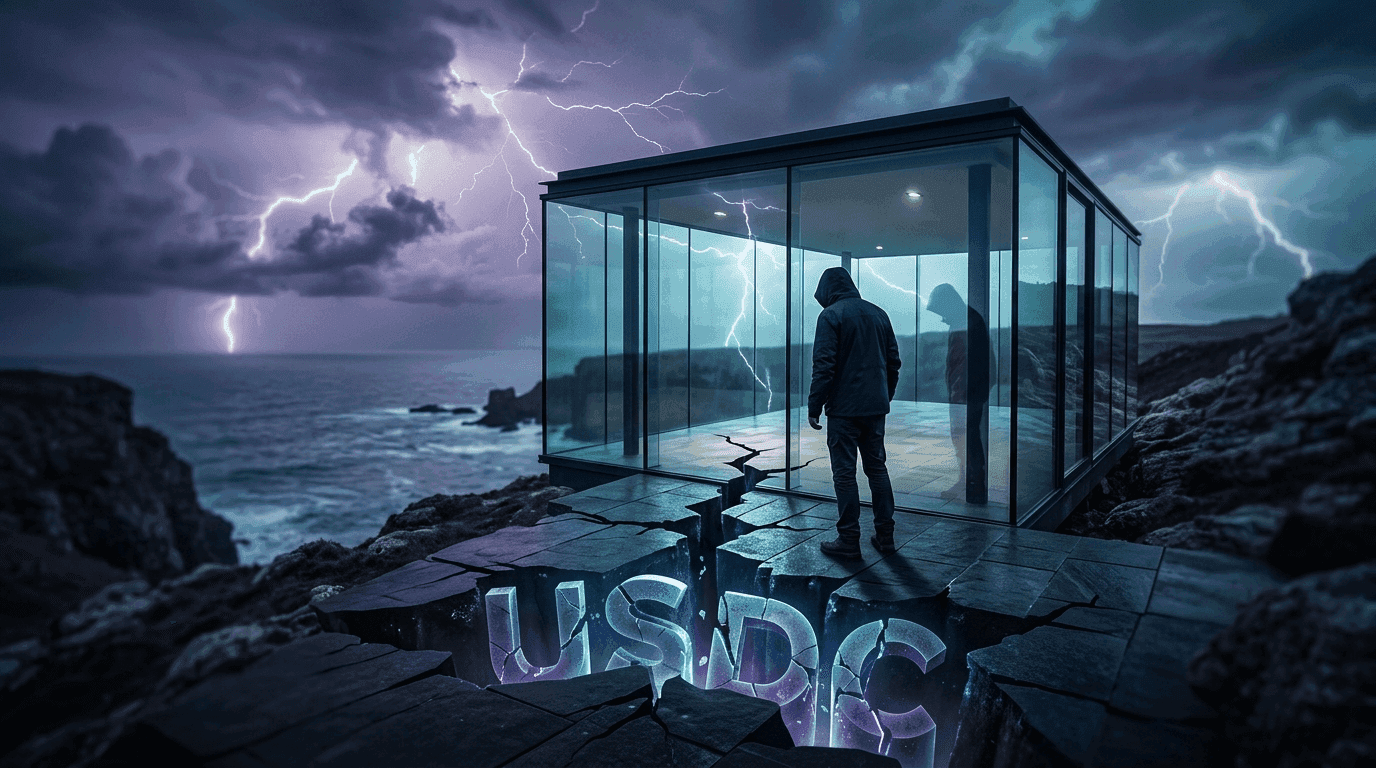
March 10, 2023. Circle discloses that $3.3 billion of USDC's cash reserves are stuck at Silicon Valley Bank. USDC drops to roughly $0.87 on secondary markets. That part you probably remember.
Here's the part most people missed.
DAI - the stablecoin with no freeze function, no admin key, no blacklist, no issuer - followed USDC down. It hit approximately $0.85. The "decentralized" stablecoin depegged harder than the centralized one it was supposed to replace (S&P Global).
How? Because by early 2023, USDC and USDC-related instruments represented over half of DAI's collateral reserves. The token that can't be frozen was backed by a token that can. The contract was bulletproof. The foundation beneath it wasn't.
This post explains what that dependency means for anyone holding or building on DAI, and how it compares to a design where the collateral itself is non-freezable.
Key Takeaways
- DAI's token contract is genuinely immutable: no freeze function, no blacklist, no pause, no admin key. Rune Christensen confirmed this directly (CryptoRank).
- By early 2023, over 50% of DAI's collateral was USDC and USDC-related instruments, tying DAI's peg directly to Circle's banking relationships (S&P Global).
- During the SVB collapse, DAI depegged to ~$0.85 - deeper than USDC's ~$0.87 trough - despite having no issuer and no centralized point of failure at the token level.
- DAI doesn't qualify as a "payment stablecoin" under GENIUS or MiCA, placing it outside regulated payment rails alongside other non-issuer tokens.
- UPD is a pre-audit, Sepolia-stage over-collateralized stablecoin where both the token AND the collateral are non-freezable crypto assets, avoiding the upstream dependency that exposed DAI during SVB.
What Actually Happened in March 2023?
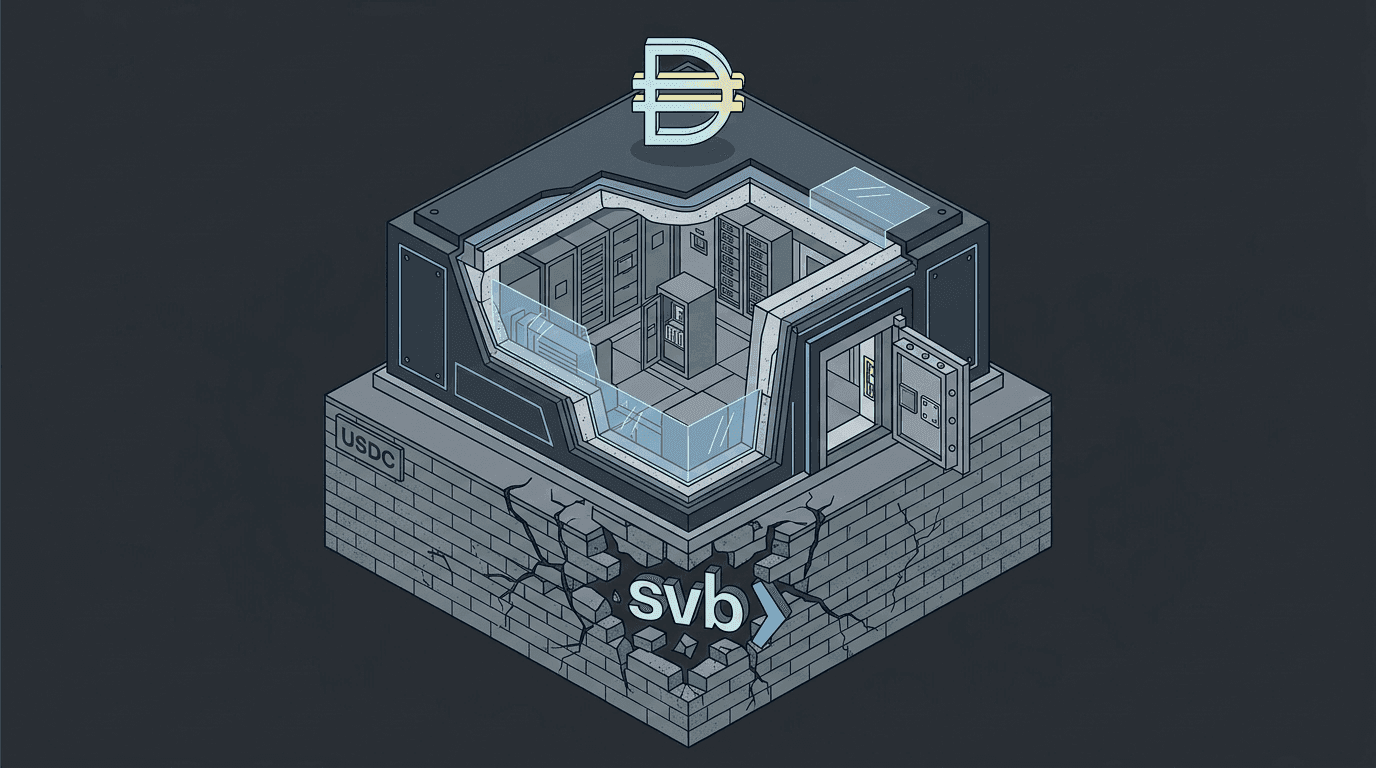
The timeline moved fast. On Friday, March 10, regulators shut down Silicon Valley Bank after a classic bank run. Over the weekend, Circle confirmed that approximately $3.3 billion of USDC's reserves - about 8% of total backing - sat in SVB accounts. Nobody knew if those deposits would be recoverable.
USDC dropped to roughly $0.87 on DEXes within hours. Arbitrageurs who normally keep the peg tight pulled back. Why buy at $0.95 when it might go to $0.80?
Then the cascade hit DAI. MakerDAO's protocol held more than half its collateral backing in USDC and USDC-linked instruments. When the market repriced USDC, it repriced DAI's backing along with it. DAI fell to approximately $0.85 - actually undershooting the asset that was dragging it down (CoinTelegraph).
S&P Global later published a study covering five major stablecoins over the 2021-2023 period. The conclusion was blunt: USDC and DAI spent more time below parity and experienced deeper depegs than USDT or BUSD. Both dipped below $0.90 for meaningful stretches. USDT and BUSD never did (CryptoTimes).
The US government stepped in that Sunday to guarantee all SVB deposits. USDC recovered. DAI recovered. But the data point remained. The stablecoin with no freeze function, no admin key, and no centralized issuer had lost more value than the ones with all three.
Surely the contract itself is solid, though? What does the code actually say?
What's Actually in the DAI Contract?
Here's where DAI deserves genuine credit. The DAI ERC-20 token contract is immutable. Not upgradeable-behind-a-proxy immutable. Actually immutable. The bytecode deployed is the bytecode you get. There is no owner role, no proxy admin, no upgrade path.
Search the contract for a freeze function. It doesn't exist. Search for blacklist. Nothing. Search for pause. Not there. There is no mapping of blocked addresses. There is no modifier that checks whether you're allowed to transfer. DAI's token contract is, at the code level, exactly what people think it is.
Rune Christensen, MakerDAO's co-founder, confirmed this publicly: "DAI is an immutable smart contract and can't be altered" (CryptoRank). He went further, noting that the new stablecoin, USDS (the Sky rebrand), will have a freeze function - but DAI itself remains unchanged (DailyHodl).
Compare that to what we've seen in previous posts. USDT has destroyBlackFunds, which burns your balance to zero. USDC has a blacklister role that can freeze any address. PYUSD has freeze() plus wipeFrozenAddress(), a two-step confiscation path. DAI has none of these. At the token contract level, it's the real deal.
So if the contract is genuinely non-freezable, how did DAI lose 15 cents on the dollar worse than USDC during SVB? The answer isn't in the token contract. It's underneath it, in the collateral.
How Does a Non-Freezable Token Depend on Freezable Collateral?
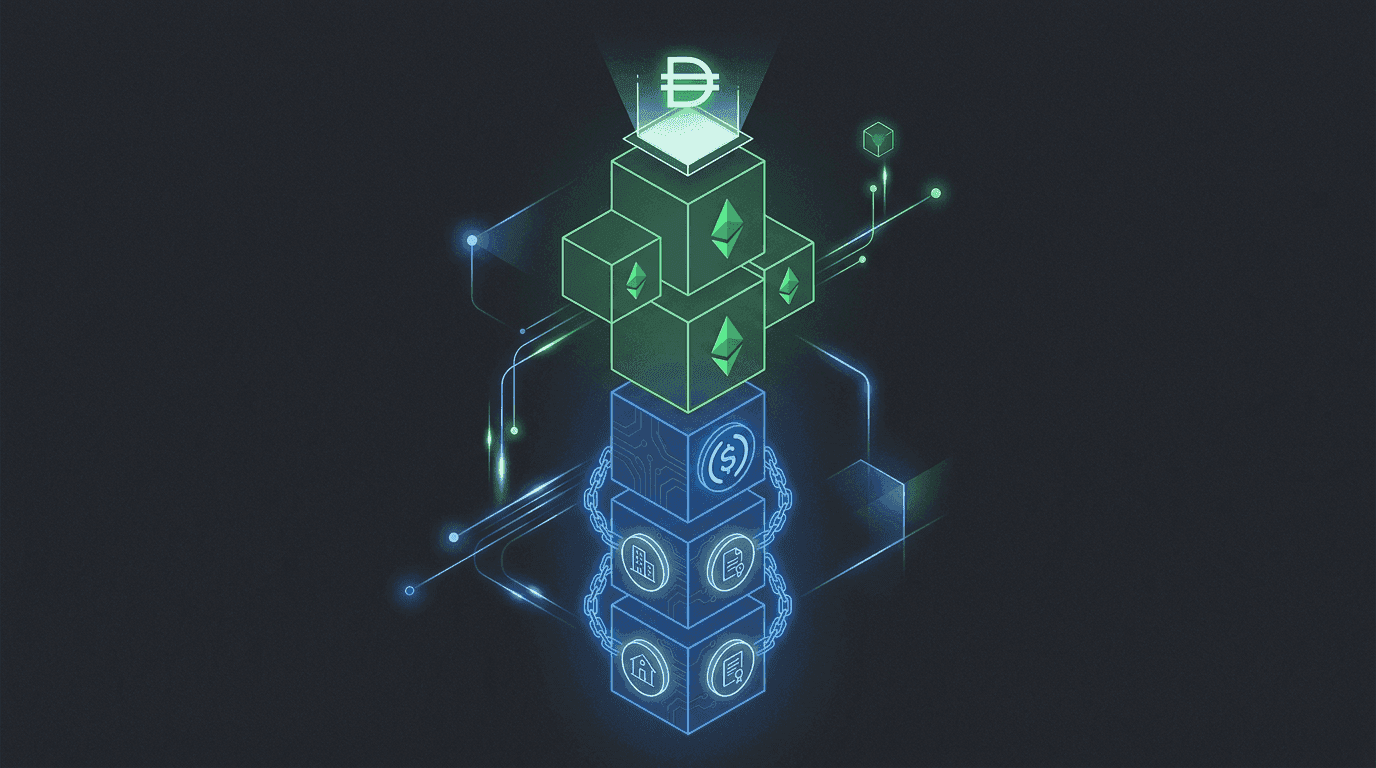
DAI didn't start this way. In the beginning, there was Single-Collateral Dai - backed entirely by ETH. One collateral type. Fully crypto-native. No centralized dependencies. That version launched in 2017 and it was, in its purest form, exactly what the decentralization thesis promised.
Then came Multi-Collateral Dai. MakerDAO governance approved a growing list of collateral types: wrapped Bitcoin, various LP tokens, and critically, USDC. The rationale made sense at the time. USDC provided stability. It reduced DAI's volatility exposure to ETH price swings. It made the protocol safer in normal conditions.
But the composition kept shifting. Real-world asset (RWA) vaults followed - short-term US Treasuries held through legal wrappers, managed by off-chain entities. By early 2023, S&P Global and other analysts estimated that USDC and centralized RWA instruments represented over 50% of DAI's total collateral. Some analyses put the centralized exposure even higher (S&P Global).
Think of it like building a house on rented land. The house is yours. The deed is in your name. Nobody can take the house itself. But if the landlord can collapse the foundation, how much does the deed actually protect you?
That's DAI's relationship with USDC collateral. If Circle freezes or restricts USDC sitting in Maker vaults, the protocol faces a backing shortfall. DAI's contract can't be frozen, but DAI's value can crater because the assets backing it can be impaired. The token is sovereign. The backing is not.
This creates three structural risks that don't show up in a contract audit. First, regulatory dependency: DAI's value is coupled to Circle's regulatory standing and banking relationships, despite DAI having no issuer. Second, bank and sovereign risk: RWA vaults expose DAI to failures in custodial institutions and sovereign debt markets, as SVB proved. Third, governance capture: Maker's ability to allocate into USDC and RWAs depends on off-chain legal arrangements, meaning on-chain governance decisions are shaped by off-chain constraints.
What happens when these dependencies actually break? DAI holders don't have to guess. It happened twice.
Two Crises, Two Different Failures
Black Thursday: When the Mechanism Broke (March 2020)
On March 12, 2020, ETH crashed roughly 43% in a single day. Ethereum's network got congested. Gas prices spiked. And MakerDAO's liquidation system - the safety net designed to keep the protocol solvent - failed spectacularly.
Here's what was supposed to happen. When a vault's collateral ratio drops below its liquidation threshold, automated Keeper bots detect the unsafe position, trigger a liquidation, and bid in a Dutch auction for the collateral. The auction is designed to recover the outstanding DAI debt plus a penalty, with any surplus returned to the vault owner.
Here's what actually happened. Keeper bots couldn't submit transactions because gas was too expensive. Some Keepers crashed entirely. With no competing bidders, some liquidations settled at bids of zero ETH - meaning the protocol seized collateral and sold it for nothing. The system became undercollateralized. MakerDAO had to mint and auction MKR tokens to recapitalize, diluting governance token holders to cover the shortfall (MakerDAO Docs).
The DAI token contract worked perfectly throughout Black Thursday. Every transfer went through. No freeze, no pause, no admin intervention at the token level. But the mechanism around it - the oracles, the gas market, the Keeper infrastructure, the auction parameters - broke under stress.
SVB: When the Collateral Broke (March 2023)
Three years later, a completely different failure mode. The liquidation mechanism worked fine. The Keeper bots ran. The auctions processed normally. Nothing in the protocol's machinery malfunctioned.
Instead, the collateral itself lost value. Over 50% of DAI's backing was USDC, and USDC's backing was partly stuck in a failed bank. The market looked at DAI's collateral composition and repriced accordingly. No smart contract bug. No infrastructure failure. Just a simple question: what's a dollar-denominated token worth when half its backing might be worth 87 cents?
S&P Global's answer: about 85 cents (CryptoTimes).
Two crises. One broke the mechanism. The other broke the backing. Neither involved a freeze at the DAI token level. Both cost DAI holders real money. The lesson? Non-freezability at the token layer is necessary but not sufficient. If the machinery can fail or the collateral can be impaired, the token's immutability only protects one layer of a multi-layer problem.
If DAI's contract is clean but its collateral is compromised and its mechanism can fail under stress, why does anyone still hold $5.4 billion of it?
Why Does Anyone Hold $5.4 Billion of DAI?
Because DAI's advantages are real, and dismissing them would be dishonest.
Token-level censorship resistance matters. When Aave, Compound, Uniswap, or any other DeFi protocol integrates DAI as collateral, they don't need to worry about an issuer freezing tokens inside their smart contracts. No admin key can pause DAI transfers mid-liquidation. No compliance team at a stablecoin company can blacklist a protocol's treasury address. For DeFi composability, this is genuinely important.
DeFi integration depth matters too. DAI has been live since 2017. It's integrated across lending protocols, DEXes, yield aggregators, cross-chain bridges, and structured products. The network effects compound over years. A new protocol can't replicate that depth on day one.
Governance transparency is another real strength. MKR governance is entirely on-chain. Risk parameters, collateral types, stability fees, debt ceilings - all publicly debated, voted on, and observable. You can disagree with governance decisions, but you can watch them happen in real time. That's more than most stablecoin issuers offer.
And regulatory positioning has value for certain use cases. For protocols that specifically need an asset outside the regulated payment stablecoin perimeter - one with no issuer to subpoena, no entity to sanction - DAI's structure is a deliberate fit.
DAI is the most credible attempt at a decentralized stablecoin in the top 10. It's just that "most credible attempt" still leaves a gap between the promise and the collateral reality. What would it look like to close that gap?
How Does UPD Handle This Differently?
UPD is an over-collateralized stablecoin currently in tech-preview on Sepolia and pre-audit. Like DAI, it has no freeze function, no admin key, no pause, and no blacklist. Users self-mint by depositing collateral into the protocol's smart contracts. No company creates the tokens. No entity distributes them.
The critical architectural difference is the collateral itself. UPD's backing consists of non-freezable crypto assets. No USDC. No centralized RWAs. No tokenized Treasuries held by off-chain custodians. The collateral can't be frozen or seized upstream, which closes the gap that exposed DAI during SVB. When you hold UPD, both the token and its backing sit outside the reach of any single issuer or bank.
Does that make UPD "safer" in every dimension? No. It changes the risk surface. Crypto-only collateral has its own stress modes — the kind that hit DAI during Black Thursday. DAI has nine years of live operation and two recovered crises behind it; UPD is currently in tech-preview on Sepolia, with the design drawing on lessons from an earlier beta we ran.
The regulatory position is similar to DAI's. No issuer means UPD sits outside GENIUS and MiCA payment stablecoin frameworks. A business holding UPD would classify it as a crypto asset on the balance sheet - the same line item as DAI, different from the cash-equivalent treatment available to USDC or PYUSD. Different accounting category, same practical utility: hold, transfer, settle, collateralize.
Both DAI and UPD are permissionless at every layer - no freeze, no blacklist, no admin override. The compliance question arises in a different product entirely. The Universal Private Pool (UPP) is a separate multi-ERC20 privacy pool - similar to Railgun - where an ASP-based compliance layer screens participants before they can enter. That compliance framework belongs to the pool, not to UPD. The stablecoin itself is permissionless, like ETH. ASP vs Proof of Innocence covers the privacy pool's compliance architecture in detail.
Head-to-Head Comparison
| Dimension | DAI | UPD |
|---|---|---|
| Market cap | ~$5.4B (CoinMarketCap) | Pre-launch (Sepolia) |
| Issuer | No issuer - MakerDAO governance | No issuer - users self-mint |
| Collateral model | Over-collateralized (ETH, USDC, RWAs) | Over-collateralized (crypto-only, non-freezable) |
| Token-level freeze | None (immutable contract) | None |
| Token-level wipe | None | None |
| Global pause | None | None |
| Admin key | None on token; governance controls protocol parameters | No admin key |
| Collateral freeze risk | High: 50%+ USDC/RWA backing is freezable upstream | None: crypto-only collateral |
| Supply control | Protocol-governed via vaults and stability fees | Collateral-ratio governed |
| Regulatory fit | Outside GENIUS/MiCA payment stablecoin perimeter | Outside issuer frameworks |
| Balance sheet treatment | Crypto asset | Crypto asset |
| DeFi composability risk | Peg depends on centralized collateral quality | No upstream freeze path |
| Reserve transparency | On-chain vaults (real-time), RWA portion off-chain | Fully on-chain, real-time auditable |
| Depeg history | $0.85 (SVB 2023), Black Thursday (2020) | No mainnet history yet (design draws on lessons from a prior beta) |
| Current maturity | Live since 2017, deep DeFi integration | Pre-audit, testnet stage |
Which Risk Profile Fits Your Use Case?
Token-Level Freedom vs Collateral-Level Dependency
DAI gives you genuine token-level non-freezability. Among the top 10 stablecoins, that's rare. But if over half the backing can be frozen upstream, the peg becomes the transmission mechanism for centralized risk. You hold a non-freezable token whose value is coupled to freezable assets.
UPD's design addresses this gap by using only non-freezable collateral. When both the token and the backing are outside the reach of any issuer, there's no transmission channel for upstream freeze events. The trade-off is that crypto-only collateral carries its own volatility risk - the same kind that hit DAI during Black Thursday.
Maturity vs Architecture
DAI has nine years of operational history. It has survived two major crises. It depegged both times but recovered. That track record has value. You can study its failure modes because they've actually occurred and been resolved.
UPD is in tech-preview on Sepolia. The architecture is structurally cleaner along the dimensions this post compares, and the design draws on lessons from an earlier beta we ran — but it hasn't accumulated DAI's depth of live mainnet history. The trade-off this section names is exactly that: nine years of recovered crises versus a newer, narrower design.
Complexity vs Simplicity
Minting DAI requires vault management: choosing collateral types, setting ratios, monitoring liquidation thresholds, understanding Dutch auctions and Keeper bot dynamics. Most DAI holders never do this directly - they buy DAI on exchanges or receive it in DeFi flows. But the complexity is real for anyone who needs to understand the risk beneath their position.
Can the average treasury operator explain what happens to their DAI when a Keeper bot fails to bid during a liquidation cascade? If the answer is no, that's a risk management gap, regardless of how the token contract is designed.
When to Use Each
When DAI Makes Sense
- DeFi collateral positions requiring a non-freezable token with deep existing integration and proven liquidity.
- Protocol treasuries that need an operational track record spanning multiple market cycles.
- Use cases where upstream collateral-level centralization risk is acceptable because positions are short-duration or hedged.
- Contexts where MakerDAO's on-chain governance transparency and parameter adjustability are features, not bugs.
When Collateral-Level Non-Freezability Matters
- Long-duration DeFi positions where an upstream collateral freeze could cascade into peg loss.
- Protocol architectures where collateral composition risk must be zero, not just reduced.
- Privacy-preserving infrastructure where every layer - token, collateral, compliance - needs to be censorship-resistant.
- Treasury positions where a repeat of the SVB-style cascade is an unacceptable scenario.
- Operations in the two-tier stablecoin market that need a pure DeFi-tier asset with no centralized dependencies at any layer.
Frequently Asked Questions
Can anyone freeze DAI?
No. The DAI ERC-20 contract is immutable with no freeze, blacklist, pause, or admin key. Rune Christensen confirmed this publicly. The residual risk isn't at the token level - it's at the collateral level. Over 50% of DAI's backing consists of USDC and centralized RWAs, which can be frozen by their respective issuers. That can destabilize DAI's peg without anyone touching the token contract.
How did DAI depeg to $0.85 if it can't be frozen?
During the SVB collapse, USDC depegged to roughly $0.87 because Circle had $3.3 billion at SVB. DAI, with over half its collateral in USDC-backed instruments, tracked and exceeded that depeg. The token contract functioned perfectly. The collateral backing it lost value. Non-freezability at the token level doesn't protect against collateral impairment.
What's the difference between DAI and USDS?
DAI is the original MakerDAO stablecoin with an immutable, non-freezable contract. USDS (the Sky rebrand) is the new version that will include freeze capability. MakerDAO is building USDS as the compliance-ready version while DAI continues unchanged. Read that again: the team behind DAI decided that the next generation needs a freeze function. DAI remains non-freezable, but it's being sidelined in favor of the freezable alternative.
Does DAI qualify as a regulated stablecoin under GENIUS or MiCA?
No. DAI has no issuer to regulate, no reserves held in cash or Treasuries by a supervised institution, and no freeze mechanism. It doesn't meet the requirements for a "permitted payment stablecoin" under the GENIUS Act or an EMT under MiCA. It would be treated as an unregulated crypto asset in both jurisdictions.
Is UPD just DAI without the USDC?
Architecturally, there are similarities. Both are over-collateralized. Both have no freeze function. Both have no issuer. The critical difference is collateral composition. DAI's backing includes freezable centralized assets. UPD uses only non-freezable crypto collateral. UPD is also pre-audit and on testnet, while DAI has been live since 2017 with deep protocol integration.
Conclusion
DAI is the most honest attempt at a decentralized stablecoin in the top 10. The token contract is genuinely non-freezable. The governance is on-chain. The operational history is the longest in DeFi.
But the collateral tells a different story. When over half the backing is USDC and centralized RWAs, the "decentralization" lives at the token layer only. The value itself is coupled to centralized assets with their own freeze risk, banking risk, and regulatory risk. The SVB depeg proved this isn't theoretical. DAI holders lost value not because of a freeze, but because the collateral behind the non-freezable token was exposed to the same banking system the token was designed to avoid.
Non-freezability at the token level is necessary. It isn't sufficient. You also need non-freezable collateral. Choose accordingly.
- USDT vs UPD: $4.2 Billion Frozen - and Counting - blacklist plus burn at scale
- USDC vs UPD: One Man's Judgment Call - discretionary freeze governance
- PYUSD vs UPD: PayPal's Two-Transaction Wipe - freeze and wipe in two calls
- Can Stablecoins Be Frozen? A Solidity-Level Forensic Guide - contract-level mechanics across major stables
- The Two-Tier Stablecoin Market - how regulated and non-freezable stablecoins coexist
UPD is pre-audit and currently deployed on Sepolia. The comparison in this post is architectural and educational, not investment or legal advice.