
April 16, 2026 · Permissionless Technologies
USDC vs UPD: One Man's Judgment Call
Circle's CEO won't freeze USDC during a $285M hack - but has blacklisted 600+ wallets holding $117M on his own terms. Here's what that discretionary power means for your funds.

On April 1, 2026, hackers walked away with approximately $285 million from Drift protocol, with most of it bridged through USDC via Circle's Cross-Chain Transfer Protocol. Days later, Circle's CEO Jeremy Allaire publicly stated he won't freeze USDC without a court order or law enforcement direction. Allaire's position is, on its own terms, defensible. Vigilante freezes without legal basis create their own problems.
But the Allaire statement exposed something that gets less attention than it deserves. Whether your USDC gets frozen, left alone, or unfrozen isn't governed by published rules, a transparent process, or any appeal mechanism. It's one person's judgment call. Freeze when he wants. Delay when he wants. Act on law enforcement requests when presented. ZachXBT claims $420 million or more in illicit funds escaped since 2022 because of delayed or absent action (CoinDesk, April 2026).
Meanwhile, when Circle did choose to act, it blacklisted 600+ wallets holding approximately $117 million in USDC (AMLBot, 2025) - including, during the DFINITY incident, legitimate wallets that shouldn't have been frozen at all (CryptoSlate). Critics from both directions - some say Circle moves too slowly, others say it acts too broadly. The common thread is that it's discretionary. That's the structural problem.
Key Takeaways
- Circle's
blacklisteraddress controls USDC freeze and unfreeze for $78 billion in assets - no multi-sig, no time-lock, no governance vote. - Unlike USDT, frozen USDC is NOT burned. Balances persist on-chain but can't move - meaning the funds remain in limbo unless Circle unfreezes them.
- Circle has blacklisted 600+ wallets holding ~$117M (AMLBot, 2025). False positives have occurred, including legitimate protocol infrastructure wallets.
- UPD is an over-collateralized design with no freeze function at the token layer - currently pre-audit on Sepolia, with mainnet planned.
- USDC is the natural fit for the GENIUS Act's "permitted payment stablecoin" framework. UPD has no issuer to regulate, making it an accounting token rather than a payment token - a different balance sheet line item, but no less usable for businesses and individuals.
USDC: How It Works
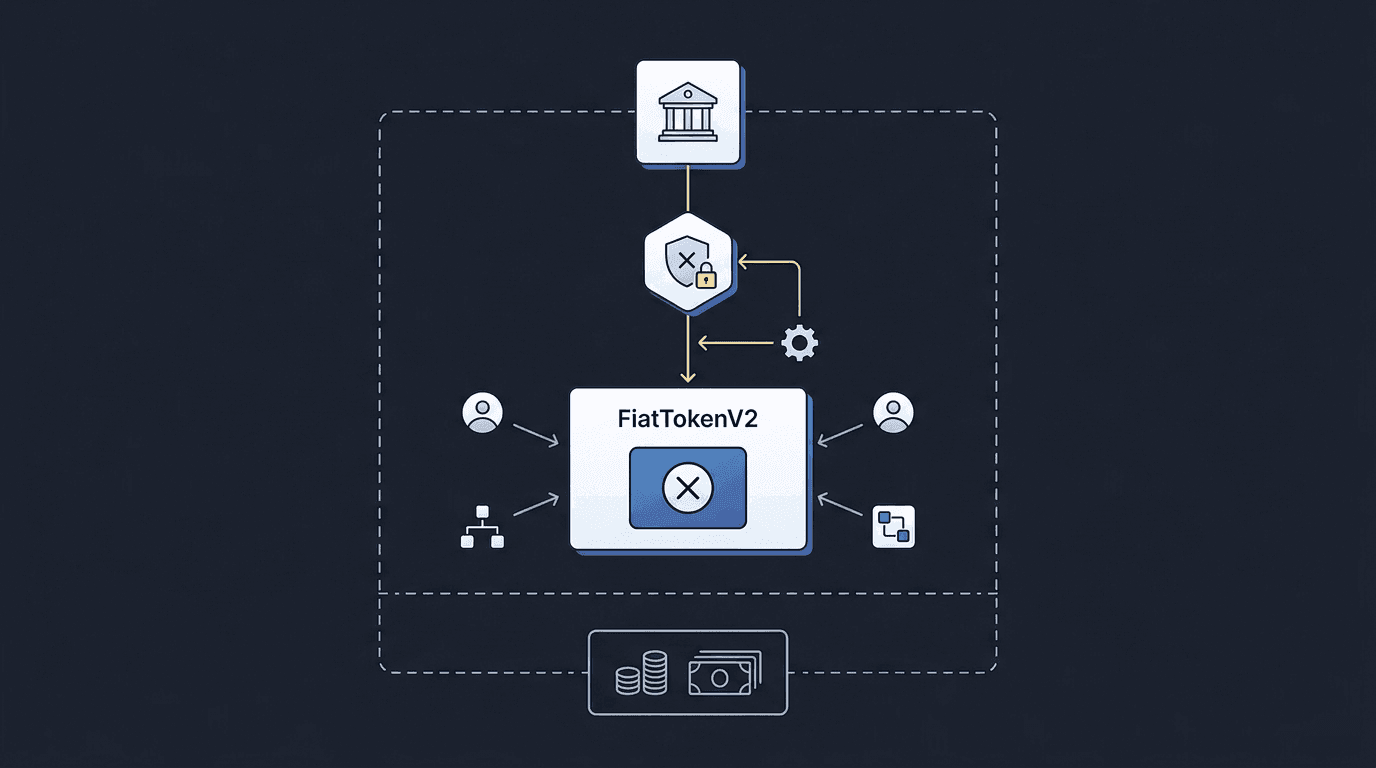
USDC is the second-largest stablecoin by market cap at approximately $78 billion and the dominant stablecoin in US-regulated contexts. It's issued by Circle Internet Financial, a US company regulated under state money transmission laws and the federal Bank Secrecy Act. Unlike Tether, Circle publishes monthly attestations of its reserves from Grant Thornton - cash and cash equivalents held in US regulated financial institutions.
The token itself is built on Circle's FiatTokenV2_2 contract, which inherits from a Blacklistable base contract. That base contract is the compliance layer. It defines a single blacklister address with full authority over freeze and unfreeze operations for the entire $78 billion supply.
The Freeze Mechanics
USDC's blacklist architecture is cleaner and more explicit than USDT's. The Circle GitHub repository contains the full implementation:
address public blacklister;

modifier onlyBlacklister() {
    require(msg.sender == blacklister, "Blacklistable: caller is not the blacklister");
    _;
}

function blacklist(address _account) external onlyBlacklister {
    _blacklist(_account);
    emit Blacklisted(_account);
}

function unBlacklist(address _account) external onlyBlacklister {
    _unBlacklist(_account);
    emit UnBlacklisted(_account);
}
Two things stand out here. First, the blacklister is a single address - no multi-sig requirement, no time-lock, no on-chain governance. Second, unBlacklist exists as a first-class function. That matters because of what USDC does NOT do - unlike USDT's destroyBlackFunds, USDC doesn't burn the balance. Frozen USDC stays in the wallet, inert. The transfer modifier enforces the freeze:
modifier notBlacklisted(address _account) {
    require(!_isBlacklisted(_account), "Blacklistable: account is blacklisted");
    _;
}
This modifier applies to both sender and recipient on every transfer. Blacklisted addresses can receive but cannot send. Their funds exist on-chain, visible, but immovable - until Circle decides to unfreeze them. There's no timeline for that decision. No published SLA. No due process.
The first USDC blacklist transaction - a 100,000 USDC freeze in 2020 (CoinGeek) - set the precedent. You can track current USDC freezes in real time at bl.dzen.ws.
Why USDC Gets Used
Describing USDC only through its freeze mechanics would be unfair. USDC has genuine advantages that explain its dominance in specific contexts.
USDC is the stablecoin of choice for US-regulated entities. Coinbase integrates it natively. Major DeFi protocols - Aave, Compound, Uniswap - hold billions in USDC liquidity. Its reserve structure is more transparent than Tether's, its issuer is a known US entity, and its regulatory posture makes it compatible with compliance-sensitive institutions. For a US bank, a licensed payment processor, or a corporate treasury with legal obligations, USDC's regulatory clarity is a genuine advantage, not just window dressing.
The GENIUS Act framework (Latham & Watkins) explicitly requires issuers to have the ability to "seize, freeze, burn, or prevent transfer" of tokens. USDC has all of that. It's the natural fit for "permitted payment stablecoin" status, and Circle has been positioning for exactly that outcome.
Is that a good thing? That depends on where you sit. For a compliance officer at a bank, absolutely. For someone whose legitimate wallet got flagged by a broken heuristic, considerably less so.
The Discretion Problem

The Allaire statement from April 2026 was meant to reassure people. Circle won't freeze your USDC unilaterally during a hack. It will only act on court orders or law enforcement direction. That's a more restrained policy than Tether exercises.
But look at what it actually establishes. There is no published standard for when freezes happen. No criteria for what constitutes sufficient law enforcement direction. No minimum evidence threshold. No timeline commitment. No appeal process if your wallet is frozen by mistake. No compensation for false positives. Just one person's ongoing judgment about when to act and when not to.
The $420M Argument
ZachXBT's claim - cited in the CoinDesk piece on the Drift hack - is that Circle's policy of waiting for legal process has allowed $420 million or more in illicit USDC to move freely since 2022. From this view, Circle isn't using its power aggressively enough. Hackers benefit from Circle's restraint.
This is a coherent argument. When a hack is happening in real time, a rapid freeze could preserve user funds. Circle has the technical capability. The argument is that the restraint is a policy choice, not a technical limitation - and that it has costs.
The DFINITY False Positive
The counter-argument arrives from the other direction. Weeks before the Drift hack, in a March 2026 civil-dispute freeze (MEXC), Circle froze a set of legitimate wallets - including the ckETH Minter, a DFINITY protocol infrastructure address that has no connection to any hack or illicit activity. CryptoSlate covered the incident in detail.
The ckETH Minter isn't a person. It's a smart contract operated by DFINITY that moves ETH cross-chain. It can't explain itself to Circle. It can't submit identity documents or prove funds provenance. It just... stops working. Any user relying on that infrastructure loses access to their assets while Circle's freeze is in effect.
That's the false positive problem. When your compliance tooling is a single address with unilateral freeze authority and no feedback loop, collateral damage happens. And there's no published process to correct it quickly.
The Structural Issue
Both of these stories - the $420M escape and the ckETH Minter freeze - are symptoms of the same root cause. Circle's compliance model is discretionary, not rules-based. It depends on human judgment applied inconsistently, under time pressure, with imperfect information, and with no published criteria for what triggers action.
What would a rules-based alternative look like? A smart contract either has a freeze function or it doesn't. There's no judgment call in the code. If the rule is "freeze wallets on the OFAC SDN list," a contract can enforce that deterministically and transparently, the same for every address, every time, without a phone call to a CEO.
Neither USDC nor a fully permissionless token does this. USDC gives the power to one person. A fully permissionless token gives no one the power. Whether there's a middle ground - where the token stays permissionless but a separate privacy pool layer enforces compliance through cryptographic proofs - is what the ASP model is designed to explore.
UPD: How It Works
UPD is an over-collateralized stablecoin currently on Sepolia, pre-audit, with mainnet launch planned. That framing matters: it's not a USDC replacement today. It's an architectural alternative designed for a different tier of the market.
Here's the design.
UPD mints tokens against on-chain crypto collateral - stETH specifically - at a ratio where collateral value exceeds token supply. stETH is itself non-freezable, making it a natural fit for a non-freezable stablecoin. The liquid staking yield from stETH flows through the system, giving the protocol a revenue source independent of transaction fees. There is no central issuer, no off-chain reserves, and no redemption desk. The peg holds through collateral ratios, automated liquidations, and oracle design.
The token contract contains no blacklist function, no freeze function, no pause function, and no admin key with authority over balances. There is no blacklister address to configure. No single call can freeze your funds.
No Compliance at the Token Layer
UPD has no compliance mechanism attached to it at all. No freeze, no blacklist, no restrictions on who can send or receive. It behaves like raw ETH - anyone can hold it, transfer it, or use it, and no single entity controls the flow.
On a public ledger, that's straightforward from a compliance perspective. You can follow the trail. Every transaction is visible, every address is traceable, and standard blockchain analytics tools work the same way they do for ETH or any other permissionless token.
The privacy pool is a different story. When you move funds into a system designed to provide privacy guarantees, the on-chain trail becomes less obvious. That's where the Association Set Provider (ASP) model comes in - covered in detail in ASP vs Proof of Innocence. The privacy pool requires participants to prove that their funds don't originate from illicit sources before entering. That compliance framework belongs to the pool, not to UPD itself. The token is permissionless. The pool has its own access rules.
The Regulatory Position
UPD doesn't just lack a freeze function. It lacks an issuer entirely. Users mint their own UPD by depositing collateral into the protocol's smart contracts. No company distributes the tokens. The user is their own minter.
The GENIUS Act regulates stablecoin issuers and requires them to freeze on demand. MiCA requires the issuer to be a licensed EU entity. When the user is the minter, neither framework applies in the traditional sense. UPD isn't a "permitted payment stablecoin" - it's an accounting token. The regulatory category it doesn't fit assumes an issuer exists, and one doesn't.
What does that mean in practice? A business holding UPD would likely classify it as a crypto asset on their balance sheet rather than a cash equivalent - a different line item, different impairment rules, but no restriction on using it. You can still receive it, send it, settle invoices with it, hold it as treasury, and use it as collateral. The accounting treatment differs. The utility doesn't.
Head-to-Head Comparison
| Dimension | USDC | UPD |
|---|---|---|
| Market cap | ~$78B | Pre-launch (Sepolia) |
| Collateral model | Fiat off-chain (cash, T-bills, US regulated banks) | Crypto on-chain (stETH - non-freezable, yield-bearing) |
| Freeze capability | Yes - blacklist() freezes transfers | None |
| Admin key | Single blacklister address, no multi-sig | No admin key |
| Blacklist behavior | Freeze in place (balance persists, transfers blocked) | No blacklist |
| Unfreeze capability | Yes - unBlacklist(), at Circle's discretion | N/A |
| Peg mechanism | Issuer redemption at par | Collateral ratios + liquidation |
| Liquidity | Deep - dominant in US-regulated venues | Pre-launch, mainnet planned |
| Regulatory status | GENIUS Act "permitted payment stablecoin" fit | Accounting token - user self-mints, no issuer to regulate |
| Transparency | Monthly attestations (off-chain reserves) | Fully on-chain, auditable in real time |
| Counterparty risk | Single US issuer + bank counterparties | Smart contract risk, pre-audit |
| Audit status | Independent audit published | Pre-audit, fully tested on Sepolia |
| DeFi composability | Good, with freeze risk for protocol collateral | No freeze risk, pre-launch |
| Capital efficiency | 1:1 (fiat-backed) | Over-collateralized (capital inefficient) |
| Compliance model | Token-layer blacklist (single key, discretionary) | None at token layer - privacy pool has separate ASP compliance |
| False positive risk | Documented - ckETH Minter incident (2026) | No freeze mechanism to trigger false positives |
The Trade-Offs
Regulatory Clarity vs Discretionary Control
USDC's regulatory alignment is a genuine advantage for a specific class of users. Payment processors, custodians, licensed exchanges, and corporate treasuries operating under US or EU law need an instrument that regulators can identify and enforce against. USDC fits that need cleanly. Its issuer is identifiable, its reserve model is attested, and its token has freeze capability that satisfies the GENIUS Act's requirements.
The cost of that regulatory clarity is the discretion problem. The same mechanism that makes USDC acceptable to regulators - a single authorized party with unilateral freeze power - is the mechanism that created the ckETH Minter incident and the $420M delayed-action controversy. You can't have regulatory compliance without assigning authority to someone. And once you assign it, you've created a discretionary power. How carefully that power is used is a governance question, not a technical one.
UPD takes a different path. It doesn't qualify as a "permitted payment stablecoin" under GENIUS or an EMT under MiCA - but that's a regulatory classification, not a usability limitation. A business holding UPD treats it as a crypto asset on its balance sheet rather than a cash equivalent. Different accounting line item, different impairment rules. But the token itself works the same way: you can hold it, transfer it, settle with it, use it as collateral. The absence of an issuer means no one can freeze your balance - which for many businesses is a feature that outweighs the accounting distinction.
Does the concentration of freeze power in one address, with no multi-sig and no time-lock, concern you? That's the question every institution holding USDC at scale should be answering.
Frozen but Not Burned: A Key Difference from USDT
This distinction matters for anyone evaluating stablecoin freeze risk across issuers. When USDT freezes a wallet, Tether's destroyBlackFunds function can burn the balance entirely - zeroing it and removing it from total supply. $4.2 billion has been eliminated this way (Reuters).
USDC's model is different. Blacklisted USDC stays in the wallet. It's visible on-chain. The balance hasn't been destroyed. Circle can unfreeze it. That means frozen USDC represents a limbo state: assets exist technically but are operationally unusable for however long Circle takes to resolve the case. For a DeFi protocol whose collateral includes frozen USDC, that limbo is a protocol-level problem. The liquidation engine can't move those tokens. The math breaks.
Smart Contract Risk vs Issuer Risk
What does counterparty risk actually mean for each design?
USDC's counterparty risk runs through Circle and its banking partners. A regulatory action against Circle, a bank failure holding USDC reserves, or a policy shift at the executive level all affect your ability to use or redeem your tokens. The $3.2 billion in AML fines issued in 2024 alone (Consilient) illustrates how aggressively regulators are moving in this space. Circle is not immune to that pressure.
UPD's counterparty risk is smart contract risk. The protocol is pre-audit. Bugs in the collateral manager, oracle manipulation during a market stress event, or a liquidation failure under extreme volatility could all cause peg instability or user losses. DAI, the closest comparable over-collateralized design, required emergency governance action during the March 2020 ETH crash. That's not hypothetical. It happened.
Neither risk profile is obviously safer. They're structurally different risks suited to different user types.
DeFi Protocol Composability
Corporate digital asset treasury flows now exceed $100 billion on-chain (Chainlink, 2025). 43% of hedge funds plan DeFi integration (CryptoSlate). As institutions build on-chain infrastructure, the question of stablecoin freeze risk inside protocols becomes less abstract.
When USDC is used as collateral inside a lending protocol or liquidity pool, the protocol inherits Circle's freeze risk. If Circle blacklists a wallet mid-liquidation, the liquidation engine may be unable to complete. The protocol's safety model assumed it could move the collateral - and it can't. That's not a theoretical edge case. It's a composability risk that every DeFi protocol holding USDC collateral should document in its risk disclosures.
A non-freezable collateral asset doesn't have this problem. The trade-off is that it may not be acceptable to institutions requiring freeze capability in their stablecoin holdings.
Use-Case Recommendations
When USDC Makes Sense
- US-regulated payment flows. USDC is the correct instrument for payment processors, custodians, and licensed exchanges that need a stablecoin whose issuer can respond to legal orders. The regulatory clarity is a feature, not a concession.
- Institutional treasury on regulated venues. For firms with compliance obligations that require holding a known, audited, issuer-backed stablecoin, USDC's reserve model and regulatory posture are genuine advantages.
- Coinbase and Coinbase-integrated products. USDC is Coinbase's native stablecoin with deep product integration. For anything built in that ecosystem, USDC is the path of least resistance.
- Short-duration positions where freeze risk is low probability. If your holding period is hours to days, the statistical probability of your specific address being frozen is low. USDC's liquidity makes entry and exit simple.
When a Non-Freezable Design (Like UPD) Makes Sense
- Businesses that want sovereign control over their funds. Any company that doesn't want a third party to be able to freeze its operating capital unilaterally. UPD shows up as a crypto asset on the balance sheet rather than a cash equivalent - a different accounting line item, but functionally just as usable for treasury, settlement, and operations.
- Individuals who want certainty of access. If you hold UPD, no single phone call, compliance heuristic, or false positive can lock your balance. That's a stronger property guarantee than any issuer-controlled stablecoin offers.
- DeFi protocol collateral. Protocols that need stablecoin collateral that can't be frozen mid-liquidation have a structural reason to prefer designs without issuer-controlled blacklists. The composability risk described above is real.
- Long-duration on-chain treasury positions. Protocols or DAOs holding stablecoin reserves for months or years see freeze probability compound over time. Long durations also mean more exposure to Circle's policy evolution over time.
- Privacy-preserving infrastructure. Applications that need a stablecoin with no token-layer admin key - where a freeze could compromise the privacy architecture - need non-freezable designs. More on this in What Is a Non-Freezable Stablecoin?.
- Protocol infrastructure addresses. Smart contracts - like the ckETH Minter - can't submit KYC documents or respond to a freeze notice. Protocol infrastructure needs stablecoins that don't require human remediation to unfreeze.
Where UPD Stands Today
UPD is fully tested on Sepolia, pre-audit, with mainnet launch planned. It isn't a drop-in USDC replacement in any live operation today. The architecture is proven on testnet. Institutional deployment needs a completed audit and mainnet launch first.
The comparison here is architectural and forward-looking. The Two-Tier Stablecoin Market covers where each tier fits in a portfolio context.
Frequently Asked Questions
Can Circle freeze USDC without a court order?
Technically, yes. The blacklister address can call blacklist(address) with no multi-sig, no time-lock, and no governance vote. Circle's stated policy, confirmed by Allaire in April 2026, is to act on court orders or law enforcement direction - not unilaterally during hacks. But that's policy, not a technical constraint. The smart contract enforces no such restriction (CoinDesk, April 2026).
What happens to frozen USDC? Is it burned like USDT?
No. Frozen USDC stays in the wallet. The blacklist() function blocks transfers but doesn't destroy the balance. The tokens remain on-chain and visible. Circle can unfreeze them with unBlacklist(). This is a meaningful difference from USDT's destroyBlackFunds, which permanently zeros the balance. Frozen USDC is in limbo - technically present, operationally useless - until Circle acts.
Has Circle ever frozen legitimate wallets by mistake?
Yes. In March 2026, weeks before the Drift hack, Circle froze the ckETH Minter - a DFINITY protocol infrastructure address with no connection to any hack. The wallet is a smart contract. It can't submit identity verification or explain its funds provenance. The incident was documented by CryptoSlate and MEXC and illustrates the false positive risk of discretionary, single-key freeze mechanisms.
Is UPD actually non-freezable, or could an upgrade add a freeze function?
The current UPD token contract has no blacklist, pause, or admin key. Whether a future upgrade could add one depends on the deployment mechanism. An immutable contract with no proxy genuinely can't be changed. A contract behind an upgradeable proxy introduces upgrader key risk. This is the correct due-diligence question to ask about any non-freezable stablecoin claim - including UPD. The definitive answer is in the deployed contract architecture, not the documentation.
How does the privacy pool's ASP compliance differ from Circle's blacklist?
Circle's model assigns freeze authority to a single address at the token layer - one key controls whether your USDC can move. UPD itself has no compliance mechanism at all. It's like ETH: anyone can send or receive, no restrictions.
The compliance question arises at the privacy pool layer, which is a separate system. On a public ledger, you can follow the money trail directly. When a privacy pool obscures that trail, participants need another way to prove their funds aren't illicit - that's what the ASP model provides. Participants prove positive membership in a compliance-screened association set using a zero-knowledge proof before entering the pool. The compliance is deterministic, transparent, and the same for every participant. Whether it satisfies specific jurisdictional requirements is an open legal question. The key distinction: Circle's compliance is attached to the token. ASP compliance is attached to the privacy pool. ASP vs Proof of Innocence covers the technical details.
Conclusion
USDC and UPD aren't competing for the same position in the market. USDC is the dominant regulated stablecoin in the US - deeply integrated, transparently reserved, and designed for the compliance tier that requires issuer control over token transfers. That's a genuine strength for its intended use cases.
The discretion problem is structural. It's not about Allaire being good or bad at his job. It's about a system where the ability to freeze $78 billion in assets sits with a single key, operated by a single person, under no published criteria, with no appeals process, and no SLA for resolution. That power is exercised conservatively by current policy. But the policy is one person's ongoing decision, not a protocol rule.
UPD removes that discretion entirely. It doesn't qualify as a "permitted payment stablecoin" - it's an accounting token, classified differently on a balance sheet. But that classification difference doesn't make it less usable. A business or individual holding UPD can do everything they'd do with USDC - hold, transfer, settle, collateralize - with the added guarantee that no third party can freeze their balance. The accounting treatment is different. The practical utility is the same, or better.
For DeFi protocols where stablecoin collateral needs to be predictably moveable under all conditions, the choice is clear. For regulated payment processors that specifically need freeze capability as a licensing requirement, USDC is the right tool. For everyone in between - businesses, individuals, treasuries that want reliable access to their own funds - the accounting token model deserves serious consideration.
The posts below cover the adjacent pieces in more depth.
- USDT vs UPD - the same comparison for Tether, including the destroyBlackFunds mechanics
- What Is a Non-Freezable Stablecoin? - the full architecture breakdown
- Who Freezes Your Stablecoins? - the decision chain behind freeze events
- Can Stablecoins Be Frozen? - the Solidity mechanics across all major issuers
- Stablecoin Regulation 2026 - GENIUS Act and MiCA implications for each tier
- The Two-Tier Stablecoin Market - how regulated and non-freezable stablecoins coexist
- ASP vs Proof of Innocence - compliance without a freeze function, in detail
- Stablecoin Market Map 2026 - where USDC, UPD, and others sit architecturally
UPD is pre-audit and currently deployed on Sepolia. The comparison in this post is architectural and educational, not investment or legal advice.