
April 17, 2026 · Permissionless Technologies
PYUSD vs UPD: PayPal's Two-Transaction Wipe
Paxos minted 300 trillion PYUSD by accident in October 2025. The same contract gives one role the power to freeze and wipe any holder's balance in two calls.

On October 15, 2025, someone at Paxos made a mistake. A routine internal transfer went wrong, and the PYUSD contract minted approximately 300 trillion tokens - roughly 73,000 times the entire crypto market cap - in a single transaction. For about 20 minutes, the on-chain supply of PayPal's stablecoin read like a phone number (Yahoo Finance).
Paxos burned the excess within half an hour. Customer funds were fine. The peg held. Crisis averted.
But here's what that incident actually revealed. A single externally owned account at Paxos had the authority to mint 300 trillion dollars worth of tokens with no multisig, no sanity check, and no on-chain guardrail. The supplyController role just executed (Halborn).
That same contract - the one holding $4.1 billion of real user value (CoinMarketCap) - also gives a single role the power to freeze any address and wipe its balance to zero. Two transactions. No appeal. No governance vote. No time-lock.
This post walks through what that control architecture actually means for anyone holding or integrating PYUSD, and how it compares to a stablecoin design that removes the admin key entirely.
Key Takeaways
- PYUSD's
assetProtectionRolecan freeze any address and then wipe its entire balance - a two-step confiscation path controlled by Paxos with no multi-sig or time-lock. - In October 2025, Paxos accidentally minted ~300 trillion PYUSD, revealing that a single EOA controls unlimited supply operations with no on-chain safeguard (Yahoo Finance).
- Aave and other DeFi protocols froze PYUSD markets in response, showing how issuer-level incidents cascade into protocol-level disruption (Halborn).
- PYUSD sits at ~$4.1 billion market cap under NYDFS regulation - the compliance model is a feature for payment rails and a risk for DeFi collateral.
- UPD is a pre-audit, Sepolia-stage over-collateralized stablecoin with no freeze function, no admin key, and no issuer - an accounting token rather than a payment token, with a different balance sheet line but the same practical utility.
What Happened on October 15, 2025?
Paxos operates PYUSD through an upgradeable proxy contract on Ethereum at 0x6c3ea9036406852006290770BEdFcAbA0e23A0e8. The contract's supplyController role has unrestricted minting authority - no cap, no cooldown, no multisig requirement (build.pyusd).
During what Paxos later described as an internal transfer input error, that role minted approximately 300 trillion PYUSD in a single transaction. The on-chain total supply jumped to a number that didn't fit on most dashboard displays (Yahoo Finance, MEXC).
Paxos burned the excess within roughly 20 minutes and stated that customer assets and backing remained intact. The supply returned to its previous level.
But the damage wasn't financial. It was informational.
Aave immediately froze new PYUSD deposits as a precaution. Other DeFi protocols flagged PYUSD activity until the situation was clarified. Halborn, the security firm, published a post-incident analysis arguing that a single EOA with unlimited minting power represents a structural risk - and that better controls like multisig wallets, per-transaction caps, and sanity checks should be standard for any role with this authority (Halborn).
What does a 300-trillion-token accident have to do with freeze risk? Everything. The same contract architecture that allowed an unchecked mint also concentrates freeze and wipe authority in a single role. If the minting side has no guardrails, what makes you confident the enforcement side does?
What's Actually in the PYUSD Contract?
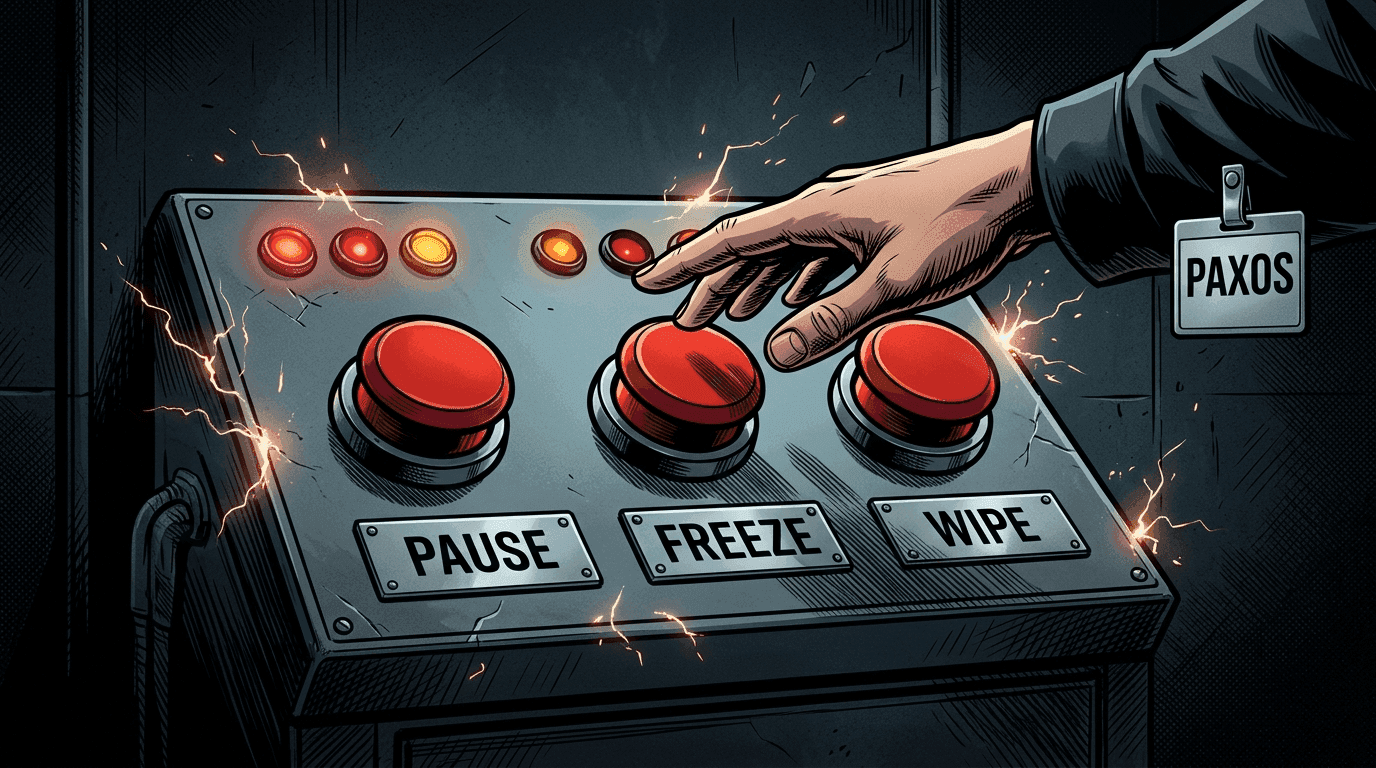
The PYUSD implementation uses Solidity 0.4.24 and is structurally very similar to Paxos' USDP contract. Several auditors have flagged the compiler version as a technical debt concern (James Bachini).
Three administrative roles define who controls what (build.pyusd, LlamaRisk):
owner: Can pause and unpause the entire token, halting all transfers for every address globally. Also reclaims PYUSD accidentally sent to the contract.assetProtectionRole: Can freeze and unfreeze specific addresses, and wipe the balance of any frozen address.supplyController: Can increase or decrease total supply by minting or burning to its own address - with no on-chain limit.
Here's the critical detail. Paxos' own documentation notes that the owner and assetProtectionRole are set to the same address (LlamaRisk). One entity controls both the global kill switch and the per-address enforcement path. Pause everything, or target a single wallet. Same key.
The enforcement functions from the open-sourced contract (GitHub):
function freeze(address _addr) external onlyAssetProtectionRole {
    frozen[_addr] = true;
    emit AddressFrozen(_addr);
}

function wipeFrozenAddress(address _addr) external onlyAssetProtectionRole {
    require(frozen[_addr], "address is not frozen");
    uint256 _balance = balances[_addr];
    balances[_addr] = 0;
    totalSupply_ = totalSupply_.sub(_balance);
    emit FrozenAddressWiped(_addr);
}
The transfer function also checks the frozen mapping for both sender and receiver, meaning a frozen address can't send or receive PYUSD until Paxos unfreezes it (CoinGape). This is functionally equivalent to USDT's blacklist, with the added ability to zero out balances entirely.
How Does the Two-Transaction Wipe Work?
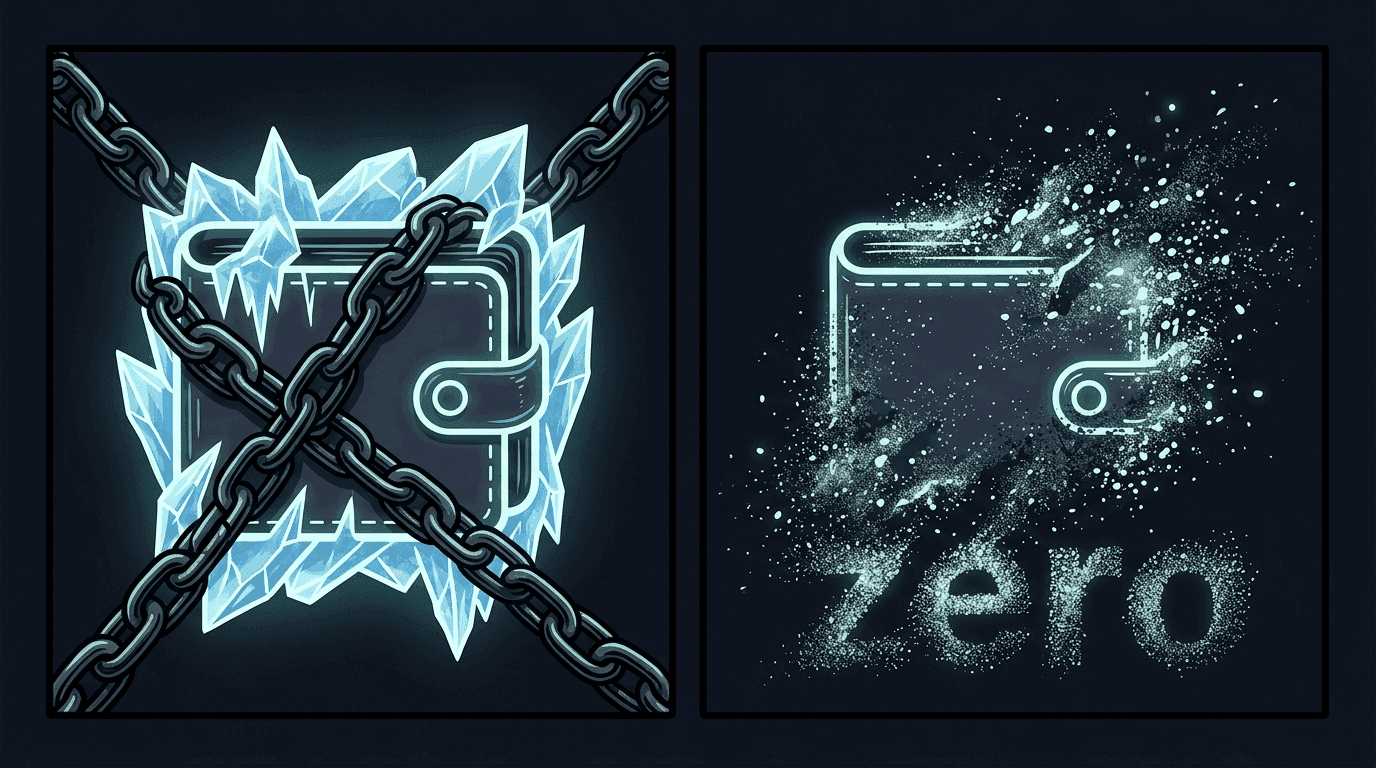
The sequence is deliberate. You can't wipe an address that isn't frozen first. That's a design choice - it forces a two-step process where immobilization precedes confiscation.
Transaction 1: Freeze. The assetProtectionRole calls freeze(targetAddress). The target's PYUSD becomes immovable. They can't send it. They can't receive more. Their balance still shows on-chain, but it's operationally dead.
Transaction 2: Wipe. The same role calls wipeFrozenAddress(targetAddress). The balance goes to zero. The totalSupply is reduced by that amount. The tokens don't move to Paxos or to a government seizure address. They stop existing.
From Paxos' perspective, this is an enforcement tool for court orders, sanctions, and fraud cases. The two-step design adds an intentional checkpoint - freeze first, investigate, then decide whether to wipe or unfreeze. Paxos has stated these powers would be used rarely and primarily in response to serious legal or security requirements (247 Wall St, CryptoRank).
But "rarely" isn't "never." And from the holder's side, the interim state - frozen but not yet wiped - is already a crisis.
Picture this. You're running a treasury operation. Your operating wallet holds $2 million in PYUSD for payroll and supplier settlements. On a Tuesday morning, that address gets frozen. Maybe it's a false positive. Maybe it's guilt by association with a counterparty three hops upstream. Maybe it's a sanctions screening flag that takes weeks to resolve.
You don't know yet. What you do know is that payroll is Friday, and your money doesn't move.
The wipe might never come. The freeze alone can be existential for a fast-moving operation. And unlike USDC - where Circle has a documented (if inconsistent) response process - PYUSD's freeze resolution path isn't widely documented for affected holders.
What Happens When Protocols React to Issuer Incidents?
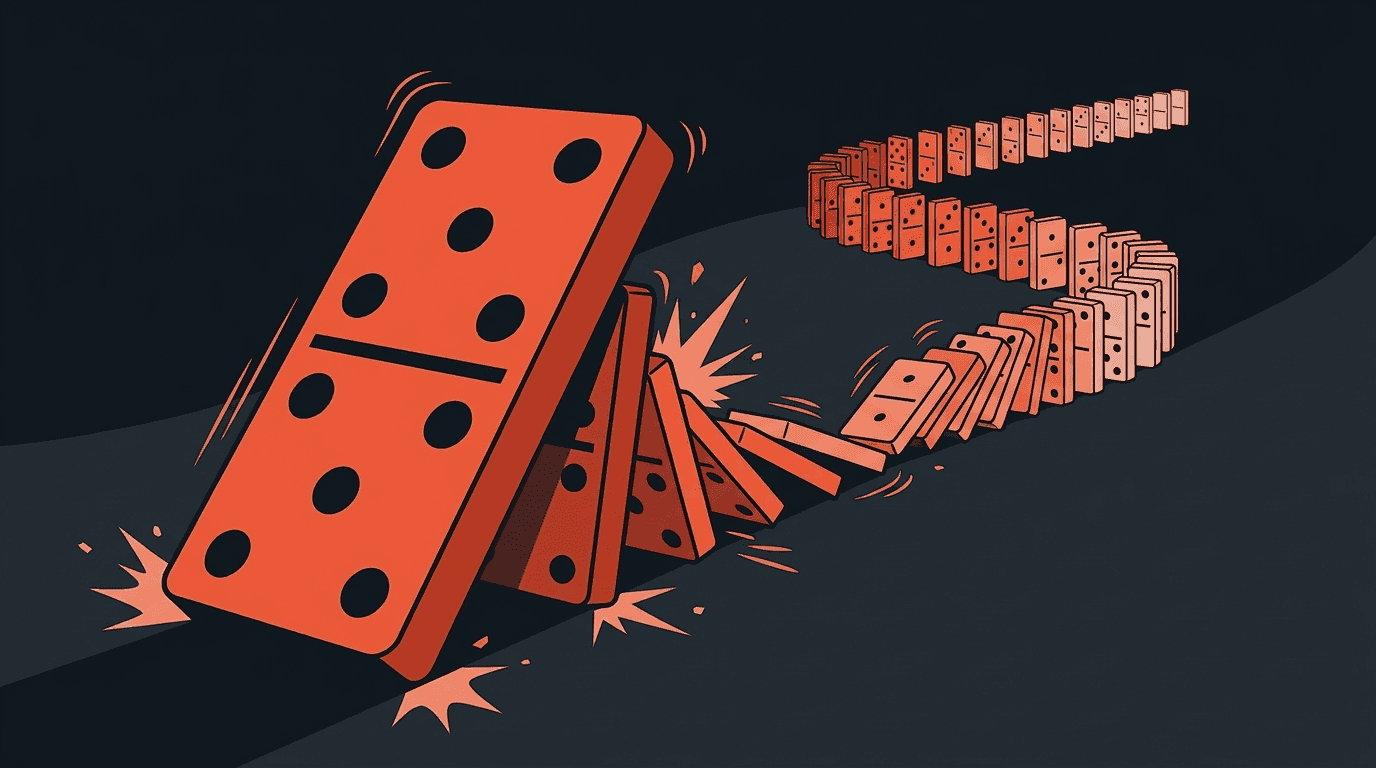
The 300-trillion mint wasn't a freeze event. But it triggered something arguably worse for DeFi composability: protocol-level defensive freezes by third parties.
When Aave froze new PYUSD deposits, that wasn't Paxos exercising its contract authority. That was an independent protocol's governance deciding that PYUSD's issuer-level risk profile had changed enough to warrant shutting down that market. Other DeFi platforms flagged PYUSD activity similarly until the situation was clarified (Halborn).
This creates a second-order freeze risk that most PYUSD holders don't consider. Even if Paxos never freezes YOUR address, if Paxos does something that makes DeFi protocols nervous - an accidental mint, a regulatory announcement, an unexpected global pause - those protocols may freeze PYUSD markets on their own.
If you're using PYUSD as collateral in a lending protocol and that protocol disables PYUSD deposits or liquidations during a crisis, your position is stuck. Not because Paxos targeted you, but because the market infrastructure around PYUSD reacted to issuer behavior. Your collateral didn't get frozen by the contract. It got frozen by the ecosystem.
What about direct freezes? Has Paxos actually used the assetProtectionRole on mainnet? On-chain evidence suggests yes. The contract emits AddressFrozen events, and Dune Analytics contributors have added PYUSD freeze events to stablecoin blacklist tracking datasets (Dune/GitHub).
But unlike USDT's $4.2 billion frozen across thousands of addresses, PYUSD's freeze history is thin on public documentation. There are no widely reported high-profile PYUSD freeze cases as of early 2026 (Xangle). Most commentary focuses on the capability rather than documented large-scale use.
That doesn't make the capability less real. It means the track record is still forming - and the contract is ready whenever the instruction arrives.
Why Does Anyone Hold $4 Billion of PYUSD?
Because the same centralization that creates freeze risk also creates exactly what regulators and compliance departments want.
PYUSD is issued by Paxos Trust Company, a New York limited-purpose trust company regulated by the New York State Department of Financial Services. Reserve attestations are published monthly under NYDFS-supervised standards. The backing is described as U.S. dollar deposits, short-term Treasuries, and cash equivalents (Coinbase, LlamaRisk).
That regulatory posture is exactly what the GENIUS Act rewards. The Act requires issuers to "seize, freeze, burn, or prevent transfer" on demand. PYUSD already does all four. It's a natural fit for the "permitted payment stablecoin" category that GENIUS creates.
Then there's distribution. PayPal has hundreds of millions of users. When PYUSD shows up in PayPal wallets, Venmo, and merchant checkout flows, it doesn't need to compete on DeFi TVL or DEX liquidity. It wins on familiarity and access. For payment teams, custodians, and legal departments, "it's the PayPal stablecoin regulated by NYDFS" is a sentence that ends due-diligence meetings early.
The compliance trade is straightforward: better policy fit for payment rails, less sovereignty at the holder level. For businesses operating in regulated corridors, that's a feature. But is it the right trade for every use case? For payment float in a PayPal-adjacent flow, probably yes. For DeFi collateral or long-duration reserves, the October 2025 incident should give any risk team pause.
How Does UPD Handle This Differently?
UPD is an over-collateralized stablecoin currently in tech-preview on Sepolia and pre-audit. The architecture takes a fundamentally different approach to every control mechanism in the PYUSD contract.
There is no owner role. No assetProtectionRole. No supplyController with unlimited minting authority. Users mint their own UPD by depositing collateral into the protocol's smart contracts. No company creates the tokens. No entity distributes them.
The token contract contains no freeze function, no wipeFrozenAddress, no pause, and no admin key with authority over balances. If you hold UPD, no single transaction can immobilize or zero your balance. There is no role to call.
Does that make UPD "safer" in every dimension? No. It changes the risk surface. You reduce issuer-level seizure risk and admin-key exposure to zero, but you take on smart contract risk, oracle risk, and collateral-volatility risk. The codebase is pre-audit. DAI, the closest comparable over-collateralized design, required emergency governance intervention during the March 2020 ETH crash. Protocol risk is different from issuer risk, but it isn't zero.
The regulatory position is also different. UPD has no issuer to regulate. Users self-mint by depositing collateral. That means it doesn't fit into the GENIUS Act or MiCA frameworks that regulate "issuers" of stablecoins. It isn't a "permitted payment stablecoin" - it's an accounting token. A business holding UPD would classify it as a crypto asset on the balance sheet rather than a cash equivalent. Different line item, different impairment rules. But functionally, it works the same way: hold, transfer, settle, collateralize. The accounting category differs from PYUSD. The utility doesn't.
UPD itself is fully permissionless - like ETH. No compliance mechanism is attached to the stablecoin at all. The compliance question arises in a separate product: the Universal Private Pool (UPP), a multi-ERC20 privacy pool where an ASP-based layer screens participants before entry. That framework belongs to the pool, not to UPD. ASP vs Proof of Innocence covers the privacy pool's architecture in detail.
Head-to-Head Comparison
| Dimension | PYUSD | UPD |
|---|---|---|
| Market cap | ~$4.1B (CoinMarketCap) | Pre-launch (Sepolia) |
| Issuer | Paxos Trust Company (NYDFS-regulated) | No issuer - users self-mint |
| Collateral model | Fiat-backed (USD deposits, Treasuries) | On-chain over-collateralized (crypto) |
| Compiler version | Solidity 0.4.24 (upgradeable proxy) | Modern Solidity |
| Token-level freeze | Yes - freeze() by assetProtectionRole | None |
| Token-level wipe | Yes - wipeFrozenAddress() after freeze | None |
| Global pause | Yes - owner can halt all transfers | None |
| Admin key concentration | owner + assetProtectionRole at same address | No admin key |
| Supply control | Single EOA, no on-chain cap | Collateral-ratio governed |
| Regulatory fit | GENIUS Act / MiCA payment stablecoin | Accounting token - outside issuer frameworks |
| Balance sheet treatment | Cash equivalent (fiat-backed) | Crypto asset (different line item, same utility) |
| DeFi composability risk | Collateral can be frozen by issuer or paused globally | No issuer-level freeze path |
| Reserve transparency | Monthly attestations (off-chain) | Fully on-chain, real-time auditable |
| Current maturity | Live, PayPal distribution | Pre-audit, testnet stage |
Which Risk Would You Rather Carry?
Compliance Readiness vs Treasury Sovereignty
PYUSD gives compliance departments a clean answer. There's an identifiable issuer, NYDFS oversight, monthly attestations, and explicit enforcement hooks. When regulators ask "who can stop illicit flow?", there's a one-sentence response.
But that answer is precisely what removes holder sovereignty. If your strategy depends on guarantees that no external party can freeze or wipe balances, PYUSD's design conflicts with that requirement by construction. The two-transaction wipe isn't a bug. It's the compliance model working as intended.
Distribution vs Control Surface
PayPal distribution matters. Brand familiarity, an existing user base of hundreds of millions, and a regulated posture justify PYUSD exposure for many businesses running payment flows and short-duration working balances.
But does distribution scale compensate for unilateral control risk in critical treasury paths? For payment float, probably. For core DeFi collateral or long-duration reserves, the October 2025 incident showed how quickly issuer-level events cascade into protocol-level disruption - even when no freeze function was directly involved.
Issuer Risk vs Smart Contract Risk
There is no risk-free stablecoin. PYUSD concentrates risk in an issuer, its regulatory mandates, and administrative authority held by a single entity under one jurisdiction. UPD concentrates risk in code, collateral dynamics, and mechanism design that hasn't yet undergone formal audit.
Which is preferable depends on your constraints, your time horizon, and which failure mode you can survive.
When to Use Each
When PYUSD Makes Sense
- Payment flows where compliance teams require an identifiable issuer with NYDFS regulation and explicit intervention capability.
- Treasury operations tied to PayPal distribution channels and regulated partner rails.
- Short-duration working balances where freeze risk is accepted as part of policy compliance.
- Contexts where "permitted payment stablecoin" classification is a licensing requirement under GENIUS or MiCA.
When a Non-Freezable Design Fits Better
- DeFi collateral positions where an issuer freeze or global pause could break liquidation logic.
- DAO and protocol treasuries that need guaranteed transferability without issuer-level override.
- Long-duration strategic holdings where admin-key exposure compounds over time.
- Privacy-preserving infrastructure where a token-layer freeze could compromise the architecture.
- Any operation where a $2 million payroll freeze on a Tuesday morning is an unacceptable scenario.
Frequently Asked Questions
Can PYUSD really zero a wallet balance?
Yes, through the two-step path: freeze() first, then wipeFrozenAddress(). The wipe sets the balance to zero and reduces total supply. Both functions are controlled by the assetProtectionRole, which Paxos holds. No governance vote, no time-lock, no multi-sig on-chain (GitHub).
How is the 300-trillion mint incident related to freeze risk?
The same contract architecture that allowed an unchecked 300-trillion-token mint also concentrates freeze and wipe authority in single administrative roles. Halborn's post-incident analysis specifically argued that better controls - multisig, per-transaction caps, sanity checks - are needed across all privileged roles, not just the supply controller (Halborn).
Has Paxos actually frozen PYUSD addresses on mainnet?
On-chain data shows at least one AddressFrozen event on the PYUSD contract, and Dune Analytics contributors have added PYUSD freeze events to stablecoin blacklist tracking (Dune/GitHub). But there are no widely reported high-profile PYUSD freeze cases as of early 2026, unlike the extensively documented histories of USDT and USDC.
Does UPD solve compliance requirements by itself?
No. UPD is permissionless - like ETH. No compliance mechanism is attached to the stablecoin. The compliance question applies to a separate product: the Universal Private Pool (UPP), a multi-ERC20 privacy pool with an ASP-based screening layer. That framework belongs to the pool, not to UPD. Whether the ASP model satisfies specific jurisdictional requirements is a legal question, not a technical one.
Which stablecoin should institutions choose?
It depends on mandate and risk tolerance. If you need issuer-led regulatory alignment and "permitted payment stablecoin" classification, PYUSD fits structurally. If you need token-layer censorship resistance and no admin-key seizure path, a non-freezable design is the structural match. Most serious institutional operators will use both categories, each in tightly scoped roles - The Two-Tier Stablecoin Market covers this framework in depth.
Conclusion
PYUSD isn't bad design. It's deliberate design for a compliance-first payment regime backed by one of the largest consumer finance brands in the world. The two-transaction wipe, the global pause, the concentrated admin roles - these are features of that regime, not bugs.
The October 2025 incident didn't break anything permanently. But it showed exactly how much unilateral power sits in the PYUSD contract, and how quickly the broader DeFi ecosystem reacts when that power surfaces unexpectedly. If you're holding or integrating PYUSD, the question isn't whether Paxos will use these capabilities on your address. It's whether your operation can survive the possibility - directly, or through the protocol infrastructure around you.
Stablecoin selection is control-plane design. Choose the failure mode you can survive.
- USDT vs UPD: $4.2 Billion Frozen - and Counting - blacklist plus burn at scale
- USDC vs UPD: One Man's Judgment Call - discretionary freeze governance
- Can Stablecoins Be Frozen? A Solidity-Level Forensic Guide - contract-level mechanics across major stables
- Stablecoin Regulation in 2026: GENIUS, MiCA, and the Global Freeze Mandate - policy context behind issuer controls
- The Two-Tier Stablecoin Market - how regulated and non-freezable stablecoins coexist
UPD is pre-audit and currently deployed on Sepolia. The comparison in this post is architectural and educational, not investment or legal advice.