
April 25, 2026 · Permissionless Technologies
Terra UST Post-Mortem vs UPD: What a $40 Billion Collapse Taught Us About Stablecoin Design
Terra erased $40-60B in four days, caused an Interpol Red Notice, and ended with a $4.47B SEC settlement. Here's what UPD is built to avoid.

March 23, 2023. Podgorica Airport, Montenegro. A man tries to board a flight to Dubai using a forged Costa Rican passport. In his luggage, investigators later find additional forged Belgian documents. Within minutes he's handcuffed. Within hours, news outlets on three continents lead with the same photograph. Six months earlier, an Interpol Red Notice had been issued for his arrest (Reuters coverage of Kwon arrest). The man is Do Kwon. Behind him, across the Pacific and through most of DeFi's balance sheet, sits the wreckage of $40 to $60 billion of crypto market value wiped out in four days (Harvard Anatomy of a Run).
This is the article in our comparison series where the comparison ends. Terra UST isn't a competitor to UPD in the sense that Liquity, GHO, crvUSD, and FRAX are. It's a falsified hypothesis: a specific claim about how to build a scalable decentralized dollar that arithmetic disproved in public over 96 hours in May 2022. Every decentralized stablecoin that ships in 2026, including UPD, is shaped by what happened to Terra. The architectural decisions we make are, in part, decisions about what not to repeat.
This post walks through what actually broke, who got hurt in the splash radius, what the pre-collapse warnings looked like (and how they were dismissed), and the design principles UPD inherits from the wreckage. We'll say where UPD's design is deliberately different from UST and where it's deliberately similar, honestly.
Key Takeaways
- UST used endogenous collateral: its redemption promise was backed by LUNA, a volatile governance token issued by the same system. When LUNA's market cap fell below UST's outstanding supply, the peg became mathematically indefensible (Anatomy of a Stablecoin Failure, Briola et al.).
- Anchor Protocol offered roughly 19-20% APY on UST deposits, subsidized from Terraform Labs reserves. At peak, estimates put 70-75% of circulating UST parked in Anchor, chasing yield rather than used in organic transactional demand (Richmond Fed "Why Stablecoins Fail").
- Contagion was severe and measurable. Three Arrows Capital defaulted on loans including $650-670M from Voyager Digital, which filed Chapter 11 in July 2022 citing "prolonged volatility and contagion" (Chicago Fed, "A Retrospective on the Crypto Runs of 2022"). Celsius, BlockFi, Genesis, and FTX followed over the next year.
- Do Kwon was arrested at Podgorica Airport on March 23, 2023 with a forged Costa Rican passport (Reuters). In 2024, a US jury found Terraform Labs and Kwon liable for fraud, leading to a $4.47 billion SEC settlement and the company's bankruptcy wind-down (SEC v. Terraform Labs).
- UPD rejects each of Terra's structural choices at the design level: exogenous stETH collateral instead of a self-referential token, no protocol-subsidized yield program, no founder-concentrated governance, a single contract (
StabilizerNFT) as the only minter, and no blacklist function on the token.
What Actually Broke Between May 9 and May 12, 2022?
Terra UST didn't fail in a single transaction. It failed in a four-day sequence where every attempted defense made the problem worse. Understanding the sequence matters because it's the falsified experiment that shaped modern decentralized stablecoin design.
May 7-8, 2022. Curve Finance is in the middle of migrating UST liquidity from a 3pool to a new 4pool. The migration temporarily thins UST's deepest on-chain liquidity venue. In that window, a sequence of large UST sells (on the order of hundreds of millions of USD) pushes UST off peg on Curve (Chainalysis reconstruction). Arbitrage should have closed the gap. In calm markets, it had, many times.
May 9-10, 2022. UST slides to around $0.98, then $0.92. Anchor Protocol, which was holding the majority of circulating UST, starts seeing mass withdrawals. Depositors who had been earning 19-20% APY on "stable" principal panic when the principal stops being stable. Over a 36-hour window, billions of UST flow out of Anchor into sell orders on centralized exchanges and on-chain pools.
May 10-11, 2022. Luna Foundation Guard (LFG) deploys its Bitcoin reserves, which by this point had been built up to tens of thousands of BTC intended to backstop the peg (Galaxy Digital post-mortem). The deployment hits a market where BTC itself is selling off. The reserves are simultaneously too small and too correlated with the thing they're supposed to hedge. Confidence erodes rather than stabilizes.
May 11-12, 2022. The death spiral engages. LUNA supply explodes from roughly 345 million tokens to over 6.5 trillion within 72 hours (Briola et al.). LUNA price collapses from around $60 pre-crisis to fractions of a cent. Once LUNA's fully diluted value sits below UST's outstanding supply, the 1:1 redemption promise becomes arithmetically impossible to honor. The peg is gone. So is LUNA.
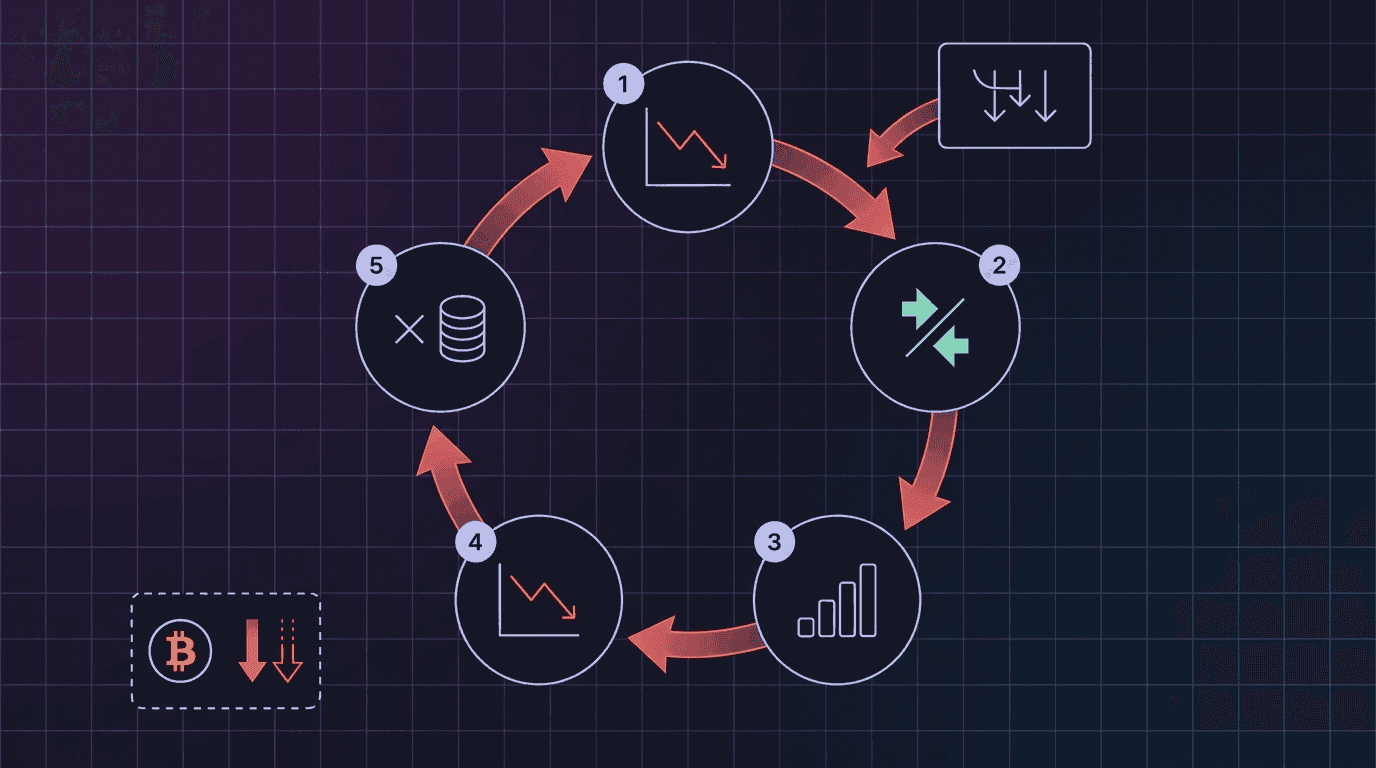
The Mechanism in One Paragraph
Terra's protocol let anyone swap 1 UST for $1 worth of freshly minted LUNA at an oracle price, regardless of UST's market price. When UST traded below $1, this was supposed to be profitable arbitrage that burned UST and stabilized the peg. Which it was, until LUNA itself started falling. Once LUNA was falling, every redemption minted more LUNA at a lower price, which pushed LUNA further down, which meant the next redemption minted even more LUNA at an even lower price (Richmond Fed). A feedback loop that stabilized UST in calm conditions accelerated its collapse under stress. That's the design flaw. It wasn't hidden. It was just dismissed.
What Did UST's Design Actually Promise?
Terra called UST "decentralized money" and marketed it as a scalable alternative to fiat-collateralized stablecoins like USDC and USDT. The pitch had two parts.
Part one: capital efficiency. UST didn't require a dollar of reserves for each UST minted. Instead, the backing was LUNA, which the market valued based partly on expected future seigniorage from UST's growth. If UST grew, LUNA captured value. If LUNA appreciated, UST's backstop strengthened. In steady state, this was more capital-efficient than DAI's 150% collateral ratio or USDC's 1:1 fiat backing.
Part two: arbitrage-driven stability. As long as there was a profitable arbitrage opportunity when UST traded away from $1, rational traders would close the gap. The Terra whitepapers and public communications leaned heavily on this claim. The implicit assumption: arbitrageurs would always show up, and the peg mechanism would always be credible.
Both claims were true in calm markets. Both claims broke when LUNA's price trajectory itself became the variable arbitrageurs were reading. The design worked until it was the design that was being attacked.
Why This Matters for UPD
UPD's collateral is exogenous. Stabilizers deposit stETH, a Lido-issued liquid staking token backed by real ETH staked on the Beacon Chain. stETH's value does not derive from UPD's adoption, from UPD's market cap, or from anything UPD does. If UPD fails tomorrow, stETH is still stETH. If UPD succeeds, stETH is still stETH.
That's not a clever property. It's the minimum requirement for a decentralized dollar that's supposed to hold its peg under stress. Terra failed to meet it. Every stablecoin we've compared in this series that meets it (Liquity's LUSD against ETH, crvUSD against wstETH and friends, UPD against stETH) has survived stress events that Terra's design could not. The lesson is boring. It was also not free.
The Anchor Problem: When "Yield" Is Subsidy Dressed in Spreadsheets
Here's the part of the Terra story that gets undersold, because it's less dramatic than the death spiral. Anchor Protocol offered 19-20% APY on UST deposits (Richmond Fed). That yield wasn't coming from borrower demand. It wasn't coming from real-world cash flows. It was coming from Terraform Labs and LFG subsidies designed to drive UST adoption.
At peak, estimates put 70-75% of all circulating UST deposited in Anchor, chasing that yield (Briola et al.). Which means UST's "demand" was overwhelmingly yield-seeking capital, not transactional capital. The moment the yield stopped being credible, or the peg started wobbling enough that principal risk outweighed the yield, that capital would leave in unison.
That's what the first 36 hours of May 9-10 2022 actually were. Anchor depositors withdrew billions of UST. The outflows hit the Curve 4pool, which was already thin. The peg cracked. The rest followed arithmetically.
The Translation to Modern Stablecoins
When a stablecoin protocol advertises "yield" that's meaningfully above the risk-free rate, ask what's paying for it. If the answer is "protocol subsidies" or "token emissions" or "foundation reserves," the yield is synthetic. It can stop. And when it stops, the deposits that were there for the yield leave together.
UPD doesn't run a yield program. Stabilizers earn whatever Lido pays on stETH (recent 2.8-3.5% APR range from Beacon Chain rewards), routed directly through the rebasing mechanism. That yield comes from actual ETH staking validators performing actual work. It isn't subsidy, it isn't a promise, and it won't suddenly stop if protocol revenues dip. The consequence is that UPD is not a high-yield product. That's by design.
Who Got Hurt Beyond UST Holders?
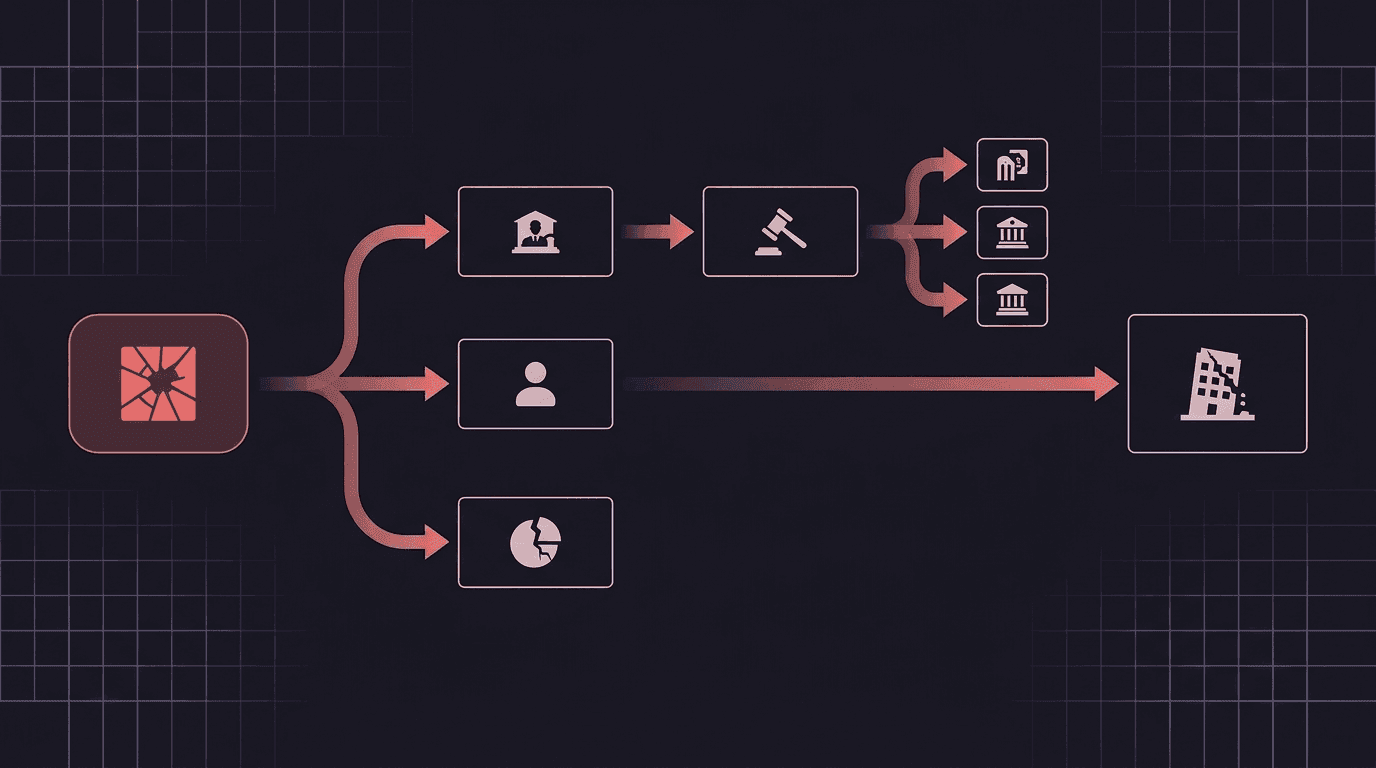
Terra's collapse wasn't contained to UST holders. The balance-sheet contagion was documented in real time and has since been formalized in Federal Reserve and Chicago Fed papers.
Three Arrows Capital was a Singapore-based hedge fund with substantial leveraged exposure to LUNA and UST, including large Anchor positions and directional LUNA bets. When Terra collapsed, 3AC's losses are reported in the hundreds of millions, and within weeks 3AC defaulted on loans from multiple counterparties (Chicago Fed retrospective).
Voyager Digital filed Chapter 11 in July 2022, citing a default of over $650 million by Three Arrows Capital as a proximate cause (Voyager bankruptcy filing). Voyager depositors lost access to hundreds of millions in assets, much of which was later recovered only partially through the bankruptcy process.
Celsius Network, BlockFi, and Genesis Asia Pacific each had indirect exposure through lending to hedge funds that had Terra exposure, or through collateral rehypothecation schemes that assumed stablecoin collateral wouldn't suddenly revalue. All three filed for bankruptcy or experienced severe distress within six months of the Terra collapse.
FTX and Alameda Research collapsed in November 2022. The causal chain is more contested than the others, but multiple analyses argue that Terra's collapse accelerated the leverage unwind that eventually exposed Alameda's balance-sheet hole (NBER contagion paper). The subsequent criminal prosecution of Sam Bankman-Fried is partly a story about what Terra's collapse surfaced.
Direct vs Indirect Contagion
Academic work on stablecoin contagion distinguishes two channels (Briola et al. arXiv 2022):
- Direct contagion via balance-sheet exposure: 3AC held UST and LUNA; Voyager lent to 3AC; Celsius borrowed from Voyager. Losses propagated through explicit obligations.
- Indirect contagion via risk-perception spillover: investors who didn't hold UST still reduced exposure to other stablecoins because Terra's failure made the stablecoin asset class itself feel riskier.
Both channels are real. Both are measured in the academic literature. The lesson for anyone building a decentralized stablecoin: your design decisions affect not just your token holders but the broader market's confidence in the category. Ship something that fails, and you harm peers who had nothing to do with your design.
The Warnings Were Public. They Were Mocked.
The Terra story includes a documented record of sophisticated critics who flagged the design flaw before the collapse. Frances Coppola, a British economist who writes on monetary systems, argued publicly that UST's mechanism resembled an equity-linked pyramid that would fail under stress (Coppola commentary). Other economists made similar points. None of the critiques required insider information. The math was visible from the whitepaper.
Do Kwon's response was a series of now-famous tweets:
- "I don't debate the poor on Twitter."
- "Have fun staying poor."
- "Your size is not size."
Months before UST collapsed, Kwon posted that he expected 95% of crypto projects to fail and that watching them fail would be "entertaining" (Briola et al.). Terra was in the 95%.
In a later interview with Laura Shin (after the collapse), Kwon described his pre-collapse persona as "cringe" and said it was partly for "entertainment value" (Unchained interview, Shin). The reframe didn't land well with the South Korean retail investors, reported in the hundreds of thousands, who had put savings into UST and Anchor on the strength of the stability marketing.
The Structural Lesson
"Charismatic founder who dismisses critics" is not a technical design choice. It doesn't appear in the whitepaper. But it's a warning sign that has now appeared, in retrospect, in several of the largest crypto failures. The Terra case is the clearest example because the criticism was mathematical, specific, and public, and the response was personal insults.
When UPD gets critiqued (and it will), the correct response is technical engagement. The wrong response is arrogance dressed as swagger. We say this here because the pattern matters and because calling it out costs nothing.
The Legal Aftermath: Red Notice, Podgorica, $4.47 Billion
September 2022. South Korean authorities open investigations into Terraform Labs and Do Kwon. An arrest warrant is issued. Interpol publishes a Red Notice requesting Kwon's detention in any member country (Reuters Red Notice coverage).
March 23, 2023. Kwon and an associate are arrested at Podgorica Airport in Montenegro attempting to board a flight to Dubai using forged Costa Rican passports. Belgian documents, also forged, are found in their luggage. Montenegrin authorities seize laptops and phones. Both South Korea and the United States file extradition requests within days (Reuters Montenegro arrest).
A Montenegrin court sentences Kwon to four months for passport fraud. A higher court revokes his bail on flight-risk grounds. A series of competing rulings follows on whether he should be extradited to South Korea or to the United States; the Montenegrin Supreme Court at one point sends the case back down, noting that the justice minister holds final authority.
2024. The US Securities and Exchange Commission wins a civil fraud verdict against Terraform Labs and Do Kwon. Terraform agrees to a settlement on the order of $4.47 billion, including disgorgement and civil penalties, as part of a bankruptcy wind-down (SEC v. Terraform Labs press release). Montenegrin authorities approve extradition. Subsequent reporting through 2024-2025 indicates Kwon is ultimately extradited to the United States, where he pleads not guilty to criminal fraud charges in Manhattan federal court (US extradition coverage).
What This Establishes
The Terra case is now the legal precedent for treating misrepresented stablecoin schemes as securities fraud. That matters for every stablecoin project, including UPD. The specific behaviors the SEC pursued were:
- Marketing a token as "stable" while the mechanism relied on a volatile companion asset.
- Misrepresenting adoption, backing, and the nature of risk.
- Blending securities-like fundraising with stablecoin-like products.
None of the above describes UPD, and we'll keep it that way. "Pre-audit Sepolia testnet" is the current accurate statement, not "production-ready" or "battle-tested." The distinction isn't just rhetorical. It's part of not setting up the same enforcement pattern for ourselves.
How Is UPD's Design Structured to Avoid Terra's Failure Modes?
This section is the most important one in this post, and also the shortest, because the answer is unfortunately straightforward. Terra's design had four structural choices that interacted to produce the collapse. UPD rejects each.
1. Exogenous Collateral, Not a Companion Token
Terra backed UST with LUNA, a token issued by Terra itself. UPD is backed by stETH, a Lido-issued liquid staking token of ETH. When ETH is staked on the Beacon Chain, validators produce rewards regardless of what UPD does. The collateral's value source is independent of the stablecoin's adoption. This was the single biggest lesson from Terra, and it's table stakes for any decentralized stablecoin shipping after May 2022.
2. No Protocol-Subsidized Yield Program
Anchor paid 19-20% APY on UST from foundation subsidies. UPD has no equivalent. Stabilizers earn Lido staking yield directly via stETH rebasing (recent 2.8-3.5% APR). Minters don't earn yield; they hold a dollar-denominated asset. No foundation runs a deposit program at above-market rates. The consequence is that UPD's demand doesn't have a yield-chasing hot-money component that could exit in unison if subsidies stopped.
3. Per-Position Collateralization, Not System-Level Backstop
UST's peg was defended by the entire LUNA supply. When LUNA fell, the peg fell. UPD works position-by-position. Each position is backed by stabilizer-deposited stETH in a dedicated PositionEscrow. Under-collateralized positions liquidate individually, with an InsuranceEscrow covering shortfalls best-effort. There's no system-wide backstop token that has to retain value for the peg to hold. The worst-case isn't a death spiral; it's individual positions becoming underwater, which is a bounded event.
4. Narrow Admin Surface, Not Founder-Concentrated Governance
Terraform Labs and aligned whales effectively ran Terra governance despite formal on-chain voting structures. UPD's admin surface is narrower and explicitly disclosed: admin authority on the UpgradeableBeacon contracts for PositionEscrow and StabilizerEscrow, and UUPS authority on the PriceOracle. The UPDToken itself is not upgradeable, so balances can't be rewritten. The mitigation path is progressive: admin, then timelock, then governance. No single founder controls the monetary policy, because there is no monetary policy in the sense that Terra had one.
None of the above is clever. All of it is specifically, deliberately unlike Terra.
Head-to-Head Comparison
| Dimension | Terra UST (pre-collapse) | UPD |
|---|---|---|
| Peak / current market cap | ~$18-19B at peak (May 2022); USTC ~$10-30M (April 2026) | Pre-launch |
| Collateral type | Endogenous (LUNA companion token) | Exogenous (stETH liquid staking token) |
| Peg mechanism | Algorithmic mint/burn arbitrage against LUNA | Per-position stETH collateral with direct liquidation |
| Minimum collateral ratio | Not enforced at token level (LUNA market cap acted as implicit backstop) | 125% per-position floor; liquidation thresholds 125% down to 110% by NFT ID |
| Yield product | Anchor Protocol ~19-20% APY, subsidized | None; stabilizers earn Lido native rebasing (~2.8-3.5% APR) |
| Demand concentration | 70-75% of UST supply parked in Anchor at peak | Distributed across stabilizer queue; no single protocol concentration |
| Governance model | Terraform Labs-led; validator set coordinated; formal DAO with concentrated influence | Admin authority on escrow beacons and oracle; no DAO; no veToken |
| Token freeze / blacklist | None at token layer | None |
| Reserve disclosure | LFG BTC reserves publicly disclosed but insufficient in stress | On-chain OvercollateralizationReporter via stETH share accounting |
| Stress behavior | Death spiral: redemptions mint more LUNA, LUNA falls, more LUNA needed per redemption | Bounded: undercollateralized positions liquidate individually with InsuranceEscrow backstop |
| Contagion footprint | Direct losses at 3AC, Voyager, Celsius; indirect across DeFi | No live operation, no contagion exposure |
| Legal outcome | $4.47B SEC settlement; Do Kwon extradited, criminal fraud charges | No enforcement context |
What Three Design Principles Does UPD Take From the Terra Wreckage?
We'll restate these plainly because they're the architectural choices that matter most in 2026 and beyond.
Principle 1: Collateral must be independent of the stablecoin's success. If your backing asset's value depends on your stablecoin's adoption, stress events create feedback loops. Exogenous collateral breaks the loop.
Principle 2: Yield must come from real activity, not subsidy. Protocol-paid yield attracts capital that leaves together when the yield stops. Native-source yield (staking rewards, real interest, actual fees) attracts capital that sizes itself to the underlying activity.
Principle 3: Governance influence must be disclosed and bounded. "Decentralized in name, centralized in practice" is the pattern that shows up in every post-mortem. Being explicit about who can change what, and through what process, is both safer and more honest.
None of these principles are novel to UPD. They're the consensus that emerged after May 2022. What varies across modern stablecoins is how rigorously each principle is applied. Terra violated all three. UPD tries to satisfy all three within the scope of what's shippable on a real chain.
Frequently Asked Questions
Could a stablecoin with Terra's algorithmic design ever be made safe?
The academic consensus says no, not at scale (SSRN survey on algorithmic stablecoins). Endogenous-collateral designs require either enough exogenous reserves to cover realistic stress (at which point the algorithmic part becomes cosmetic), or a credible lender-of-last-resort, or they remain fragile by construction. Several small-scale experiments continue, but no serious post-2022 protocol launches a pure Terra-style algorithmic stablecoin as its primary product.
Didn't Anchor's yield work for years before it broke?
Yes, that's the hardest part of the lesson. Anchor paid 19-20% APY for a long time and many depositors made real money on it. "It works until it doesn't" is exactly what makes a Ponzi-adjacent design dangerous: the working phase reinforces confidence in the mechanism, which allows the design to scale, which makes the eventual failure larger and more destructive (Richmond Fed). If you see "it's been working for years" used as evidence of safety, ask what changed to make the mechanism arithmetically sound. If the answer is "nothing, demand just keeps growing," that's the warning sign.
What did LFG's BTC reserves actually accomplish?
Approximately nothing useful in the collapse itself. LFG had amassed tens of thousands of BTC in early 2022 intending to use them as peg-defense reserves (Galaxy Digital post-mortem). When the peg broke, LFG deployed the reserves into a market where BTC was itself selling off, and the reserves were insufficient relative to UST's outstanding supply. The reserves were consumed within days without meaningfully stabilizing UST. The lesson: pro-cyclical reserves held in correlated assets cannot backstop a correlated stress event. Exogenous reserves have to be either large relative to the stablecoin float or genuinely uncorrelated with the failure mode.
How is UPD different from every other stablecoin that "claims" to avoid Terra's mistakes?
UPD is not different in its avoidance of Terra's specific algorithmic trap. Nearly every serious stablecoin launched after 2022 learned that lesson. What distinguishes UPD from Liquity, crvUSD, GHO, FRAX, or Frax USD is the combination of specific architectural choices we've walked through in prior posts in this series: per-position direct liquidation instead of pooled Stability Pool or LLAMMA, stabilizer-minter role separation instead of CDP borrower-as-minter, narrow admin surface instead of DAO-governed parameter regimes, and integration into UPP for shielded transfers and ASP-compatible compliance. The difference with Terra isn't the comparison we're drawing. Every decentralized stablecoin in 2026 beats Terra. The difference with Liquity, GHO, and the others is the comparison that's worth drawing.
Did anyone predict Terra's collapse who wasn't named Frances Coppola?
Several did. The Briola et al. arXiv paper (arXiv 2207.13914) cites multiple pre-collapse critiques from academic and industry sources. Nansen, 0xHamz, and others had documented the thin Curve liquidity and Anchor concentration weeks before the collapse. The most famous case is Kevin Zhou of Galois Capital, who publicly predicted UST's collapse for months and shorted LUNA profitably (Galois Capital commentary, multiple sources). The "nobody saw it coming" narrative is false. What's true is that the mainstream crypto press and much of the DeFi ecosystem chose not to take the warnings seriously.
What's the best single source to read on Terra if I want to understand the mechanics?
Three recommendations. The Richmond Fed's "Why Stablecoins Fail" brief (link) is the clearest policy-oriented walkthrough. Briola et al., "Anatomy of a Stablecoin's Failure" (arXiv) is the most rigorous quantitative post-mortem with trade-by-trade reconstruction. The Chicago Fed's "A Retrospective on the Crypto Runs of 2022" (link) places Terra in the full 2022 sequence of crypto failures. Read any one; read all three if you're doing serious work on stablecoin design.
Is UPD immune to the kind of contagion Terra caused?
No, and nobody is. If UPD fails, the failure modes are different (per-position undercollateralization that runs into InsuranceEscrow exhaustion, or an oracle exploit, or a malicious upgrade through the admin beacon) but the second-order effects on market confidence in decentralized stablecoins would still exist. The practical answer to contagion risk is not "our design is immune" but "we're transparent about our failure modes, narrow in what we can break, and explicit about the current stage of maturity." We're at Sepolia testnet, pre-audit. That's the correct thing to say now and we intend to say similarly precise things after audit and mainnet.
Conclusion
Terra UST is the negative space around modern decentralized stablecoin design. Every architectural choice we make, in UPD and elsewhere, is made in partial response to what broke in May 2022. Endogenous collateral, unsustainable yield subsidies, concentrated demand, founder-dominated governance: each of those four choices was load-bearing in Terra's collapse, and each has been deliberately rejected by the serious stablecoin designs that followed.
That's not the entire story. You can fail a stablecoin in many ways that don't look anything like Terra. Collateral that depegs (stETH in March 2024, for 48 hours). Custodian banks that fail (SVB in March 2023). Oracle exploits. Governance capture. Enforcement action against a regulated issuer. The architecture you build against Terra may still break against something else. Humility is part of what "learned from Terra" means.
But within the specific failure mode Terra established, there's now a consensus. Decentralized dollars need exogenous collateral, sustainable yield mechanisms, distributed demand, and bounded governance. UPD is one design that tries to hit those marks. Liquity is another. crvUSD, GHO, Frax USD: each makes different trade-offs within the same constraints.
Pick the one that matches your risk profile. Don't pick anything that claims to have solved the scalability problem with a clever mechanism backed by its own token. That's the exact sentence Terra shipped. It didn't work. It's still not going to work.
- FRAX vs UPD: From Fractional-Algorithmic to Two Stablecoins in One Ecosystem - how FRAX survived 2022 and later bifurcated
- GHO vs UPD: Aave's DAO-Governed Stablecoin Meets a Permissionless One - facilitator-based DAO governance alternative
- crvUSD vs UPD: Curve's LLAMMA vs Pure Non-Freezability - post-Terra CDP design with soft liquidation
- Liquity (LUSD + BOLD) vs UPD: The Closest Competitor We Have - the immutability answer to Terra's governance problem
- USDD vs UPD: Why Over-Collateralization Alone Is Not Enough - Tron's post-Terra algorithmic attempt
- What Is a Non-Freezable Stablecoin? - pillar post on the core property
- Stablecoin Regulation in 2026: GENIUS, MiCA, and the Global Freeze Mandate - regulatory framework shaped partly by Terra's aftermath
UPD is pre-audit and deployed on Sepolia testnet at time of writing. This comparison is architectural and educational, not investment or legal advice.