
April 24, 2026 · Permissionless Technologies
FRAX vs UPD: From Fractional-Algorithmic to Two Stablecoins in One Ecosystem
FRAX split itself in two. Legacy stays DeFi-native with self-referential AMOs. frxUSD goes through a Delaware PBC to hold BlackRock BUIDL. UPD stays one thing.

March 11, 2023. Silicon Valley Bank fails on a Saturday. Circle confirms $3.3 billion of USDC reserves are stuck at the failed bank. USDC trades at $0.88 by Sunday morning. FRAX, whose backing at the time was heavily USDC routed through Curve and Fraxswap AMOs, falls in lockstep to about $0.96 (Forklog, Arctic Wallet). The chain-of-custody question stopped being abstract. FRAX's independence could not exceed USDC's, and USDC's could not exceed Silicon Valley Bank's.
Two years later, Frax's answer was not to fix the old stablecoin. It was to split into two.
Legacy Frax Dollar (FRAX, ~$274M circulating as of April 2026) keeps the AMO machinery, the USDC-and-crypto backing, the Curve-and-Fraxlend integrations, the Decentralization Ratio metric, the protocol revenue loops. Frax USD (frxUSD, ~$138M circulating), launched February 8, 2025, is a fully-collateralized fiat-redeemable payment stablecoin backed by BlackRock's BUIDL and Superstate's USTB tokens, held by enshrined custodians, routed through a Delaware public-benefit corporation called FinResPBC (now FRAX Inc.), and structured explicitly to meet the requirements of the GENIUS Act. Sam Kazemian, FRAX's founder, is widely reported to have helped draft that act (Bloomingbit, Edgen).
UPD is designed so it doesn't need the split. No AMOs. No custodians. No DeFi-versus-regulated fork of the same brand. One stablecoin, one backing model, one governance surface. This post walks through what FRAX chose to do, why the bifurcation was rational given the constraints, and what UPD's single-track design gives up and what it keeps.
Key Takeaways
- Frax ships two stablecoins from the same team. Legacy Frax Dollar retains AMO-driven monetary policy, partially self-referential collateral, and DeFi-native integrations. Frax USD (frxUSD) is a GENIUS-Act-structured payment stablecoin backed 1:1 by tokenized money-market and bond fund reserves held by enshrined custodians (FIP-430, Chaos Labs frxUSD review).
- Legacy FRAX's collateral is not what a casual reader would expect. LlamaRisk's August 2024 analysis found that FRAX was self-reporting roughly 95% collateralization, but over half of that reported collateral was FRAX itself inside AMO positions (LlamaRisk assessment). Decentralized, yes. Fully exogenously-backed, no.
- frxUSD is redeemable only through enshrined custodians. Minting 1 frxUSD requires depositing $1 of BUIDL, USTB, or an equivalent approved reserve token to a
frxUSDCustodiancontract. Users without KYC access to those reserve tokens exit via secondary markets (LlamaRisk frxUSD PegKeeper review, Chaos Labs). - FRAX governance runs through a dual-Governor system (FraxGovernorAlpha and FraxGovernorOmega) sitting atop Gnosis Safes. FraxGovernorOmega proposals can pass immediately via a 51% short-circuit threshold (Frax governance docs). That's faster than Aave's Stewards cadence and faster than most on-chain DAOs.
- UPD has one stablecoin, one collateral type (stETH held in
PositionEscrow), no AMOs, no enshrined custodian list, no off-chain public-benefit corporation, no dual-governor Safe module. TheUPDTokencontract grantsMINTER_ROLEandBURNER_ROLEexclusively toStabilizerNFT. No blacklist function exists.
What Actually Happened on March 11, 2023?
The SVB weekend is the most-cited single event in every post-2023 stablecoin design review, including FRAX's. It deserves a careful retelling because the lesson shaped what FRAX chose to become.
Circle banked USDC reserves at multiple U.S. institutions. About $3.3 billion of them sat at Silicon Valley Bank when the FDIC closed SVB on Friday, March 10, 2023. Jeremy Allaire confirmed the exposure on Saturday. USDC, a "fully-backed" stablecoin, briefly detached from its peg because the bank holding part of the backing had failed overnight. The token traded near $0.88 at its Sunday-morning low (Arctic Wallet, Ideas/RePEc study).
FRAX's design at that moment routed a large share of its backing through AMO-deployed USDC. Curve AMOs sat on USDC in FRAX3CRV. Lending AMOs held USDC in Aave and Compound. The math is brutal in retrospect: if half your backing is USDC and USDC is down 12%, you're down roughly 6% on your effective collateral. FRAX traded at about $0.96 during the incident (Forklog). DAI, with a similar dependency, followed the same path.
The Lesson FRAX Took From It
You cannot build a "decentralized" stablecoin on rails you don't control. FRAX had been gradually reducing USDC exposure before March 2023, but that weekend made the case urgent. FIP-188 and subsequent proposals pushed FRAX toward a 100% exogenous collateral target, with RWA-backed holdings via sFRAX meant to gradually replace USDC-backed liquidity (Frax V3 overview).
The problem is that "replace USDC with RWAs" means "replace one centralized counterparty with a different centralized counterparty." Tokenized Treasuries require a custodian bank. A Delaware public-benefit corporation. Regulated money-market funds. Which is how you end up with FinResPBC, Lead Bank, and eventually BUIDL and USTB sitting inside frxUSDCustodian contracts as the "decentralized" replacement for USDC.
UPD's response to the same problem is different. stETH is collateral that isn't routed through a bank and isn't a tokenized claim on a money-market fund. It's a Lido-issued staking derivative of ETH itself. The trade-off is narrow collateral (no multi-asset diversification) in exchange for a backing chain that doesn't terminate at a chartered bank or an MMF sponsor.
What Is Legacy Frax Dollar Today?
Legacy Frax Dollar is the original FRAX contract at 0x853d955aCEf822Db058eb8505911ED77F175b99e, deployed December 20, 2020 (Etherscan). It's an ERC-20 with OpenZeppelin AccessControl. It has no blacklist. Transfers are permissionless. That's the clean part.
The complicated part is how it enters and exits circulation. FRAX was the first widely-adopted fractional-algorithmic stablecoin. Minting required a combination of exogenous collateral and burning the FXS governance token, in proportions dictated by a global_collateral_ratio that the protocol adjusted over time in response to market price (Frax V1 docs). In 2021 the protocol generalized that idea into AMOs, Algorithmic Market Operations, which are smart-contract strategies that can mint FRAX or move collateral into external venues (Curve, Aave, Compound, Fraxlend, Fraxswap) within invariants the protocol enforces (Curve AMO docs).
The Self-Referential Problem
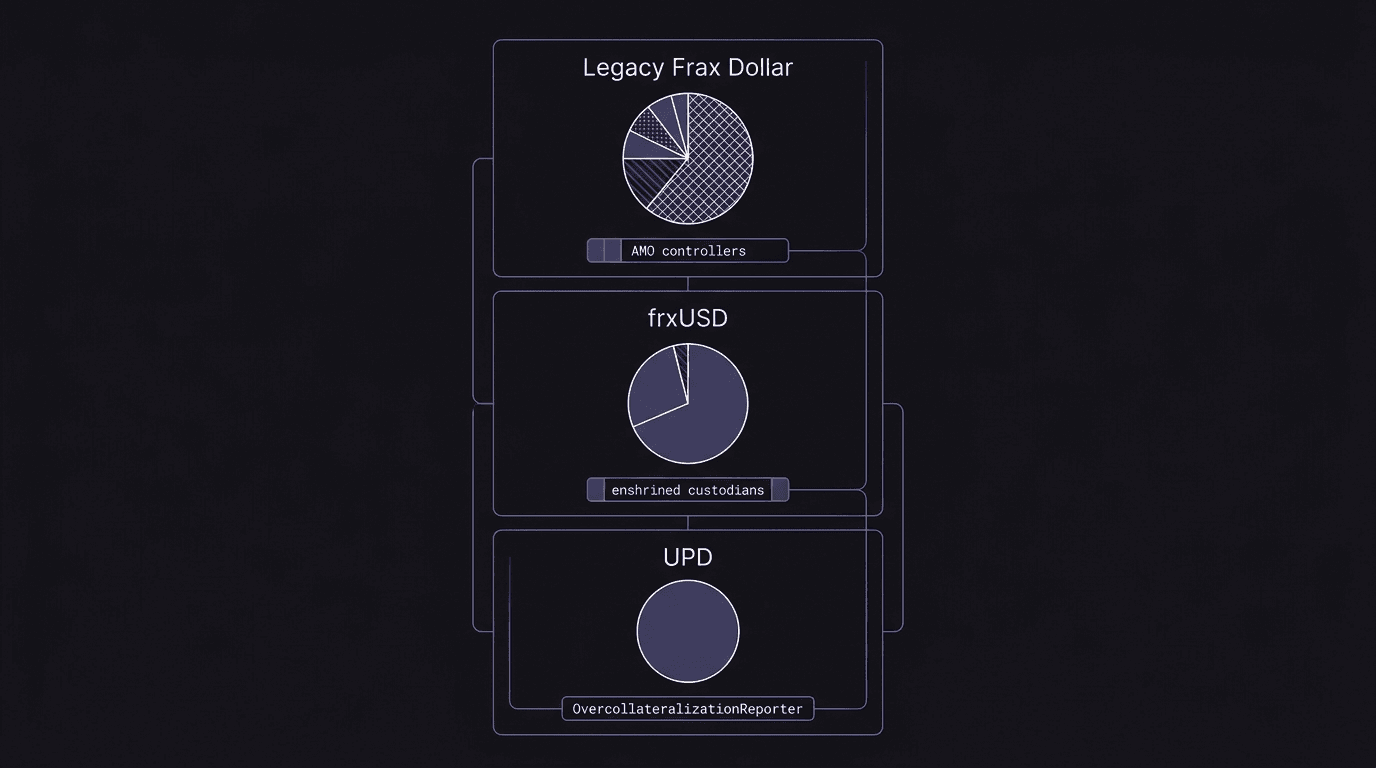
Here's the part that surprised even sophisticated reviewers. LlamaRisk's August 2024 assessment reported that Legacy FRAX was self-reporting a collateralization ratio of about 95%, excluding ~$103M in "locked liquidity." But when they looked at the composition of that collateral, they found that more than half of it was FRAX itself, sitting in AMO-deployed positions like FRAX3CRV pool tokens where FRAX is one of the two assets (LlamaRisk report).
A stablecoin backed substantially by itself has a name in monetary economics. It's a circular reserve. You can call it overcollateralized only if you believe the collateral retains value in a stress scenario where the very thing you're collateralizing is selling off. Re-read that sentence slowly. LlamaRisk's recommendation to the Aave DAO was to keep conservative LTVs when using FRAX as collateral on other protocols, precisely because the effective exogenous backing was meaningfully lower than the headline CR suggested.
This isn't a claim that FRAX is about to fail. It hasn't. The peg has held close to $1 for years and the AMOs have been well-managed through multiple stress events. It's a claim that "95% collateralized" means something different in FRAX than it means in, say, Liquity or UPD, where collateral is a distinct asset.
Decentralization Ratio as a Protocol Metric
Frax tracks a separate metric called the Decentralization Ratio (DR), which measures how much of the backing sits in decentralized crypto assets versus fiat-backed instruments like USDC (treated as 0% decentralized) or custodial RWAs (Frax DR docs). The DR is an honest attempt to surface the question: if you care about censorship resistance, what share of this backing can actually be frozen by a counterparty above the protocol?
Over the last two years, Frax governance has raised the DR by rotating USDC into ETH, frxETH, and RWA instruments. The DR today is higher than it was in 2022. It is not, however, 100%. And the RWA portion is, by definition, custodial.
Who Are the Enshrined Custodians Behind frxUSD?
frxUSD is the opposite architectural answer. It doesn't pretend to be decentralized. It is, explicitly, a fiat-redeemable, fully-collateralized, regulated payment stablecoin designed to meet the standards of the GENIUS Act.
Deployed at 0xCAcd6fd266aF91b8AeD52aCCc382b4e165586E29 on Ethereum mainnet on February 8, 2025 (TradingView launch announcement, Etherscan), frxUSD is minted by enshrined custodians, which are governance-approved entities holding tokenized reserve assets in dedicated frxUSDCustodian contracts. The dominant reserve tokens are BlackRock's BUIDL (tokenized money-market fund shares) and Superstate's USTB (short-duration Treasuries fund) (LlamaRisk PegKeeper review, stables.cool tracker).
The flow is strict: a custodian deposits BUIDL, receives frxUSD 1:1. A user with KYC access to BUIDL can interact with the custodian contract directly. A user without that access exits via secondary markets, effectively outsourcing redemption to arbitrageurs.
Why This Is a Different Risk Profile Than FRAX
Three observations stack up here:
- Redeemability depends on which custodians have reserves. There's no guarantee that any particular MMF token (BUIDL versus USTB) will be available at any given moment. As long as one enshrined custodian holds reserves, frxUSD is redeemable against something (Chaos Labs review).
- Custodians require governance approval and minting caps. They're real-world entities. BlackRock is the same BlackRock. Superstate is the same Superstate. If either pulls BUIDL or USTB from the protocol, a facilitator's bucket effectively freezes.
- The reserves sit in U.S. regulated funds. Same underlying instruments (short Treasuries, overnight repo) as USDC. The risk that SVB weekend exposed, counterparty concentration at U.S. banks, exists at the MMF layer now, just more diversified across sponsors.
FinResPBC / FRAX Inc. and Lead Bank
Off-chain, the stack includes FinResPBC, a Delaware public-benefit corporation established in August 2023 (IQ.wiki, FIP-277). FinResPBC (later rebranded FRAX Inc.) holds cash deposits and tokenized reserves, returning all net yield to the protocol rather than extracting profit. Its partner bank is Lead Bank, a Missouri state-chartered institution (FDIC).
FinResPBC doesn't develop smart contracts and doesn't control on-chain governance. It custodies reserves and executes tokenizations. But its dependence on Lead Bank, on U.S. banking law, and on the continued approval of MMF sponsors like BlackRock means frxUSD's risk surface includes conventional off-chain banking risk. That's by design. frxUSD is trying to look like a bank-grade stablecoin to U.S. regulators, and doing so requires it to actually be one.
Why Did Frax Bifurcate Itself?
Two contradictory facts about stablecoin demand in 2025 explain the split cleanly.
On one side, DeFi users want stablecoins that can sit inside AMMs, earn yield via AMOs, integrate with Fraxlend and Curve's LLAMMA, and carry no KYC overhead. They'll tolerate self-referential collateral and complex governance if the integrations are deep and the yields are real.
On the other side, U.S. institutions, treasury managers, and fintechs processing payments want a stablecoin that can satisfy the GENIUS Act. That means 100% reserve backing with high-quality liquid assets, regular disclosures, AML/CFT controls, and issuance under an OCC-chartered or state-supervised entity (GENIUS Act summary via Dotfile, Sullivan & Cromwell OCC proposed rules). AMOs are incompatible with that. Self-referential collateral is incompatible with that. Direct user mint from a smart contract without KYC gates is incompatible with that.
FIP-430, titled "Preparation for frxUSD Payment Stablecoin Charter Compliance," is the on-record governance proposal that formalized the split (FIP-430 on gov.frax.finance). It isolates the frxUSD balance sheet from Legacy FRAX, ends the internal migration period between the two stablecoins, and formalizes separate AMO strategies for sfrxUSD yield operations. The governance message is blunt: we can't run one stablecoin that satisfies both audiences.
The Kazemian Angle
Multiple reports state that Sam Kazemian, FRAX's founder, personally participated in drafting the GENIUS Act (Bloomingbit, Edgen). That detail changes how you read FIP-430. frxUSD wasn't retrofitted to match a law that passed over its head. It was designed in parallel with the drafting of that law, by someone who knew what the final text would require and what compromises would be locked in.
This is an uncomfortable fact to sit with, because it can be read two ways. The generous read: Kazemian helped shape regulation to leave room for an on-chain, transparent, auditable payment stablecoin architecture, and frxUSD is the first implementation of that architecture. The critical read: one of the most vocal DeFi-native stablecoin founders helped codify a framework that his own non-compliant stablecoin cannot meet, and then spun up a second compliant stablecoin to capture the regulated flow. Both reads are defensible. Both leave the architecture where it is: two stablecoins, two risk profiles, one brand.
How Does UPD Avoid the Bifurcation?
UPD's design choice is to not play either extreme. It's not trying to be a GENIUS-Act payment stablecoin (no custodian chain, no OCC charter application, no MiCA-licensed subsidiary on the ramp). It's also not routing collateral through AMOs into external protocols to capture yield for the DAO.
The mechanism is deliberately minimal:
- A stabilizer deposits stETH into a
PositionEscrowproxy tied to their Stabilizer NFT. - A minter sends ETH, the contract pulls stabilizer collateral from the priority queue, and mints UPD against it at the system's 125% minimum collateral ratio.
- When a minter wants out, they burn UPD, and the
StabilizerNFTcontract releases the proportional stETH back. - Under-collateralized positions get liquidated per-position with an
InsuranceEscrowbackstop for shortfalls.
There's no USDC in the backing, so SVB-style bank-counterparty contagion doesn't reach into UPD's collateral base. There's no AMO pushing UPD into Curve pools, so there's no self-referential backing. There's no enshrined custodian list, so nobody needs to trust BlackRock's attestations or Superstate's audit cadence.
The Honest Trade-Offs
UPD gives up real things for this. Listed in order of how much they matter to different users:
- No GENIUS-Act compliance path. A U.S. institution that specifically needs a GENIUS-Act-structured payment stablecoin is not UPD's customer. frxUSD is.
- One collateral type, for now. Legacy FRAX accepts ETH, LSTs, USDC, RWAs, FXB, and external LP tokens via AMOs. UPD accepts stETH. That's narrower.
- No yield loop into the DAO. Legacy FRAX's AMOs generate protocol revenue. UPD's minters don't pay protocol interest; stabilizers earn Lido staking yield directly on their stETH.
- No L2 gas-token role. FRAX is the native gas token on Fraxtal. UPD isn't anything's gas token.
What UPD keeps: a single stablecoin with one backing model, no bifurcation to explain to a counterparty, no ambiguity about whether you're holding the DeFi-native version or the regulated version. That's valuable to exactly the kind of user who doesn't want the trade-offs the FRAX stack makes in either direction.
Governance: veFRAX + Gnosis Safes vs a Narrower Admin Surface
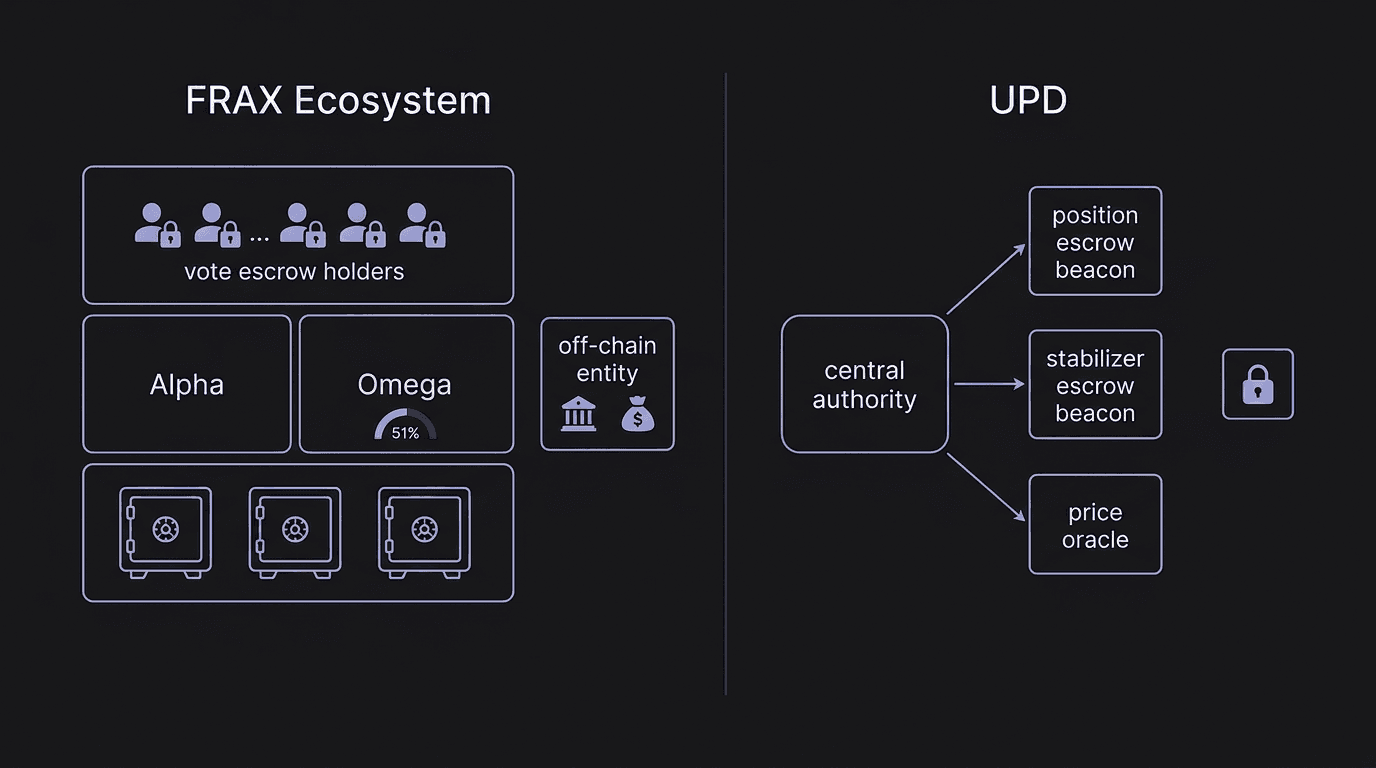
Frax governance is a dual-Governor system sitting on top of Gnosis Safes. FraxGovernorAlpha handles formal upgrades and major parameter changes via standard quorum-and-voting cycles. FraxGovernorOmega is an "optimistic" governor that lets the core team or Safe owners create proposals mapped 1:1 to Safe transactions; the voting period is short, quorum is low, and any proposal reaching 51% of veFXS in favor passes immediately via a "short-circuit" threshold (Frax governance how-it-works, frax-governance repo).
Read that paragraph twice. FraxGovernorOmega lets a proposal pass instantly at 51% approval. That's a feature if you want responsive parameter management during a peg event. It's also a much shorter delay between "delegates vote" and "Safes execute" than you get on most L1 DAOs. Combined with veFXS delegation through Convex's vlCVX vote markets, the practical power to pass a proposal quickly sits with whoever has coordinated the veFXS vote (Convex Finance docs).
The final state of Frax governance, per the docs, is veFRAX holders controlling all major Safes (treasury, AMOs, parameters) through the frxGov module, with team multisigs holding only limited operational authority (Frax governance overview). The path there is incremental. Today, team multisigs and delegated vote blocs are meaningful factors in what parameters change and how quickly.
UPD's Narrower Surface
UPD has no governor, no Safe stack for treasury operations, no AMO permissions to grant, no veToken lockup mechanism. The admin surface is:
- The admin on the
UpgradeableBeaconforPositionEscrow(can push new implementations that affect all active positions). - The admin on the
UpgradeableBeaconforStabilizerEscrow. - The UUPS authority on the
PriceOracle.
The UPDToken contract itself is not upgradeable, so balances can't be rewritten. A malicious admin could push a malicious escrow implementation; that's a real risk the reader should understand. The mitigation path is progressive: admin, then timelock, then governance, with scope narrower than administering AMOs, custodian lists, and payment-stablecoin-charter compliance.
Different authority, different surface area, different process. Neither model is strictly safer. They concentrate trust in different places.
Head-to-Head Comparison
| Dimension | Legacy Frax Dollar | Frax USD (frxUSD) | UPD |
|---|---|---|---|
| Live since | Dec 20, 2020 | Feb 8, 2025 | Pre-launch (Sepolia) |
| Circulating supply | ~$274M (April 2026) | ~$138M (April 2026) | Pre-launch |
| Token freeze / blacklist | None | None at token layer; custodian contracts gate mint/redeem | None |
| Minting model | Fractional-algo V1/V2 evolving to AMO-based; protocol-controlled minters | Enshrined custodians deposit BUIDL/USTB 1:1 | StabilizerNFT holds MINTER_ROLE; stabilizer queue allocates stETH |
| Collateral | USDC, ETH, LSTs, frxETH, RWAs, external LP tokens, and FRAX itself in AMO positions | BlackRock BUIDL, Superstate USTB, other approved MMF/bond fund tokens | stETH only |
| Self-referential backing | Yes (LlamaRisk Aug 2024: >50% of reported collateral was FRAX itself in AMOs) | No | No |
| Reserve attestation | On-chain AMO dashboards plus DR metric | Periodic attestations on custodian holdings | On-chain OvercollateralizationReporter via stETH share accounting |
| Regulated off-chain entity | FinResPBC / FRAX Inc. (Delaware PBC) for sFRAX RWA strategy | FinResPBC / FRAX Inc. and enshrined custodians | None |
| Banking dependency | Indirect via USDC and RWA strategy | Direct (Lead Bank, MMF sponsors like BlackRock/Superstate) | None |
| Governance | Dual-Governor (Alpha + Omega) with 51% short-circuit on Omega; veFRAX-weighted | Same governance atop separate balance sheet (FIP-430) | None at DAO layer; admin on escrow beacons and oracle |
| AMO / protocol revenue | Yes (Curve, Fraxlend, lending AMOs feed DAO revenue) | Separate AMO strategies for sfrxUSD yield | None |
| Yield products | sFRAX (ERC-4626) tracks IORB rate via sFRAX RWA | sfrxUSD (ERC-4626) on BUIDL/USTB yield | sUPD delta-neutral design (in scope, not live) |
| Regulatory target | DeFi-native, not GENIUS-compliant | GENIUS Act payment stablecoin charter (FIP-430) | No regulatory-class targeting; ASP-compatible entry via UPP |
| Peg history | 817 depeg events over 4 years per Pharos; $0.96 during SVB/USDC weekend | Pharos "clean slate" since launch | No live operation |
| Notable incidents | Oct 2023 DNS hijack of frax.finance; June 2024 X account compromise | None reported | None (pre-launch) |
| Privacy layer | None | None | Designed for UPP shielded transfers |
Which Risk Profile Fits Your Use Case?
When Legacy Frax Dollar Fits
- You want a DeFi-native stablecoin with deep integrations across Curve, Fraxlend, Fraxswap, and the Fraxtal L2 where FRAX is the native gas token
- You value AMO-captured protocol revenue that flows back to veFRAX holders and funds ecosystem incentives
- You're comfortable that a meaningful share of reported collateral is FRAX itself in AMO positions and that the effective exogenous collateralization is lower than headline CR suggests
- You can underwrite governance risk from a dual-Governor system where 51% of veFXS votes can short-circuit most proposals
- The Pharos depeg history (817 events over 4 years, mostly within a few cents) is a tolerable operational profile for your use case
When Frax USD (frxUSD) Fits
- You are a U.S. institution, fintech, or payment processor that needs a GENIUS-Act-structured payment stablecoin backed by tokenized MMF shares
- You have KYC access to BUIDL, USTB, or similar reserve tokens, or you're comfortable exiting via secondary markets
- You can underwrite off-chain banking risk at Lead Bank and MMF-sponsor risk at BlackRock, Superstate, and WisdomTree
- You want monthly disclosures, regulated custody, and a token issued under a framework regulators are actively building out via OCC rulemaking
- You specifically want the regulated version of Frax's stablecoin product, not the DeFi-native Legacy version
When UPD's Risk Profile Fits
- You want one stablecoin with one backing model, not a DeFi-vs-regulated fork of the same brand
- You need shielded transfers on the dollar leg of a settlement or payment flow via UPP
- Your compliance team can work with an ASP-based attestation model rather than MiCA-licensed-ramp or GENIUS-Act-chartered compliance
- You prefer no AMO machinery routing your stablecoin's supply into external DeFi venues
- You don't need enshrined-custodian-style reserve composition; stETH backing held in per-stabilizer escrows is sufficient for your threat model
- You accept an earlier-stage protocol maturity profile in exchange for a narrower governance surface and no off-chain corporate dependency
These aren't exclusive. A U.S. fintech might hold frxUSD for regulated rails, Legacy FRAX for DeFi yield strategies, and UPD for shielded cross-border flows. Different architectures answer different questions.
Frequently Asked Questions
Is Legacy Frax Dollar actually decentralized if half its collateral is itself?
Depends on what "decentralized" is measuring. The token contract has no blacklist and no freeze. The admin surface is governed on-chain through veFRAX. That's genuinely decentralized in the freeze-resistance sense. What LlamaRisk flagged in August 2024 is different: the collateral composition is not fully exogenous. Over half of reported collateral was FRAX inside AMO positions, which means in a stress scenario where FRAX is selling off, the protocol's backing sells off with it (LlamaRisk). The Decentralization Ratio metric Frax publishes is an honest attempt to quantify the censorship-resistance question, and the DR has been rising. It's not 100%, and the RWA portion is custodial by definition.
Can the Frax DAO freeze my FRAX or frxUSD?
Not at the token layer. Neither contract has a blacklist function. What governance can do is different. For Legacy FRAX, the dual-Governor system can adjust AMO strategies, gauge emissions, global collateral ratio behavior, and can mint or burn FRAX through AMO contracts within hard-coded invariants. For frxUSD, governance controls which enshrined custodians are approved, what bucket caps they hold, and which reserve tokens count. None of these are freezes. They're structural powers over the supply and backing that sit above the token.
How did Sam Kazemian helping draft the GENIUS Act affect frxUSD's design?
It likely shortened the feedback loop between what the law required and what frxUSD implemented. Multiple reports name Kazemian as a participant in drafting the GENIUS Act (Bloomingbit, Edgen). The result is a stablecoin architecture (enshrined custodians, tokenized MMF reserves, Delaware PBC structure, regular disclosures) that maps onto GENIUS Act requirements by design rather than by retrofit. Reasonable people will read this as either constructive engagement with regulators or as regulatory capture favoring well-positioned insiders. Both readings are defensible given public information.
What broke on October 31, 2023?
Frax Finance's main web domains (frax.finance and frax.com) were DNS-hijacked and redirected to a spoofed interface designed to phish credentials (Binance Square, Bitcoin Sistemi). Users were told not to interact with the UI until name-server control was restored. No on-chain funds were lost. The incident and the June 2024 X-account compromise are reminders that a stablecoin's "system" includes front-ends, social accounts, domain registrars, and custodian websites, not just the token contract. UPD and every other stablecoin share this surface area; FRAX is just more visible because of its scale and public profile.
Does UPD have anything equivalent to Frax's AMO model?
No, and this is deliberate. An AMO mints stablecoin supply into external DeFi venues to deepen liquidity and capture protocol yield. That's a real feature for DAO economics. It's also the mechanism behind FRAX's self-referential collateral: FRAX in AMO positions counts as backing for FRAX. UPD's mint-and-burn is strictly 1:1 against stabilizer-deposited stETH, with no parallel path where the protocol issues UPD into an external pool to earn a yield for a treasury. The consequence is less revenue and simpler accounting. If you're choosing a stablecoin partly based on DAO-captured protocol revenue, UPD doesn't have that. If you're choosing based on the simplicity of the backing story, UPD's is a one-line answer.
Why not use frxUSD if the user wants a regulated stablecoin?
Often the right answer, and we'll say so plainly. For a U.S. payment processor or fintech that specifically needs a GENIUS-Act-structured stablecoin with periodic attestations on BUIDL and USTB reserves, frxUSD is the more operationally-proven and regulation-aligned choice today. UPD isn't attempting to compete in the GENIUS-Act lane. UPD's role is for users who specifically want the absence of a regulated intermediary in the stablecoin stack, who need shielded transfers via UPP, or who prefer ASP-based entry attestation over custodian-whitelisted mint flows.
What does FraxGovernorOmega's 51% short-circuit actually mean in practice?
It means the optimistic governor can pass a proposal immediately once 51% of the voting veFXS supply votes in favor, without waiting for the normal voting delay to elapse (Frax governance how-it-works). Combined with Convex's vote markets, where vlCVX holders can delegate veFXS-weighted votes across Frax proposals, the practical effect is that a coordinated vote bloc can move parameters quickly. That's valuable when you need to respond to a peg event. It's also a materially shorter adversarial window than you get on a DAO that requires 7-day timelocks on Safe transactions.
Conclusion
FRAX's story is the clearest case in this comparison series of a stablecoin team absorbing five years of hard lessons, watching Terra collapse, watching USDC break over a weekend, reading the GENIUS Act as it was being drafted, and concluding that the right answer was to split the product in two. Legacy Frax Dollar stays DeFi-native because DeFi still wants AMO-backed liquid dollar-denominated capital. Frax USD becomes regulated because U.S. payments demand it.
That's an entirely coherent response to an incoherent market. It's not the response UPD makes. UPD's bet is that a single, narrower, non-bifurcated stablecoin with stETH backing, no AMOs, no custodians, and UPP-integrated privacy is a sharper tool for a specific set of users who don't want either extreme of the Frax barbell. We might be wrong about the size of that market. We're not wrong about what we're trying to build.
Pick the architecture that matches your problem. If you want DeFi-native protocol revenue and deep AMM integrations with a dual-governor governance process, Legacy Frax Dollar is the answer. If you want GENIUS-Act-structured reserves under a U.S. PBC with periodic disclosures, frxUSD is the answer. If you want one stablecoin with a single backing model, no custodian list, and integration into shielded transfer infrastructure, UPD is worth watching.
Read FIP-430. Read LlamaRisk's August 2024 FRAX assessment. Read the Chaos Labs frxUSD review. Decide which failure modes you're more comfortable holding.
- GHO vs UPD: Aave's DAO-Governed Stablecoin Meets a Permissionless One - another DAO-governed comparison with a regulated ramp
- crvUSD vs UPD: Curve's LLAMMA vs Pure Non-Freezability - DAO-governed alternative without the payment-stablecoin bifurcation
- Liquity (LUSD + BOLD) vs UPD: The Closest Competitor We Have - immutability as the opposite pole to Frax's evolving governance
- DAI vs UPD: When Decentralized Isn't Decentralized Enough - USDC-upstream freeze risk, the same problem FRAX inherited
- What Is a Non-Freezable Stablecoin? - pillar post on the core property
- Stablecoin Regulation in 2026: GENIUS, MiCA, and the Global Freeze Mandate - regulatory context frxUSD was designed against
- ASP vs Proof of Innocence - compliance architecture that doesn't require enshrined custodians
UPD is pre-audit and deployed on Sepolia testnet at time of writing. This comparison is architectural and educational, not investment or legal advice.